Rodrigo Montiel had everything: power, money, and a family the world envied.
That night, at Madrid’s most exclusive restaurant, he raised his fork toward his mouth like any other night of his life.
But his eight-year-old son Lucas was watching him differently.
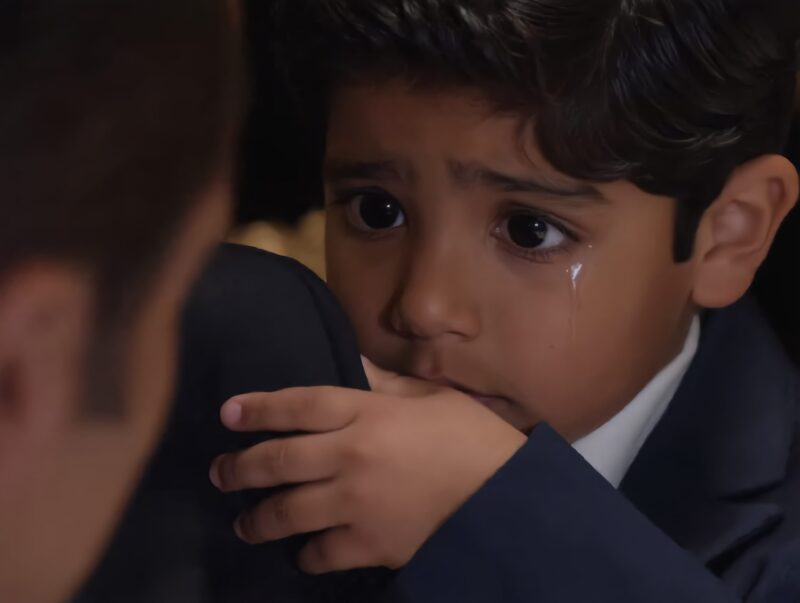
The boy’s eyes were red. His hands were trembling. And when he opened his mouth, his voice broke on the very first word.
“Dad… don’t eat that. Please.”
The entire room froze.
Rodrigo set the fork down slowly. He turned to his son. And in that moment he saw something he had never seen in Lucas’s eyes before: pure terror.
“I saw her, Dad. I saw what Isabel did when you got up from the table.”
Rodrigo’s heart stopped for one second.
He looked at Isabel.
She was smiling.
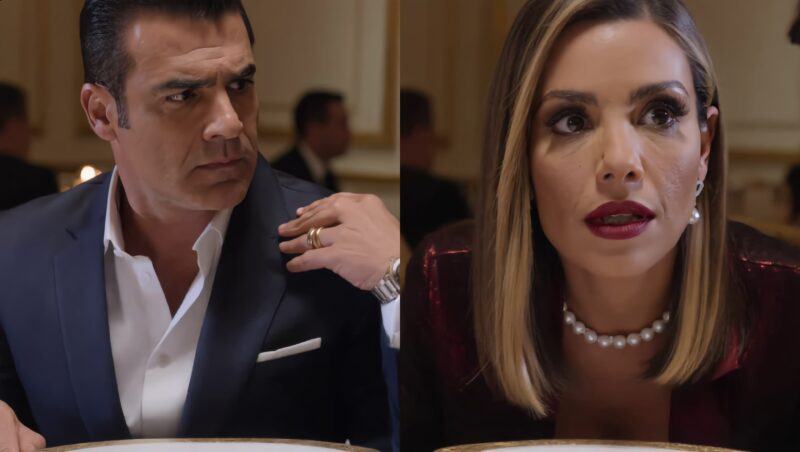
It took Rodrigo Montiel exactly three seconds to decide that tonight would change everything.
Not when Lucas spoke. Not when he set down the fork. It was when he looked into Isabel’s eyes after hearing his son, and she —without blinking, without moving, without losing even a fraction of that perfect smile— said:
“Lucas, my love… children shouldn’t make up stories at the dinner table.”
That was all. That single phrase confirmed everything.
Because Rodrigo Montiel had been suspicious for four months. Four months of sleepless nights, of reviewing accounts that didn’t add up, of conversations that ended the moment he walked into a room. Four months of wondering whether he was becoming paranoid, or whether the woman sleeping beside him every night was looking at him the way you look at a problem that needs to be eliminated.
An innocent man would have said “what?” A surprised man would have asked “what are you talking about?”
Isabel asked nothing. Isabel smiled.
And that said everything.
Rodrigo raised one hand — slowly, with the same calm with which he signed million-dollar contracts — and said without raising his voice:
“Nobody touches the plate.”
The waiter who was approaching stopped in his tracks. The two guests at the next table stopped talking. The only sound left in that room was the distant tinkle of a crystal glass somewhere in the restaurant.
Lucas was still standing beside his father. His chin was trembling. He was eight years old and had just done the bravest thing of his short life, and now he was looking at Isabel with eyes that mixed fear with something deeper: the certainty that he had done the right thing.
Isabel looked at the boy.
“Rodrigo, darling, the boy is nervous. He’s had a difficult week at school, you know that. This doesn’t make sense—”
“Bring it.”
One word. Directed at the man who had worked for Rodrigo for three years. The man who that morning, at 7:47, had installed a camera in the private dining room on direct instructions from his employer. The same man who was now walking toward the table with a phone in his hand and the screen lit up.
Isabel saw the phone.
And in that moment — only in that moment — the smile disappeared.
Not all at once. Not like a mask falling. But like color draining from a photograph left too long in the light. First the eyes. Then the corners of her lips. Then her chin, which tightened by one millimeter — just one — but Rodrigo had spent eleven years reading that face and he knew every muscle in it.
The agent turned the screen toward Rodrigo.
In the recording, with the time and date visible in the upper right corner, you could see the dining room from above. The table. Rodrigo’s plate. And Isabel — standing beside her husband’s empty chair, leaning over the plate with something small in her right hand.
Rodrigo looked at the screen for four seconds.
Then he looked at Isabel.
“I already knew,” he said. So quietly that almost no one heard. As though he wasn’t speaking to her. As though he was closing an account he had left open with himself.
Isabel opened her mouth.
“Rodrigo, listen to me, this isn’t what—”
“No.”
Just that. One syllable. But spoken in a way that Isabel — who had manipulated men far more intimidating than Rodrigo Montiel, who had survived situations that would have destroyed anyone else — understood there was no going back.
Rodrigo stood up. He buttoned his jacket. He looked at Lucas, still trembling, and placed a hand on his shoulder. Firm. Steady. The hand of a father who had just understood that his son had saved his life.
“Let’s go, son.”
Lucas nodded. He said nothing. There was nothing to say.
As they left the dining room, Rodrigo did not look back. Not once. Because men like Rodrigo Montiel don’t look back once a decision has been made.
Outside, the December air in Madrid was cold and clean. Lucas walked close to his father, small hand inside the large one, and for two blocks neither of them spoke.
It was Lucas who broke the silence.
“Are you okay, Dad?”
Rodrigo looked at his son. Eight years old. Crooked tie. Eyes still bright with the tears he had held back through the entire dinner.
“Because of you, yes.”
Lucas squeezed his hand.
“I knew for three weeks,” the boy said quietly. “But I didn’t know how to tell you.”
Rodrigo stopped in the middle of the pavement. He looked at his son for a long moment. And then, for the first time in four months, he smiled. Really smiled.
“You said it at exactly the right moment.”
That night, while Lucas slept in the back seat with his head against his father’s arm, Rodrigo made three phone calls. The first, to his lawyer. The second, to the forensic lab that would analyze the contents of the plate. The third, to the man who for eleven years had protected Isabel without knowing he had been protecting her from the wrong person.
Isabel was arrested at 2:14 in the morning at Barajas airport. She was carrying a passport under a different name and a one-way ticket to Lisbon.
In her bag, between the cash and the false passport, agents found a small vial. No label. Enough inside for what she had planned.
The trial lasted eleven weeks.
Lucas testified. With the same calm voice and the same wide eyes with which he had said “Dad, don’t eat that” that night. The prosecutor said afterward that he had never seen an eight-year-old witness hold himself together like that.
“Were you afraid?” the defense attorney asked.
Lucas thought for a moment.
“Yes,” he said. “But my dad taught me that when you’re scared and you do the right thing anyway, that’s what being brave means.”
Isabel Vega was sentenced to nineteen years.
Rodrigo Montiel never returned to that restaurant. But every year, on the fourteenth of December — the anniversary of that dinner — he took Lucas to the finest place in Madrid, they ordered whatever they wanted, and at the end of the night, without anyone asking, Lucas raised his glass of water and said the same thing:
“To those who tell the truth even when their voice is shaking.”
And Rodrigo, every time, drank without saying a word.
Because some things don’t need words.