I came home with one hope: ten quiet days.
My name is Daniel. I’m a soldier. Ten years managing equipment worth millions. I know what responsibility looks like.
But that morning, my sister Sandra was already awake when I came downstairs for breakfast. That should have been my first warning.
“Your credit is perfect,” she said, stirring her coffee. “Just let me use your card for a while. I’ll pay you back.”
It wasn’t a request. It was an order.
I said no. Calmly. Clearly.
Then the family script started: “Family helps family… you make good money… it would only be temporary…”
What nobody mentioned was the four thousand dollars I sent her in 2021 to keep her from being evicted. Or the debts I quietly cleaned up without anyone asking.
My silence had taught them only one thing: that I would keep paying.
When I said no again… Sandra picked up her mug.
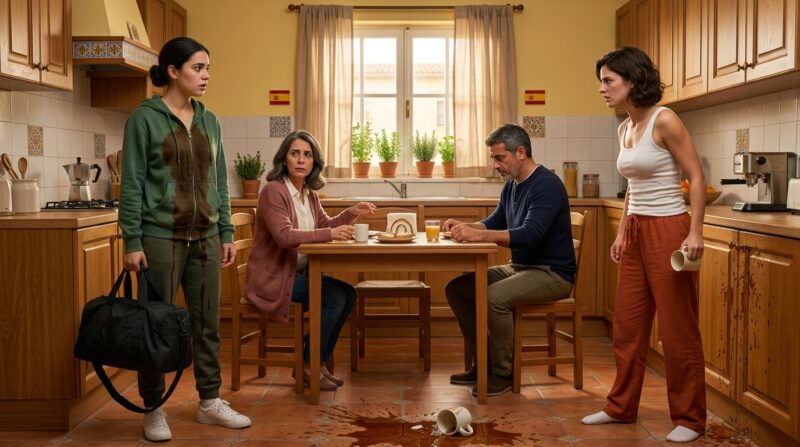
The hot coffee hit my face before I could react.
The dark liquid soaked into my clothes as the bitter smell filled the kitchen. My mother’s hand froze above the napkin holder. My father stared down at his plate. The television kept talking like nothing had happened.
Sandra was breathing hard. As if throwing coffee had been a reasonable response.
Nobody moved.
And in that silence, something inside me settled with a calm I had never felt before inside those walls. It wasn’t resignation. It was clarity. The kind of clarity that only arrives when you have nothing left to protect within a place.
I picked up my keys without saying a word.
My hands weren’t shaking. That told me everything.
I drove straight to urgent care. The nurse asked me twice what had happened. I told her the truth without drama, the way you read an inventory report. She nodded slowly and wrote down every word.
In the parking lot, I took out my phone and photographed every affected area. I saved the medical documents in two separate folders: one on the phone, one in the cloud.
Not because I was planning to sue anyone.
But because paperwork survives when people start changing the story.
And my family always changed the story.
I went back to the house one last time. My mother was washing dishes like it was any ordinary Tuesday. My father was watching the news. Sandra wasn’t visible, but I could hear music from behind her closed door.
Nobody asked how my face was.
Nobody asked if it hurt.
I went upstairs, opened my bag, and started folding clothes with the precision the Army teaches you: every item in its place, every space used, no wasted movements.
While I folded, I thought back through every time I had said yes when I should have said no.
The four thousand dollars in 2021. The store card that appeared in my name without me opening it. The midnight calls that always started with “it’s just this once.” The birthdays where I’d arrive with a gift and leave with a new debt nobody had asked my permission to create.
And always the same answer when I tried to speak up: “Don’t be so serious. It’s family.”
As if being family were a license to collect without accountability.
I closed the bag.
I walked downstairs.
My mother looked up from the sink.
“Where are you going?”
“Back south.”
“But you have six more days.”
“Not anymore.”
My father turned down the television volume. That was his way of participating without committing.
“Daniel,” he said, in the tone he used when he wanted to sound reasonable, “Sandra just lost her temper. She’ll calm down.”
I looked at the hardwood floor where there was still a dark stain nobody had cleaned.
“Have a good day,” I said.
And I left.
The drive back to Fort Carson took nearly six hours. I didn’t play music. I didn’t call anyone. I just drove while Colorado disappeared in the rearview mirror and something I had carried for years stayed behind with the highway signs.
That night, from my room on base, I did what I do best: document.
I froze my credit at all three major bureaus. I removed Sandra from my phone plan. I reviewed every bank account, every alert, every pending charge. I changed passwords. I updated emergency contacts. I saved screenshots of every relevant conversation from the past two years.
Then I opened a new document and wrote down everything I remembered — dates, amounts, details — while the memory was still fresh.
Not for revenge.

Because in the Army you learn that records aren’t optional. They’re what remains when personal versions start to diverge.
The weeks that followed were quiet. Work, routine, productive silence. Nobody called to ask if I’d arrived safely. Nobody sent a message to check on my face.
Just silence.
Which, after everything, was exactly what I had gone home looking for.
Six weeks later, I was eating lunch in the Fort Carson cafeteria when my phone vibrated on the metal table at 12:43 p.m.
First, a message from my mother:
“Your sister needs to speak to you right now. It’s serious.”
Then my father’s:
“Call us. The bank is asking questions.”
I set my fork down on the tray.
I looked at the ceiling for a moment.
I smiled slowly — not with happiness, but with the quiet recognition of someone who already knew this day was coming.
I opened my screenshot folder.
I counted the files: forty-seven documents, eighty-three screenshots, sixteen scanned receipts.
Everything in order. Everything dated. Everything signed where it needed to be.
Then I dialed the bank.
Because when your family finally calls to say there’s a problem, the most important thing is that you already have the solution saved from six weeks ago.
And I did.