From my hospice bed, oxygen tube beneath my nose, I saw it in the room’s gold-framed mirror: my husband kissing another woman by the window, all of New York glowing behind them.
My name is Camila, I’m forty-three, and doctors had given me, at best, a few weeks to live. Rodrigo had insisted I spend my final days in our penthouse instead of the hospital. How romantic that had seemed at the time.
That morning, while I pretended to sleep under the effects of morphine, I heard his low voice talking to someone on the phone. “It’s almost over,” he was saying. “We just need to be patient a little longer.”
He hung up, and minutes later flowers arrived. Then, her.
Valentina, the finance executive Rodrigo had hired two years earlier. I watched her walk straight toward him, not even glancing at my bed, as if I were already part of the furniture.
He took her by the waist. He kissed her in front of the window, my reflection watching them from the hospital bed they’d installed in my own living room.
I didn’t scream. I didn’t cry, not yet. I simply closed my eyes, breathed deeply through the oxygen tube, and made the clearest decision I’d made in months.
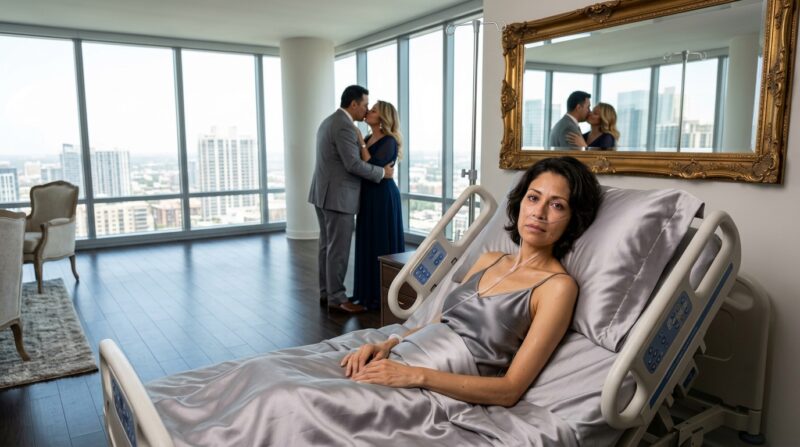
I opened my eyes again. Rodrigo and Valentina still hadn’t noticed, absorbed in their own world, completely unaware that the “nearly finished” woman in the bed was watching them with a clarity that had nothing to do with the morphine.
I pressed the button beside my bed, the one that called my private nurse, Doña Isabel.
“Do you need something, Señora Camila?” she asked as she entered, not noticing the scene at the other end of the room until she followed my gaze.
Her face hardened, but she stayed professional. “Should I call someone?”
“Yes,” I whispered. “My lawyer. And my brother.”
Rodrigo, hearing my voice, finally turned. His expression went from surprise to panic in a second. “Camila, sweetheart, it’s not what—”
“Don’t talk,” I said, my voice steadier than he expected from a dying woman. “Just leave. Both of you.”
Valentina, to her credit or her cowardice, left immediately without a word. Rodrigo stood there, searching for something to say, something that might fix what had just broken irreversibly.
“We’ve been married eight years,” he said finally. “You can’t throw it all away over a… a misunderstanding.”
“A misunderstanding doesn’t include your hands on her waist, Rodrigo.”
He went silent. That silence confirmed what I already knew: there was no excuse to invent, because there was no way to rewrite what I’d seen with my own eyes.
I asked him to leave the penthouse that same night. He didn’t argue. He knew that even though I was sick, I was still the majority founder of Duarte Capital Partners, the investment firm I’d built from nothing before I met him, and that my lawyer, attorney Mendoza, had spent twenty years protecting every legal aspect of my estate.
What Rodrigo didn’t know was just how far that protection went.
When we married, I’d insisted, against his initial objections, on an extremely detailed prenuptial agreement. Rodrigo had called it “unnecessary” and “unromantic.” I’d called it “sensible.” That agreement included a specific clause about proven infidelity: any documented evidence automatically voided any claim to marital assets beyond the legal minimum.
I never thought I’d have to use it while dying, hooked to an oxygen tank.
My brother, Andrés, arrived two hours later, furious and protective the way he’d always been since our parents died. “Do you want me to kill him?” he asked, half joking, half not.
“I want you to help me change my will.”
That night, with attorney Mendoza present and a notary certifying every step, I rewrote the provisions I’d set up “just in case” three years earlier, when Rodrigo and I still seemed happy. The earlier version left him a considerable share of my company stock, plus our shared property.
The new version left him practically nothing beyond the legal minimum.
Most of my shares in Duarte Capital Partners would go to a foundation bearing my mother’s name, dedicated to funding oncology treatment for patients without adequate medical insurance — the same kind of care I’d been able to afford without difficulty, but that I knew most people facing my diagnosis could never pay for.
A substantial portion would go to my niece, Sofía, who had just finished college and dreamed of studying medicine.
The penthouse would be sold, and the proceeds split between the foundation and an emergency fund for company employees facing family medical crises.
Rodrigo would receive the car already registered in his name, and nothing else.
I signed the documents with a shaking hand — not from weakness, but from a quiet fury I hadn’t felt in months.
The next day, Rodrigo tried to see me. Doña Isabel refused him entry, following my instructions. He left messages. He sent flowers I ordered returned unopened. He wrote a long letter talking about “genuine remorse” and “a moment of weakness.”
I answered none of them.
What Rodrigo also didn’t know was that, while he thought I was simply waiting to die quietly, my oncologist, Dr. Fuentes, had been exploring an experimental clinical trial for my specific type of cancer. Three weeks before the incident with Valentina, she’d mentioned the possibility to me, with all appropriate professional caution — no guarantees, no promises.
After Rodrigo’s betrayal, something in me changed. Maybe it was anger. Maybe it was simply refusing to let his cowardice define how my story would end. I asked Dr. Fuentes to enroll me in the trial, even though the odds of success were low.
“The odds of me dying are one hundred percent eventually,” I told her. “I’d rather try something before giving up completely.”
The treatment was brutal. Weeks of severe side effects, constant nausea, extreme weakness. Andrés moved temporarily into my new apartment, a smaller place I’d bought without telling Rodrigo, decorated exactly how I wanted it, with no trace of the life I’d shared with a man who had betrayed me while I was dying.
Sofía came every weekend, studying for her medical school admission exams beside my bed, sometimes reading me biology notes out loud that I barely understood but that made me feel less alone.
Three months later, results came in from the first scans following the experimental treatment.
Dr. Fuentes walked into my room with an expression I hadn’t seen in months.
“Camila, the tumor shrank significantly. More than we expected.”
It wasn’t an instant cure. It wasn’t a movie scene where I leapt out of bed fully recovered. It was a slow process, with more treatments, more tests, more weeks of uncertainty. But the prognosis, originally “weeks,” became “months,” and then, gradually, something resembling “real hope.”
A year after that afternoon I’d seen Rodrigo’s reflection kissing Valentina in the gold mirror, I was still alive. Thin, tired, hair barely growing back after chemotherapy, but alive.
Rodrigo, meanwhile, had tried to contest the will in the months following the divorce, claiming I hadn’t been in full possession of my mental faculties due to medication. The matter was resolved quickly thanks to the thorough documentation attorney Mendoza had prepared: recordings of the notarial session, independent psychiatric evaluations conducted that same day, and Doña Isabel’s direct testimony about my completely lucid mental state.
He lost. Completely.

I heard, through mutual acquaintances, that Valentina had left him barely two months after our separation, once it became clear the money she’d probably expected would never come.
I felt no satisfaction hearing that. By then, I didn’t think much about Rodrigo anymore.
I thought about the foundation, which in its first year had helped fund treatment for twenty-three patients who otherwise couldn’t have afforded it. I thought about Sofía, who’d been accepted into medical school and planned to specialize in oncology. I thought about mornings in my new apartment, where the sun came in directly, with no trace of a marriage that had ended in betrayal.
Two years after the original diagnosis, my cancer was in complete remission.
On the anniversary of that terrible day, I hosted a small dinner at my apartment: Andrés, Sofía, Doña Isabel, Dr. Fuentes, and a few close friends who had stayed by my side through the whole process.
Sofía raised her glass. “To Camila,” she said, “who turned the worst day of her life into the beginning of the rest of it.”
I thought about that phrase for a long time afterward.
Rodrigo had believed I was too weak, too close to the end, for anything he did in front of my hospital bed to matter. He’d miscalculated in every possible way. He underestimated my will, my determination, and the quiet strength I’d been building for twenty years running a company in a world that constantly expected women to yield, surrender, or quietly disappear when things got hard.
I didn’t disappear.
That gold mirror in the penthouse no longer belongs to me. But sometimes I think about what I saw reflected that afternoon — not just the betrayal of a man who had sworn to love me in sickness and in health, but also, though neither of us knew it at the time, the quiet beginning of the woman I’d become once he decided I was no longer worth waiting for.