My name is Mateo. I was 21, studying in Guadalajara, surviving however I could: tutoring, café shifts, whatever came along.
One day I saw a post in a Facebook group. An elderly woman lived alone and needed someone to clean her house once a week. Two hundred pesos per visit.
For me, that was a whole week of bus fare.
Her name was Consuelo.
The first time I knocked on her door, I wasn’t prepared for what I found.
She was tiny. Completely white hair. Trembling hands gripping a cane. The house smelled of stopped time — crooked photographs on the walls, a broken radio on the shelf, a wooden bed that creaked with every movement.
She had severe arthritis and high blood pressure. Walking cost her an enormous effort.
She told me she would pay me every week.
But she never did.
And I never left.
The first few weeks, I convinced myself the money would come.
Next visit, Mateo. When I get paid, I’ll give it all at once. Soon, I promise.
There was always a reason. Always a next time.
And I kept going back.
Maybe because I felt sorry for her. Maybe because something in the way she looked at me when she opened the door — as if my arrival were the best thing that had happened to her all week — made it impossible to turn around and not return.
What I couldn’t ignore was her refrigerator.
Almost always empty.
A couple of eggs. Wilted vegetables. Sometimes just rice with a little sauce.
One day I asked her directly why she lived like that.
She smiled faintly and said her children lived far away and she didn’t want to bother them.
That answer stayed with me for days.
So I started staying longer after cleaning.
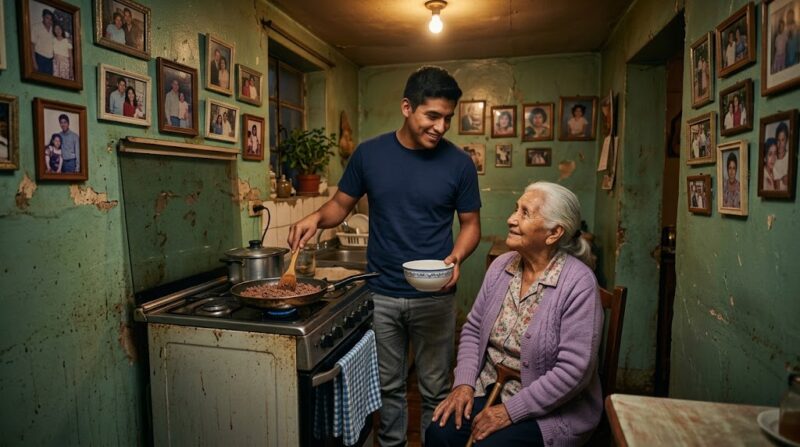
I stopped at the market on my way to her house, bought what I could afford — meat when the money stretched, fish when there was a deal, always some vegetables — and cooked her something hot and real before I left.
Consuelo loved it.
Every time I set a bowl of hot broth or a steaming stew in front of her, her eyes lit up in a way that made that small, time-worn house feel, for a moment, less alone.
We sat together at her kitchen table while she ate.
She told me things.
About her husband, who had died fifteen years ago. About her three children, who rarely called. About the neighbors who used to visit and no longer appeared. About when she was young and danced at village festivals in a blue dress she still kept in the wardrobe even though she could no longer wear it.
I listened.
And cooked.
And cleaned.
There were days when her joint pain was so intense she couldn’t even get up from her chair. On those days, I took her to the local public hospital myself and sat in those endless waiting rooms until she got her medication and we could go back.
One afternoon, leaving the hospital, she reached out and took my hand with a strength that was surprising for someone so fragile.
“You remind me so much of my youngest son,” she said quietly. “He was a good person too.”
I didn’t know what to say.
Maybe because I heard something behind her words that was more than a compliment. It was the weight of years of silence. Of calls that never came. Of birthdays that passed without anyone knocking on her door.
I kept going.
Week after week.
Month after month.
Eight months in total.
Without receiving a single peso.
My university classmates asked me why I kept wasting time with a woman who never paid me. One of them told me directly I was letting myself be taken advantage of.
And maybe they were right about the numbers.
But the numbers didn’t explain why, every time I arrived at her door and she opened it with that slow, tired smile, I felt I was exactly where I was supposed to be.
Consuelo died on a Tuesday in November.
I found out through a call from one of her sons, whom I had never met in person.
I went to the funeral. There were few of us. Some elderly neighbors. Her three children, who arrived from different cities with guilty faces and clothes too formal for the neighborhood.
Nobody introduced me. Nobody asked who I was.
I stayed at the back in silence and said goodbye to her as what I had been for eight months: someone who simply showed up.
I thought that was the end of everything.
That the time, the effort, the markets, the waiting rooms, the stews and the kitchen conversations would stay exactly where they had happened: in that small, dark house that was now empty forever.
But three days after the burial, one of her sons called me.
He said his mother had left something for me.
I went to the house one last time.
It smelled different without her. Quieter. Colder.
Her son handed me an envelope without saying much. Just: “She insisted it be given to you in person.”
My name was written on the front in her shaky handwriting.
For Mateo.
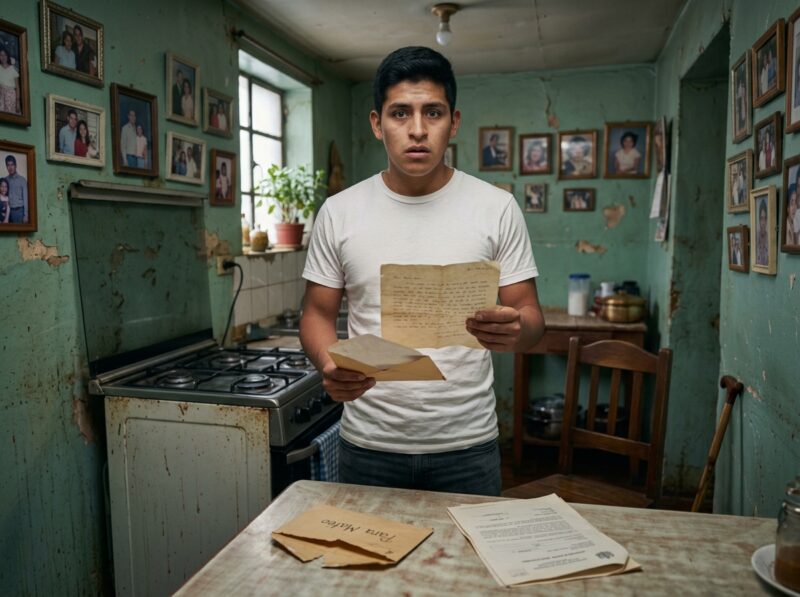
I opened it right there, standing in that kitchen where we had eaten together so many times.
Inside was a two-page letter and a folded document.
I began to read.
Mateo: I know I never paid you what I owed you. I know you found my refrigerator empty more times than I should have allowed. I know you stayed when you had no reason to stay.
For eight months you gave me something my own children couldn’t give me: presence. Not compassion from a distance. Real presence. The kind that arrives, cooks, waits in hospitals and listens to old stories without watching the clock.
I don’t have much. I never did. But the little I have, I want to be yours.
I unfolded the document.
It was the title deed to the house.
In my name.
I stood frozen for so long that her son had to ask if I was all right.
I couldn’t speak.
Not because I didn’t know what to say, but because I suddenly understood something I hadn’t seen coming: that Consuelo had never paid me week by week because she always knew she would pay me in a different way. That every soon, I promise was not forgetfulness. It was a decision made in silence, from the very beginning.
She knew exactly what she was doing.
And she waited until the end to tell me.
Consuelo’s house isn’t big.
The walls still have the crooked photographs. The broken radio is still on the shelf. The wooden bed still creaks.
But I fixed it up little by little.
And sometimes, when I cook in that small kitchen and the pot starts to boil and the smell fills the space, I have the feeling that she is still sitting in her chair by the stove, looking at me with that slow, tired smile.
And that everything is all right.