My sister, Rosie, is one year younger than me. Some kids stayed away from her or thought she was strange because she had Down syndrome. But not my best friend, Ben.
“Rosie, you’ll always have me and Ben,” I used to tell her.
Ben always looked out for her. He picked her for his team at recess, and in fourth grade even promised to take her to prom someday.
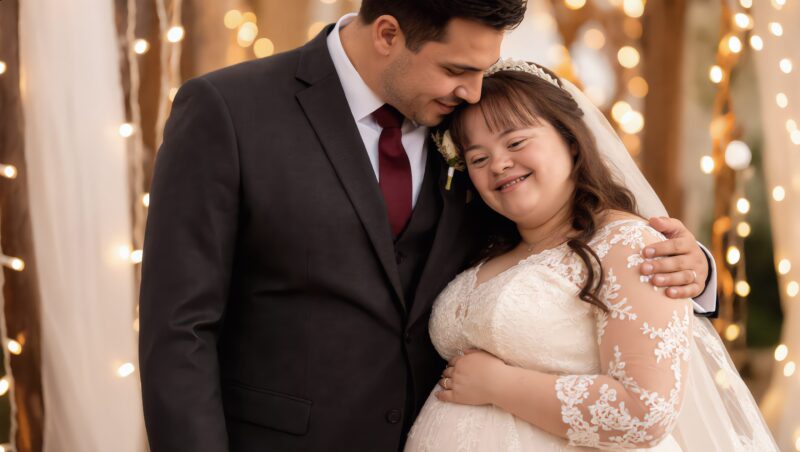
Everyone assumed Ben and I would get married. Instead, years later, he proposed to Rosie.
I cried harder than she did. My best friend became my brother, and my sister got the life strangers always insisted she could never have.
Rosie became pregnant with twins. The pregnancy was difficult. At thirty-four weeks, she was rushed to the hospital. Doctors were fighting to save her and the babies.
Ben, pale as a sheet, suddenly grabbed my hand and pulled me into an empty corridor.
“Before surgery, Rosie made me promise to tell you this if she didn’t wake up,” he said. “Now it’s time for you to understand why I really married her.”
My stomach dropped. “Ben, why would you say something like that?”
The most terrible thoughts flooded my mind within seconds. Had he done it for money? For our parents’ inheritance, which Rosie would receive someday? Or, worse, had he married her just to stay close to me, using my own sister as an excuse all these years?
Ben studied my face carefully, as if measuring how much I could bear to hear right then.
“It’s much worse than you think,” he finally said. “You should sit down.”
I didn’t sit. I couldn’t. I stood, back against the cold hallway wall, while he pulled out a sheet of paper folded several times from his jacket, as if he’d carried it with him for months, waiting for the moment he’d have to hand it over.
I’d barely read the first line when I screamed.
“If you’re reading this, it means I didn’t wake up, and you finally need to know the whole truth about why Ben and I got married.”
The handwriting was unmistakably Rosie’s, careful and deliberate as she always wrote, each letter formed with the patient effort that had characterized her since childhood.
“It wasn’t just love, though that’s real too, and has been since we were teenagers, even though neither of us dared say it out loud. Three years ago, before Ben proposed, doctors diagnosed me with a congenital heart condition related to my Down syndrome — something I never told you because I didn’t want you to worry, and because I knew you’d try to convince me not to go through with any of this. Specialists warned that a pregnancy could be extremely risky for my heart, possibly fatal. Ben knew everything from the first day we talked seriously about marriage. And still, he decided to go through with it, not despite the risk, but knowing exactly what it could mean to have a family together.”
My hands were shaking so badly I could barely hold the paper straight.
“I asked him, practically begged him, never to tell you while I was well, because I didn’t want you looking at me with pity every time you saw me, or Ben carrying the guilt of ‘allowing’ me to take this risk, as if I weren’t capable of deciding about my own body and my own life. It was my decision, completely mine, made with open eyes and a clear mind. I wanted to be a mother. I wanted a full life, not a life wrapped in cotton wool out of fear of what might happen. My whole life, people decided for me what I could or couldn’t do, what was ‘too risky’ for someone like me. I wasn’t going to let my own heart, literally, take that decision away from me too.”
“If you’re reading this, please don’t blame Ben for anything. He tried to convince me to wait, to look into other options, to consult more specialists before trying to get pregnant. I insisted, again and again, until he finally understood this was something I needed to do, with or without his support. He chose to stand by me instead of letting me do it alone, and that, sister, is the greatest act of love I’ve ever known.”
“Take care of the babies if I can’t. Take care of Ben — I know he’ll blame himself, no matter what I told him, so he’ll need someone to remind him this was my choice, not his. And please, sister, don’t let my decision make you afraid to live your own life fully, to take your own risks, to love without holding back. I love you more than words can say, more than this paper can hold. Thank you for never seeing me as ‘different.’ Just as your sister. — Rosie.”
I screamed my sister’s name in that empty hallway, the crumpled paper against my chest, while Ben held me, crying too, without another word, because there was nothing more to say.
Forty minutes later — the longest forty minutes of my life — the surgeon came out with an expression I couldn’t immediately read, a mix of exhaustion and something I desperately hoped was relief.
“It was complicated,” he said. “There was a moment we almost lost her. But Rosie is stable. The twins too. All three are going to be fine.”
I collapsed right there, on the hospital floor, and Ben collapsed with me.
Rosie woke up two days later, weak but conscious, asking first about her babies, then about Ben, and finally about me. When I showed her the letter, still crumpled from how much I’d held it, she smiled that smile of hers that never changed, no matter how much the world around her had changed.
“I had to tell you just in case,” she said simply, her voice still hoarse from the breathing tube. “But I’m so glad I get to tell you myself, in person, instead of on paper.”

Today, two years later, Rosie lives with a heart valve surgically repaired during her recovery, closely monitored by a team of cardiologists every six months, raising her twins — Matthew and Helen, both completely healthy — alongside Ben, who looks at her every day with the same unconditional devotion he showed since they were kids on the school playground, picking her for his team when no one else would.
I, for my part, changed the way I see so many things. I left a job I hated out of fear of taking risks. I started saying the hard things instead of holding them in “so as not to worry anyone,” the way Rosie had done with me. And every time I doubt whether it’s worth risking something for what I truly want, I think of my sister’s careful handwriting on that paper, and the words that forever defined what real love means:
It isn’t always measured by what people assume someone can or can’t do. Sometimes, it’s measured by who chooses to stay, eyes wide open, regardless of the risk — and by who chooses to live fully, no matter who tells them they shouldn’t.