I saw him in the first-class carriage of the Madrid-Barcelona high-speed train. My husband of eight years, leaning over a woman in red, whispering something that made her smile.
My name is Sofía. I was carrying the luggage for our anniversary trip: four days in Barcelona that I had organised down to the last detail. The hotel. The reservations. The train.
He had told me he would just step on board for a moment to speak with a client. That I should wait on the platform.
I had been waiting for twelve minutes.
I decided to get on.
And there was Marcos. Standing beside her seat, his hand resting on the back of her chair, looking at her the way he hadn’t looked at me in years.
I didn’t shout. I didn’t cry. I didn’t stop.
I walked past him with my trolley, eyes forward, neither speeding up nor slowing down.
One step. Two. Three.
Marcos looked up when I had already passed.
“Sofía?”
I didn’t turn around.
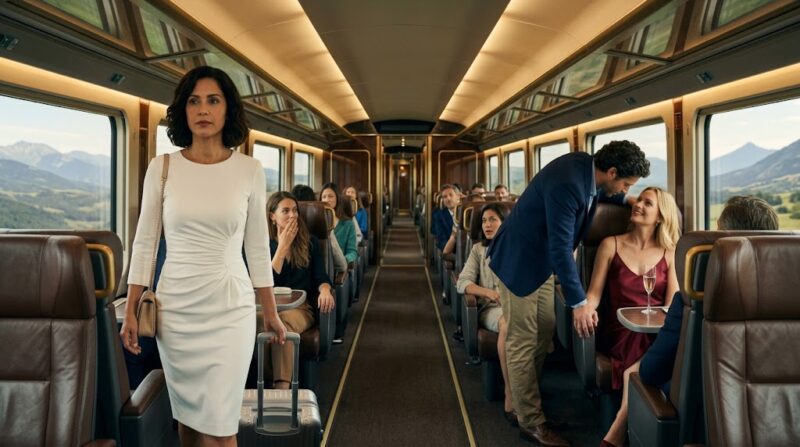
I sat down in my seat, 14A, by the window.
I put the trolley in the overhead compartment with precise movements. I placed my bag in my lap. I took out my earphones. I put them in.
I didn’t play any music. I just needed nobody to speak to me.
Marcos appeared forty seconds later.
He sat down beside me, 14B, with an expression I recognised: that of someone who has been caught but doesn’t yet know how much.
“Sofía.”
I didn’t answer.
“She was a colleague. From the legal department.”
“Right.”
“It’s not what it looks like.”
“Marcos.”
“What?”
“I’ve been married to you for eight years. I know exactly how you look at a colleague from the legal department.”
Silence.
The train started to move. Outside, Madrid was slowly disappearing.
“How long?” I asked finally.
He didn’t answer immediately. That was already an answer.
“Seven months.”
Seven months. The same amount of time I had been planning this anniversary trip. The same time he had started working later, arriving home with his phone face down, kissing me on the cheek instead of the lips.
“Do you love her?”
He took his time.
“I don’t know.”
That was worse than a yes.
I took out my earphones. I put them away carefully. Then I took out my phone and opened the banking app.
“Sofía, what are you doing?”
“Checking.”
“Checking what?”
“Whether there’s anything of mine that needs protecting before we get to Barcelona.”
Marcos went pale.
“Marcos, if at any point during these seven months there had been something worth saving, you should have told me. Not have me discover it on a train.”
I stood up. I picked up my bag.
“Where are you going?”
“To the dining car. I need a coffee. And you need to think about what you’re going to say to me when I come back. Something that doesn’t start with ‘it’s not what it looks like.'”
I walked down the carriage without looking back.
The woman in red was still in her seat. When I passed, she looked up. I held her gaze for exactly one second. Not with anger. With something colder.
She turned back to the window.
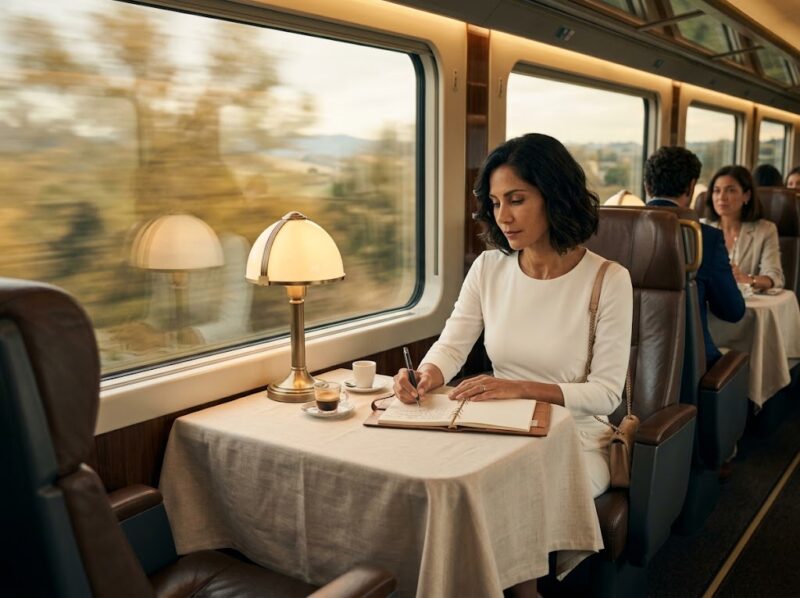
In the dining car I ordered a double espresso and took out the notebook I always kept in my bag. Not a letter for Marcos. A list. The things that were mine. The things that were his. The things that belonged to both of us.
I had been writing for twenty minutes when my phone buzzed. It was my friend Carmen.
“Weren’t you on the Madrid-Barcelona train? I just saw a photo in the neighbours’ group.”
It was me. From behind, with the trolley. And in the background, perfectly framed, Marcos and the woman in red.
The caption from the woman in 4B read: “Oh, the poor thing, walking along so dignified.”
I let out a short, dry laugh.
I wrote back to Carmen: “Don’t worry. The poor thing already knows what she has to do.”
I went back to the carriage forty minutes later.
“What do you want to do?” Marcos asked.
“I know what I’m going to do. The question is what you want to do.”
We arrived in Barcelona at 14:22.
“Shall we go to the hotel?”
“I’m going to the hotel. You decide whether you’re coming. You have until six o’clock to tell me whether you’re going to be in that room tonight to have a serious conversation, or whether I need to call reception and ask for a single room for you.”
I got off the train without waiting for him.
On the platform, the Barcelona sun was clean and direct.
I called my sister.
“Is what I think is happening actually happening?”
“Probably.”
“Are you all right?”
“I’m in one piece. Which isn’t the same as all right, but it’s what I have right now.”
Marcos called at 17:48.
“I’m coming to the hotel.”
We talked for four hours. It wasn’t a pretty conversation. There were questions that took time to answer. Answers that hurt more than expected. Silences that weighed heavily.
Marcos couldn’t bring himself to say he wanted to stay until half past eleven at night. I couldn’t bring myself to listen to him until he said it.
What happened after Barcelona took months. Couples therapy that at first felt like going through motions and then started to feel like something real.
I don’t know whether what we built afterwards was better or just different.
What I do know is that the woman who walked down that carriage with her trolley and her eyes straight ahead never needed anyone to tell her how much she was worth again.
That, in the end, was the only thing the train gave me without my asking for it.