I came home without warning after four years working abroad. What I found when I opened the door left me speechless.
My name is Andrés. I had spent four years in Germany sending money home every month so that Elena, my wife, and my mother could live well. I called when I could. My mother always told me everything was fine.
I wanted to surprise them.
I arrived on a Tuesday afternoon with two suitcases and my heart racing at the thought of seeing Elena after so long.
But when I walked into the back garden, I saw her.
She was on the ground, beside the wall, eating something from a plastic plate.
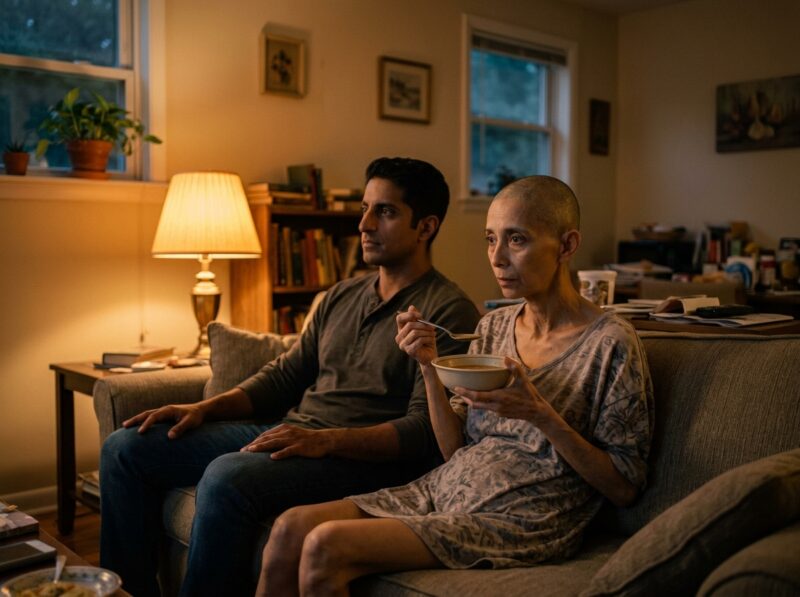
Her head was shaved. She was skin and bone.
I didn’t recognise her until she looked up.
“Elena.”
She looked at me as though she wasn’t sure whether I was real.
At that moment my mother came out through the back door.
“Andrés, it’s not what it looks like.”
I have never felt so cold in summer in my life.

I crouched down beside Elena.
Up close it was even worse.
Her shoulder bones were jutting out beneath her shirt. Her lips were dry and her eyes were sunken. The shaved head wasn’t from illness. It was a razor. The uneven cuts said everything.
I took her hand.
“Elena. It’s me. It’s Andrés.”
She took a moment to respond. When she did, her voice was a thread.
“I know who you are.”
“What happened to you?”
She didn’t answer. She glanced toward my mother, who was still standing in the doorway with her arms crossed.
I stood up. I turned to my mother.
“What have you done to her?”
My mother’s expression didn’t change.
“She brought it on herself. When you’re not here, this house needs order. I kept order.”
“What order?” My voice sounded strange even to me. “You kept her like this?”
“She ate. She had a roof over her head. She didn’t lack anything essential.”
I stood looking at her for a moment I couldn’t measure.
Then I crouched down, put one arm under Elena’s knees and the other behind her back, and lifted her. She weighed what a child weighs.
My mother took a step forward.
“Andrés, this isn’t—”
“Not another word.”
I carried her inside. I sat her on the living room sofa. I went to the kitchen, looked for food and found the fridge empty except for some out-of-date yoghurts and half a loaf of bread. I put water on to boil.
While I waited, I sat across from Elena.
“I need you to tell me everything.”
Elena looked at her hands for a long moment. Then she spoke.
She told me that from the first month after I left, my mother had started changing the rules of the house. That Elena had to ask her permission to go out. That the money I sent was controlled by my mother, who gave Elena a weekly allowance that she gradually reduced. That she took away her phone, saying it was an unnecessary luxury. That when Elena tried to call me from the landline, my mother disconnected it.
“Why didn’t you tell me something when I called?”
“You always called my mother’s mobile. She would answer. She would pass it to me with her standing right there in the room.”
I closed my eyes.
Four years of calls. Four years of my mother telling me “Elena’s fine, she’s right here” and then passing me to Elena for two minutes with her standing in the same room.
“And the hair?”
Elena pressed her hands together.
“Two months ago I brought a friend from work home. Your mother said she couldn’t receive visitors without her permission. She shaved my head as a punishment.”
The water was boiling in the kitchen.
I got up without saying anything. I made something to eat. I came back. I sat beside Elena while she ate, not across from her, because I didn’t want her to feel observed.
When she finished, I asked if she wanted more.
She said yes. I brought more.
My mother came into the living room at some point while I was in the kitchen.
“You’re going to regret this,” she said.
“I already regret it. That it took me four years to come back.”
“That woman is not right for you. She never was. I was only trying to—”
“Mum.”
She stopped.
“This afternoon you call your sister and go to her house. Tomorrow I’ll come to talk to you. But I don’t want you here tonight.”
“This is my house.”
“I pay for this house.”
There was a silence. My mother picked up her bag, opened the door and left without looking back.
That night I slept on the sofa and left the bed for Elena.
Before she fell asleep, she asked me from the bedroom doorway:
“Why did you come home today?”
“Because I missed you.”
Silence.
“I missed you too.”
“I know.”
“I didn’t know how to tell you.”
“I know that too.”
What came after wasn’t simple.
Elena took months to put weight back on. There were doctors, tests, weeks when she couldn’t eat without her stomach hurting. There were nights when she woke up frightened without knowing why.
I learned not to make noise when walking into rooms. Not to stand up suddenly. Not to speak loudly when she was nearby and didn’t expect it.
I learned, essentially, what four years had taught her body to fear.
I spoke to my mother once, on a Wednesday morning, in a neutral café.
I told her what I thought. Not shouting. With the flat voice of someone who no longer has energy for anger but does have it for clarity.
I told her what she had done was abuse. That it had a name. That if Elena decided to report it, I would support her completely.
My mother said she had only been trying to keep order in the house while I was away.
I told her that wasn’t keeping order. That was having power over someone who had nobody.
She didn’t respond. I paid for the coffee and left.
Elena didn’t report it. It was her decision and we respected it.
What she did do was go back to studying. She had left her degree when we got married. She picked it up again a year after I came back.
On the day she defended her dissertation, I was in the front row.
When she came down from the stage, she looked at me.
She said nothing. Neither did I.
Sometimes that’s all it takes.