The first crack appeared in the dam while we were driving along the service road.
“Mateo, what’s that noise?” Lucía asked.
I didn’t have time to answer.
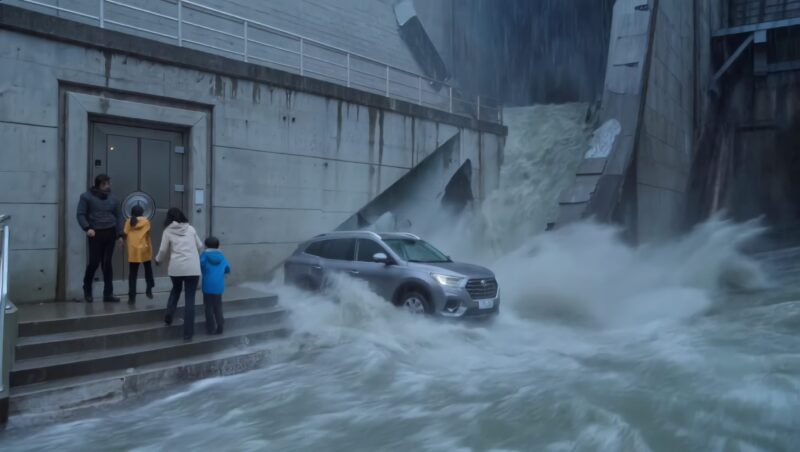
A section of concrete collapsed, and a wall of water came crashing toward our car.
I slammed on the brakes.
“Run!”
Lucía grabbed our son, I took our daughter’s hand, and all four of us ran as the water struck the SUV behind us.
Then I saw a huge metal door embedded in the dam.
“Over there!”
We raced up the soaked steps. When I reached the door, I froze.
At its center was a strange three-pronged symbol.
“What’s wrong?” Lucía asked.
I reached inside my jacket and pulled out the old key my father had left me before he died.
It carried exactly the same symbol.
Then, after thirty years of darkness, a tiny light beside the door switched on.
For several seconds, I couldn’t move.
Behind us, the water roared so violently that the ground trembled. Our SUV had almost disappeared beneath the current and white spray.
But I could only stare at the amber light.
“Mateo,” Lucía said, “why do you have a key to this door?”
I looked at the object I had carried for years.
My father, Gabriel Rivas, had worked as an engineer at that dam before I was born. He rarely spoke about his job. When I was eight, he suddenly left the project and moved our family to another city.
Years later, shortly before he died, he gave me the key.
“Keep it,” he told me. “Someday you’ll know what it opens.”
I had always assumed it was a strange souvenir from his career.
Until now.
My phone had no signal.
The road had vanished beneath the flood. There was no way back.
Then another deep crack echoed through the dam.
Lucía pulled the children closer.
“Whatever is behind that door, it may be our only option.”
I approached the mechanism and inserted the key.
For a moment, nothing happened.
Then gears began turning behind the steel.
The door slowly opened.
There was no water behind it.
There was a corridor.
We entered and closed the door. The passage descended into an old maintenance room illuminated by emergency lights.
Words remained visible on one wall:
SECTOR 7 — RESTRICTED ACCESS
On a table were helmets, yellowed plans and dusty files.
Then I noticed a name written across a metal box:
GABRIEL RIVAS
My hands began to shake.
Inside were photographs, reports and a small recorder.
I pressed PLAY.
My father’s voice filled the room.
“If you’re listening to this, the dam has failed.”
Lucía stared at me.
The recording continued.
Thirty years earlier, my father’s engineering team had discovered a serious structural weakness in one section of the dam. They recommended replacing it, but doing so would have required shutting the facility down for months.
Management chose a partial reinforcement instead.
Gabriel refused to sign the report declaring the structure completely safe.
He kept copies of the documents.
The room we had entered was an old auxiliary emergency-control center, and the key provided access to it.
But there was more.
“If the main structure fails,” my father explained, “there is a manual emergency system in this room. It can open diversion channels and reduce pressure on the remaining wall.”
I studied the plans.
A large red lever stood beneath a metal cover.
Lucía understood immediately.
“Can you stop it?”
“I can’t stop the water,” I said. “But maybe I can stop the rest of the dam from collapsing.”
We found the procedure my father had written.
Three switches had to be activated in sequence, followed by a mechanical wheel.
I followed the instructions.
Nothing happened.
I tried again.
Then the lights came alive one after another.
A gigantic motor started somewhere beneath us.
An old screen displayed:
DIVERSION CHANNELS OPEN
Water began flowing into two enormous side channels.
Pressure on the damaged section started falling.
Minutes later, we managed to contact emergency services using the control room’s radio equipment.
Rescuers reached us almost two hours later.
When we finally emerged, the road had been destroyed and our SUV had been carried hundreds of meters downstream.

But the main section of the dam was still standing.
The investigation that followed confirmed what Gabriel had documented decades earlier.
The files proved that he had repeatedly warned about the structural defect and refused to conceal it.
He had not voluntarily left his job, as I had always believed.
He had been fired.
Months later, Lucía and I returned.
The dam was closed for complete reconstruction.
An engineer handed me the old key.
“This belongs to your family.”
I held it for a moment, then shook my head.
“No. It has already done what it was meant to do.”
The key was eventually placed in a small technical museum beside the rebuilt dam.
Below it was a photograph of my father and a plaque:
“Gabriel Rivas — the engineer who warned of the danger.”
For thirty years, I believed my father had left me a key without an explanation.
That afternoon I finally understood.
He hadn’t left me the key to a door.
He had left me a way to finish the work they never allowed him to finish.