My daughter Valeria doubled over in pain while we waited for the doctor.
“Mom… it really hurts.”
Dr. Salazar helped her lie down and began an abdominal ultrasound. At first, he seemed completely calm—until an image appeared on the screen that took my breath away.
It looked like a baby.
I stared at my seventeen-year-old daughter. She looked just as confused as I was.
Then something even stranger happened.
The doctor stopped moving the probe.
He leaned toward the monitor, changed a setting, and looked again.
“Doctor… what’s wrong?” I asked.
He didn’t answer.
He checked the image a second time. The color seemed to drain from his face.
Valeria reached for my hand.
“Mom…”
Finally, the doctor looked away from the screen.
“This… can’t be.”
I thought he was talking about a pregnancy.
I was wrong.
What he had noticed on that ultrasound was something entirely different.
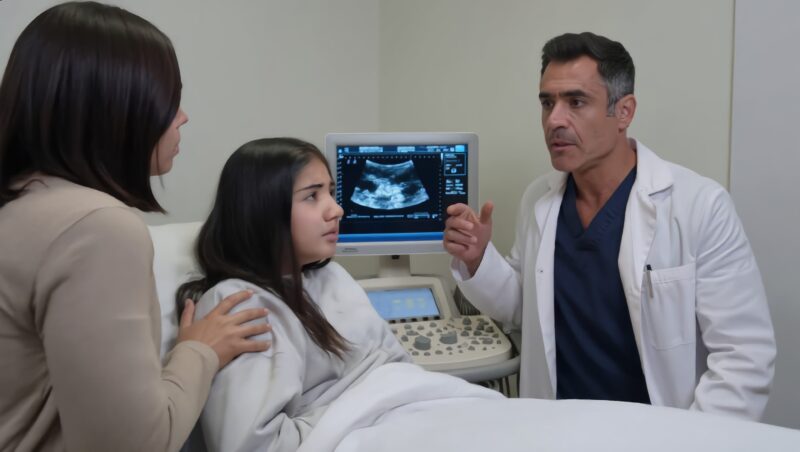
For several seconds, nobody spoke.
“Is she pregnant?” I finally asked.
Dr. Salazar didn’t answer immediately.
He partially turned off the screen and looked at Valeria.
“Before I say anything, I need to repeat the scan and run some tests.”
That frightened me more than an explanation would have.
Valeria began to cry.
“What is happening?”
The doctor sat beside us.
“The first image can resemble a pregnancy, but some details don’t fit. I don’t want to frighten you with the wrong conclusion.”
He ordered an urgent blood test and a second ultrasound using a higher-resolution machine.
As we waited, my mind filled with questions.
Valeria was seventeen. But I realized that this wasn’t the moment to interrogate her. The only thing that mattered was whether she was safe.
“Whatever happens, I’m with you,” I told her.
She hugged me.
Forty minutes later, the doctor returned.
“The pregnancy test is negative.”
I felt relieved for exactly two seconds.
He wasn’t smiling.
“Then what did we see?”
“That’s what we need to determine.”
He took us to another room.
A specialist, Dr. Navarro, repeated the ultrasound and then ordered an urgent MRI.
Valeria squeezed my hand.
“Mom, I’m scared.”
So was I.
The MRI revealed a large mass near one of her ovaries. Its shape and position had created a misleading image on the first ultrasound that could briefly resemble a pregnancy-related structure.
But that wasn’t what had shocked Dr. Salazar.
There was something else.
Inside the area, the scan showed a small calcified structure.
The doctor opened Valeria’s medical history.
“Was your daughter operated on as a baby?”
I froze.
“Not that I know of.”
He turned the screen toward me.
“There are signs of an old procedure.”
Valeria looked at me.
“Mom, what does that mean?”
There was something I knew that she didn’t fully know.
Valeria had been adopted when she was only a few weeks old.
She knew she was adopted, but we had never received complete information about her earliest weeks.
Her documents only said that she had passed through two hospitals before entering foster care.
My husband arrived less than an hour later.
He remembered a box containing old adoption documents at home and went to get it.
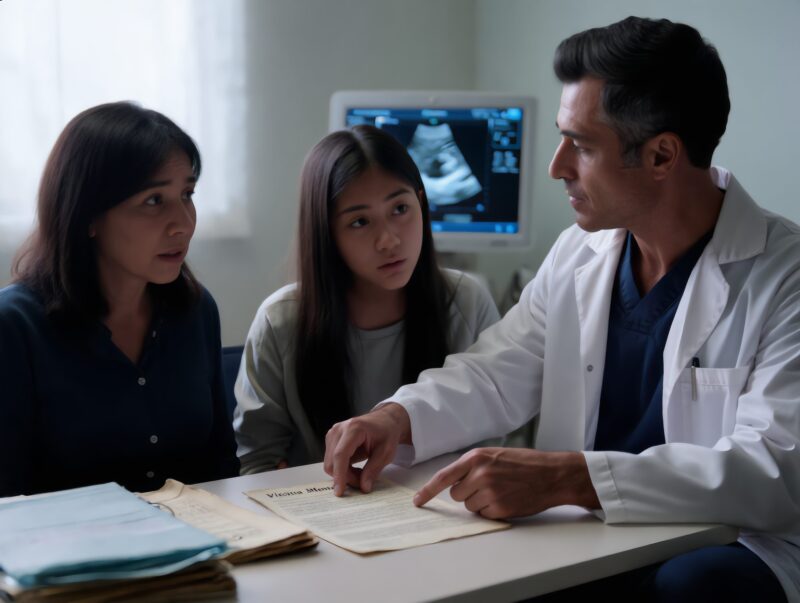
Among the papers was a folded sheet we had never noticed.
It was a neonatal surgical report.
The patient’s name wasn’t Valeria.
It was:
Victoria Méndez.
The birth date was exactly the same.
Dr. Salazar read it twice.
The report described surgery performed only weeks after birth and mentioned a small surgical marker.
It matched what the MRI had detected.
But according to Valeria’s adoption records, she had never undergone surgery.
The next day, a social worker began investigating the original files.
What she discovered changed our family history.
Seventeen years earlier, two newborn girls had arrived at the same hospital within hours of each other.
One was Valeria Cruz.
The other was Victoria Méndez.
Both were later transferred into foster care.
During one of those transfers, their medical files had been switched.
Our daughter had grown up with the wrong early medical history.
Biologically, she had been born Victoria.
Valeria went silent when we told her.
“So… Valeria isn’t my name?”
I sat beside her.
“It’s the name you grew up with. It’s yours if you want it. None of this changes who you are.”
But another question remained.
Where was the real Valeria Cruz?
Three days later, the social worker found her.
She had been adopted by a family two hundred kilometers away and was now called Lucía Herrera.
She was seventeen too.
For her entire life, she had carried medical records that actually belonged to our daughter.
After authorities confirmed what had happened, our families agreed to meet.
There had been no baby swap.
We were not the wrong families.
Only their files had followed the wrong child.
When Lucía entered the room, Valeria stared at her.
They didn’t look alike.
They weren’t sisters.
They were simply two girls whose histories had accidentally become connected as infants.
Lucía carried a folder.
“I think these belong to you,” she said.
Inside were copies of old medical records.
For the first time, Valeria had her real medical history.
With those records, doctors finally understood the findings.
The mass had nothing to do with pregnancy.
Further testing showed that it was a benign ovarian lesion requiring treatment because it was causing her pain.
Valeria underwent surgery a few days later.
Everything went well.
Testing confirmed that the lesion was noncancerous.
When Dr. Salazar visited afterward, Valeria smiled.
“Doctor, you almost scared my mother to death.”
He laughed.
“Believe me, your ultrasound scared me too.”
“Why did you say it was impossible?”
He explained that the first image seemed to tell one story, but the surrounding anatomy didn’t match it. Then he noticed evidence of an old operation that didn’t exist anywhere in the medical history he had been given.
Two incompatible stories on the same screen.
That was why he had stopped.
Months later, Valeria chose to keep her name.
Victoria was the name she had received at birth.
Valeria was the name under which she had learned to walk, gone to school, made friends and built her life.
She kept both as part of her story.
Today she is fully recovered.
We still have the medical report from that old envelope.
Because that afternoon, we entered a clinic expecting to discover the cause of abdominal pain.
Instead, an ultrasound image that initially looked like a pregnancy uncovered a seventeen-year-old mistake.
And our daughter left the hospital with something she had never had before:
her true medical history—and the missing answers about the beginning of her life.