Doña Elena’s nephew was shouting from my porch so loudly that two neighbors came out to see what was happening. “You want a dying woman’s savings! We’re calling the police, today!”
I stood in the doorway. Down the hall, Doña Elena was sleeping. It had been five years since anyone from her family had come to see her.
My name is Rodrigo, I’m thirty-one, and my life was monotonous until three weeks ago. Then Doña Elena got sick. Seventy-six years old, frail, nearly alone. Now she slept in my guest room.
Her nephew, Bruno, pointed down the hall. “You brought an elderly woman into your house without telling her family.”
Diego showed up that afternoon and stared at me. “Now they’re saying you’re after her money.”
“What am I supposed to do?”
What nobody knew was that every night, at nine, I sat beside her bed and whispered something not even Diego knew about.
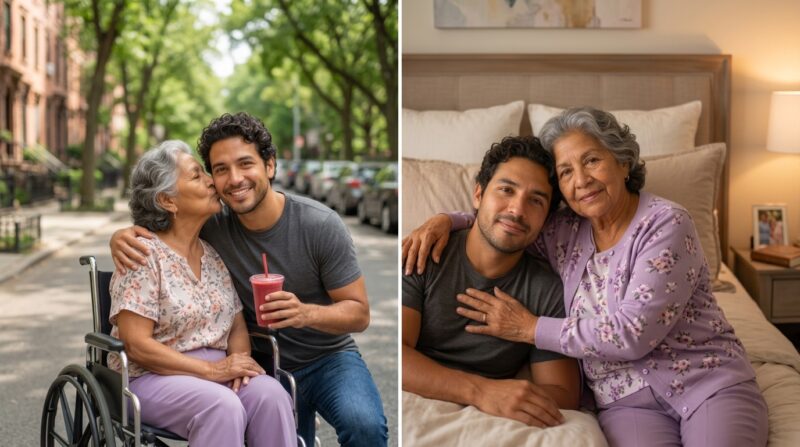
Diego lowered his voice. “What do you whisper to her?”
I didn’t answer right away. The truth was more complicated than it could fit into a sentence.
My father left when I was nine. My mother raised two kids alone with two jobs, and by the time I turned twenty, we barely spoke. I told myself I was busy. That I’d call her next weekend. That there was time.
There wasn’t.
She died alone in a hospital while I was on a work trip that, looking back, wasn’t as important as I thought. I never got to tell her the things I’d been holding onto for years: that I admired her, that I knew how much she’d sacrificed, that I regretted every call I put off.
Doña Elena had lived alone across the street from me for six years. I’d wave when I collected the mail. Sometimes she’d give me tomatoes from her garden. We never talked for more than five minutes at a time.
Until she collapsed in her kitchen one Tuesday morning, and I was the one who found the door ajar and called the ambulance.
At the hospital, a doctor asked if I was family. I said no. He paused, looked at the sheet where no functional emergency contact appeared, and asked if I could help anyway.
The first few days were just logistics: medications, soft foods, helping her move from bed to chair. But one night, while I was adjusting her pillows, Doña Elena took my hand and said, “I know I’m not your responsibility.”
Something in that sentence broke something loose inside me.
“No one is anyone’s responsibility until they decide to be,” I answered, surprising myself with the certainty in my own voice.
That night I started talking to her. Not about her. About me. About my mother. About the calls I never made, the visits I postponed, the funeral where I could barely speak because I was drowning in guilt over all the time I’d wasted.
Doña Elena listened without judgment. Sometimes she’d close her eyes and just hold my hand. Other times she’d say brief things that stayed with me for days: “Late love is still love, Rodrigo. It just arrived after you wished it had.”
It became a ritual. Every night at nine, I’d sit beside her bed and tell her a different piece of the story I’d never been able to tell anyone else: the birthdays I ignored, the Christmases I was “too busy” to visit, the last phone call with my mother, which lasted four minutes because I had “an important call” afterward.
I wasn’t trying to repair the past with my mother through Doña Elena. I was, without realizing it then, learning to be present before it was too late, with someone I could still listen to.
I told Diego all of this that afternoon, in my kitchen, while the grocery bags still sat unpacked on the counter.
“I talk to her about my mom,” I finally said. “Every night. About everything I didn’t say in time.”
Diego was quiet for a long moment. “That doesn’t sound like someone after an inheritance.”
“I’m not after one.”
“I know. But you need Doña Elena’s family to know that too, before Bruno actually calls the police.”
That night, I decided to do something I hadn’t considered before: I invited Bruno to stay for one of my nightly visits. At first he refused. Then, maybe out of curiosity, maybe because something in my tone convinced him, he agreed to sit in the corner of the room without saying a word.
At nine sharp, I sat beside Doña Elena’s bed as always. She smiled at me, unaware we had an audience.
“Ready?” I asked.
“Always,” she answered.
I started talking, a little louder than usual this time. I told her about the day my mother taught me to ride a bike, holding the seat until I stopped wobbling, never telling me she’d let go ten feet earlier. I told her about the last Christmas we spent together, when she pretended the ugly sweater I gave her was her favorite, and wore it every winter until she died.
When I finished, I looked toward the corner. Bruno’s eyes were full of tears.
“I didn’t know you did this,” he said, his voice breaking.
“No one knew. Except Doña Elena.”
Bruno looked at his aunt. “Aunt Elena, why did you never tell me any of this?”
Doña Elena looked at him calmly. “Because you never asked, mijo. Just like I never asked why you stopped coming.”
The silence that followed was different from the one on the porch. It was the silence of someone recognizing, for the first time, the true size of their own absence.
Bruno apologized that night, not just to me, but to Doña Elena. He confessed that after his wife died, five years earlier, he’d stopped knowing how to show up for anyone, including the aunt who’d practically raised him like a mother after his own died young.
The neighborhood rumors didn’t disappear right away. But once Bruno started visiting every weekend, once he brought his own kids to meet their great-aunt, once the whole family started taking turns sitting with her, the story people told about me changed without me ever needing to defend myself.
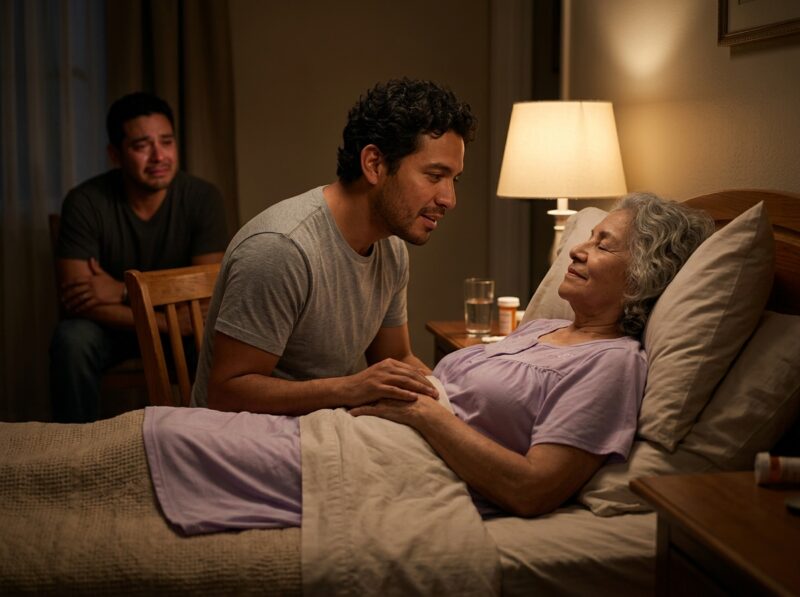
Doña Elena lived four months longer than doctors had predicted. During that time, we kept our nine o’clock ritual, though now sometimes Bruno sat in the corner, listening, sometimes adding his own memories of his aunt young, strong, full of life.
On the last night, she took my hand the way she had that first time and said, “Thank you for practicing with me, Rodrigo.”
“Practicing what?”
“Staying. Saying things in time.”
She died that morning, with Bruno on one side of the bed and me on the other, both holding her hands.
At the funeral, Bruno asked me to speak. I talked about nine o’clock, about the stories of my mother, about how Doña Elena had taught me, without meaning to, not to leave important words for later.
After that, Bruno and I stayed in touch. He became, in a way neither of us expected, the family we both needed: him, someone who finally understood what it meant to show up; me, someone who’d finally learned to do it before it was too late.
A year later, on the anniversary of her death, Bruno and I sat together on the porch where he’d once shouted at me, now sharing coffee and the same stories Doña Elena had taught us to tell in time.
“I still talk to her some nights,” I confessed.
Bruno smiled. “So do I.”