Twenty minutes before my entrance into the church, I noticed Valentina wasn’t with the other girls. My six-year-old daughter had practiced her flower girl role for weeks.
I found her in a side room, no longer in her white dress. She was wearing grey sweatpants I recognized instantly: from my mother-in-law’s suitcase. Valentina’s eyes were swollen from crying.
“Mom,” she said, “Grandma Renata said my spots would ruin the photos.”
I felt the floor shift under my feet.
“Where’s the dress I bought her?” I asked the assistant.
“Doña Renata put it in her bag,” the woman said, uncomfortable. “She said it was a practical decision.”
I walked out into the hallway and found my mother-in-law adjusting her shawl in front of a mirror, calm.
“Doña Renata,” I said, with a calm I didn’t feel inside. “Where is Valentina’s dress?”
She didn’t even turn around. “That white dress made her skin stand out too much, dear. The sweats make her look more discreet. No one needs to see that in your wedding photos.”
I was speechless for one full second. Then I felt something inside me go absolutely firm.
“Tonight, at the reception,” I told her, “you’re going to learn a lesson you’ll never forget.”
I didn’t yell at her. I didn’t make a scene in that hallway, even though every cell in my body wanted to. Instead, I opened Doña Renata’s bag without asking, pulled the crumpled white dress from the bottom, and went back to the side room.
“Valentina,” I said, kneeling in front of her, “your spots are called vitiligo. They’re part of your skin, just like your eyes are brown and your hair is curly. They don’t ruin anything. The only thing that would ruin these photos is you not being in them being exactly who you are.”
I put the dress back on her, tied the pink ribbon in her hair, and wiped her tears with my own veil, not caring if it stained.
“Do I still get to throw the petals?” she asked, unsure.
“More than ever,” I answered.
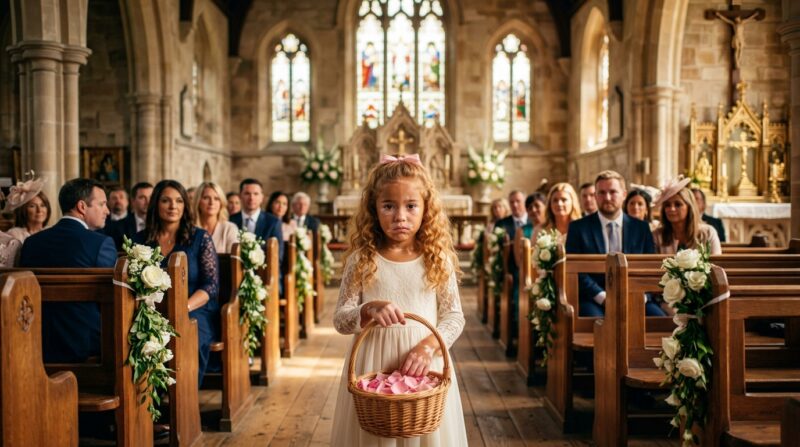
She walked down the church aisle with her chin up, throwing petals with the same precision she’d practiced for weeks. I saw Rodrigo, my now-husband, discreetly wipe his eyes as she walked in. I saw my mother squeeze my father’s hand. And I saw Doña Renata, sitting in the second row, with a tight smile that didn’t reach her eyes.
During the ceremony, I kept my composure. During the photos, I smiled. But inside, I’d been building a complete plan from the moment I saw those grey sweatpants.
My best friend, Daniela, was a professional photographer and had been documenting the whole wedding, including, without Doña Renata knowing, the exact moment she took the dress off Valentina in the side room. A nervous assistant had recorded a short video on her phone when she overheard the conversation, thinking something like that deserved to be documented. She sent it to me without my asking, apologizing for “sticking her nose in.”
It wasn’t sticking her nose in. It was exactly what I needed.
During the reception, when it came time for speeches, I took the microphone before anyone else could. Rodrigo looked at me with one raised eyebrow, not knowing what I was planning, but trusting me enough not to interrupt.
“I want to thank everyone for coming today,” I began, my voice steady. “And I want to tell you about the bravest person I know: my daughter, Valentina.”
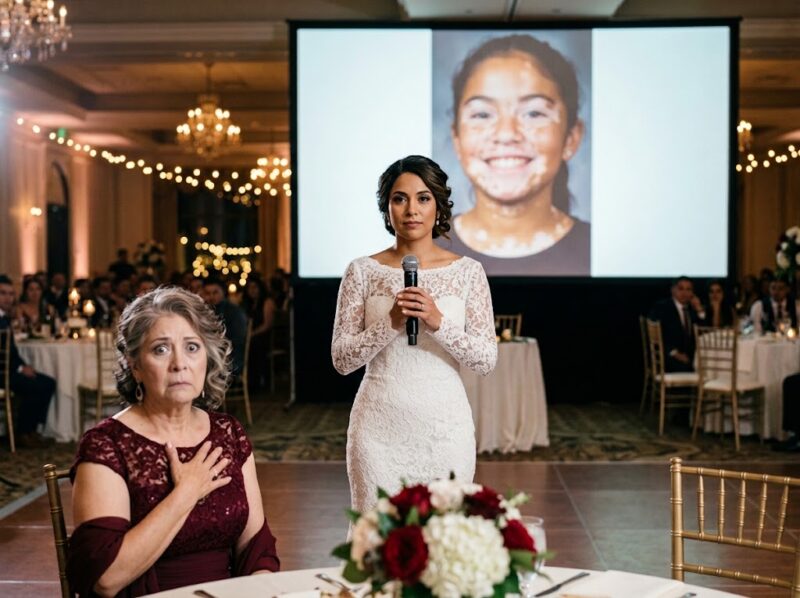
I projected onto the screen, the same one used for our love story video, a photo of Valentina smiling in her white dress, her vitiligo visible on her face and hands, proud, beautiful.
“Twenty minutes ago, someone told my daughter her spots would ruin my wedding photos,” I continued. “Someone took off her flower girl dress and put her in athletic wear to ‘hide her’ better.”
The whole room went silent. I watched Doña Renata go pale at her table.
“I want everyone to know something,” I said, looking directly at my mother-in-law. “My daughter doesn’t need to be hidden. She’s not a flaw to fix before a photo. She’s a girl with a completely normal skin condition that affects millions of people worldwide, and it makes her exactly as beautiful as any other child in this room.”
I played, without naming anyone, the twelve-second video the assistant had recorded: Doña Renata’s voice clearly saying, “The sweats make her look more discreet. No one needs to see that in the photos.”
I didn’t need to point at her. Everyone in that room knew exactly whose voice that was.
Doña Renata stood up abruptly, red with embarrassment. “This is absurd,” she said, trying to laugh it off. “I was just thinking about the photos.”
“My wedding photos are already complete, Doña Renata,” I answered calmly. “They include my daughter exactly as she is. What they won’t include, starting today, is any family event where someone decides her skin is something to hide.”
Rodrigo stood beside me, taking my hand. “Mom,” he said to her directly, “what you said to Valentina was cruel, period. There’s no context that justifies it.”
Doña Renata looked around, searching for support, but even her own sisters avoided her gaze.
Then, in the silence, a small voice rang out. Valentina, sitting at the head table in her white dress, had picked up the wireless microphone we’d given her earlier for her flower girl “speech” — a simple “thank you for coming” we’d rehearsed together.
“My spots are called vitiligo,” she said, her high voice echoing through the silent room. “And I like them.”
The whole room burst into applause. Someone shouted “Bravo!” from the back. My father stood first, then my mother, then nearly every guest, until Valentina was standing on her chair, smiling, a little confused by all the attention, but clearly enjoying every second.
Doña Renata sat back down, small, not knowing where to look.
I didn’t kick her out of the wedding. I didn’t make her leave the room, though several guests later told me they would have understood if I had. Instead, I let her sit there, in silence, watching her granddaughter receive the love and acceptance she’d tried to strip away from her just hours earlier.
After the wedding, Doña Renata tried several times to minimize what happened, calling it a “misunderstanding” or “a joke that got out of hand.” Rodrigo, to his credit, never let her rewrite the story. Every time she tried to change the narrative in front of other relatives, he corrected her calmly but firmly: “It wasn’t a joke, Mom. You told a six-year-old her body was shameful.”
We set clear boundaries after that. Doña Renata could see Valentina, but never alone, and never without one of us present for the first visits after the incident. We explained that rebuilding trust would take time, and that it depended entirely on her willingness to understand why what she’d done was so harmful — not just apologizing to look good in front of the family.
Months later, at Valentina’s birthday, Doña Renata arrived with a carefully wrapped gift. Inside was a children’s book about kids with visible differences, including vitiligo, and a handwritten letter admitting, without excuses, that she’d reacted out of her own insecurity about what others would think, instead of considering how her words would affect a six-year-old.
It wasn’t a perfect apology. But it was real, and it was the first of many steps she’d need to take to rebuild what she’d broken that day at the church.
Valentina, with the effortless generosity only children seem to have, hugged her anyway.
“Do you know my spots are cool now?” she asked.
Doña Renata, with genuine tears this time, nodded. “Yes, sweetheart. I know.”
I keep that wedding photo — Valentina walking down the aisle with her chin up, the vitiligo glowing under the church light, completely herself — as a reminder that sometimes the most important lesson you can teach someone isn’t through anger, but by showing them, in front of everyone who matters, exactly what they refused to see.