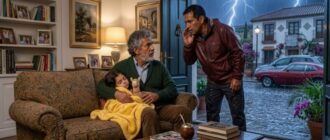
It was two in the afternoon when they knocked on Rosa’s door.
Two men. Large. Tattoos up to their necks and that smile that isn’t a smile — it’s a warning.
She came out as she was: in her house dress, her indoor slippers, her wooden cane. No coat. No time to put one on.
— We know you have money hidden, old woman. Give it to us.
Rosa tried to say she had nothing. Tried to explain. But before she could finish the sentence, one of them pushed her. Hard. Without thinking twice.
She fell into the snow. Bare hands touched frozen ground. The cane lay beside her, useless.
They laughed.
And then, from the forest, something came that nobody expected.
Rosa Vdovenko was seventy-four years old and had been living alone in that house for thirty-one of them.
Her husband Mykola had built it before she even knew him. Together they had filled it with children, winters, firewood stacked against the wall, and that particular smell that houses have when someone has truly lived in them. When Mykola died twelve years ago, Rosa didn’t leave. She didn’t leave because the house was as much hers as it had ever been his, and because there was nowhere else in the world she felt she more rightly belonged.
The forest began thirty meters from the front door. Dark firs, always heavy with snow in winter, always silent. Rosa knew it well. She had walked into it hundreds of times to gather fallen wood, to pick mushrooms in autumn, to sit on an old trunk and simply listen. She knew what lived in there. She knew that the forest, if you respected it, respected you back.
The two men who knocked on her door that February afternoon were not from the village.
Rosa knew it the moment she saw them. Not from the clothes, though they were well wrapped against the cold while she stood in her house dress with no time to reach for a coat. Not from their faces, though they had the expression of people who don’t ask — they take. She knew it from the way they looked at the house first, before they looked at her. As if they were calculating.
— Good afternoon — said the taller one, the one with the tattoo climbing his neck.
Rosa opened the door a little wider. She was wearing her everyday dress and her indoor slippers. She hadn’t had time to put on her coat.
— What do you want?
— We know you have money saved — said the other one, stepping closer —. Everyone knows old people like you keep cash at home. Give it to us and there’s no problem.
Rosa felt the cold of the porch step through the thin soles of her slippers.
— I have nothing — she said —. I swear to you. I have nothing.
The one with the tattoo smiled. It wasn’t a smile.
— Look at that — he murmured, and laughed in a way that needed no explanation.
Rosa tried to step back, inside, toward the warmth. But the one in the dark jacket was already too close. He pushed her with both hands — flat, fast, the way you move furniture out of the way.
She fell.
Backward, down the two wooden steps, landing in the snow with a dull impact that knocked the air from her chest. The cane flew and landed half a meter away, out of reach. Her bare hands sank into the cold snow and Rosa lay still for a moment, trying to understand where it hurt.
Everywhere.
From the porch, both men looked down at her. The taller one had crossed his arms. The other was laughing.
— Look for it properly, grandmother. Or we’ll be back.
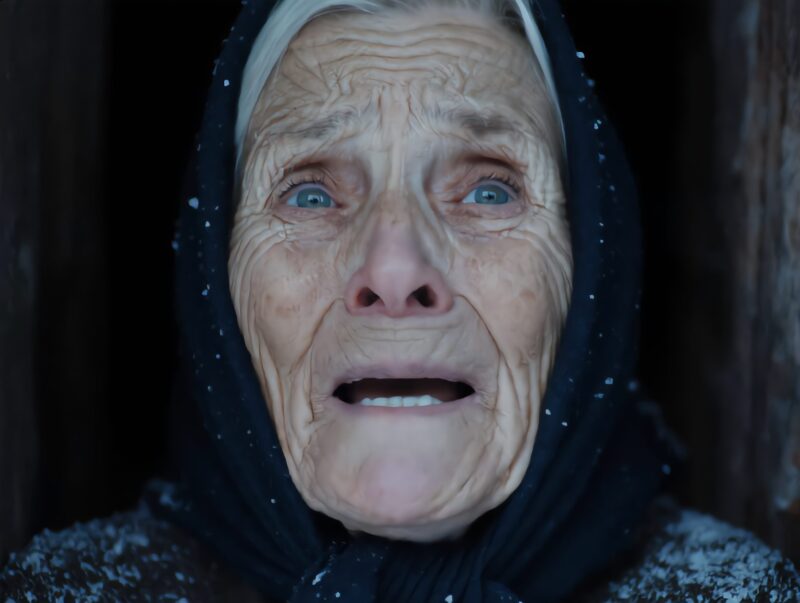
Rosa tried to get up. Knees in the snow, palms on frozen ground. Her thin dress soaking through. And then, without being able to stop it, without wanting to, something came out of her. Not a scream of fear. Something older than fear, from that place inside a person where everything they have endured in silence for too long is stored.
A sound. Long. Broken.
The forest heard it.
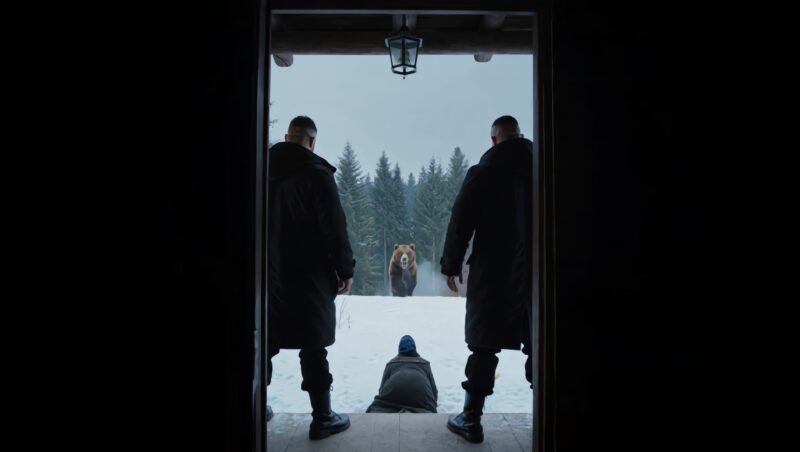
Later, Rosa would not be able to say exactly what she saw first. The movement between the trees, or the eyes. But there it was: at the edge of the forest, motionless in the snow, a dark and enormous shape that had not been there a moment before.
A bear.
Large. Larger than any she could remember seeing. Dark fur, almost black, with that warm brown across the shoulders and muzzle. Steam rising from its nostrils like smoke in the frozen air. Small fixed eyes looking directly toward the porch.
Not at her.
At them.
The two men took a few seconds to notice. Rosa saw it happen exactly: the laughter cutting off, the bodies going rigid, the hands falling to their sides with nothing to do.
The bear roared.
It was not a sound. It was a crack in the winter — something that split the silence from the inside. Rosa felt it in her chest, in her bones, in the snow beneath her hands.
The bear began to move.
It wasn’t running. It was walking. But each step sank its paws into the snow with a weight that said exactly what it had come to say.
One of the men said something. Rosa didn’t hear it clearly. Then the other ran, and the first man after him, and both crossed the yard at full speed without looking back, without picking anything up, without saying another word.
Rosa stayed in the snow, resting on her hands, watching them go.
The bear stopped ten meters from her.
It looked at her. Just looked, for what felt to Rosa like a very long time and was probably no more than thirty seconds. Then it turned, slowly, and went back into the forest. The fir branches closed behind it as if it had never been there.
Rosa took several minutes to stand up. She did it alone, slowly, gripping the cane she had managed to reach. She brushed the snow from her dress. She looked toward the forest.
— Thank you — she said quietly. She wasn’t entirely sure to whom.
That night, before falling asleep, Rosa thought about the seventy-four years she had lived in that place. About learning to respect the forest from childhood. About never cutting a tree without need, never leaving waste on the hillside, never entering its hours of silence without asking permission in her own way.
And that perhaps, just perhaps, the forest remembered.