I thought I was bringing an empty trash bin back from the curb. Instead, I opened the lid and found two little girls carrying a secret that would change our lives forever.
The house next door had stood empty for almost three months. When the new couple arrived, they barely made a sound. I saw them together only once: the man scanned the street with suspicion; the woman stood with her arms crossed, as if protecting herself. Neither ever returned my wave.
After that, I only noticed small signs of life: curtains drawn shut before dark, a car leaving at dawn. I never imagined little girls lived there.
Tuesday morning, the garbage truck had already come. I walked down the driveway, grabbed the handle of my bin, and tipped it back to wheel it into the garage.
It resisted.
It was far too heavy to be empty. Something shifted inside, followed by a barely audible whimper.
“Hello?” I called softly.
The sound stopped. I lifted the lid slowly.
Two little girls were folded into the bottom, pressed close together in the pale morning light. Identical dark curly hair, round cheeks, huge brown eyes.
“We aren’t playing,” the first one whispered. “We had to hide.”
“Who are you hiding from?” I asked.
The other one raised a finger to her lips, and whispered: “Please don’t send us back. Please don’t tell him we’re here.”
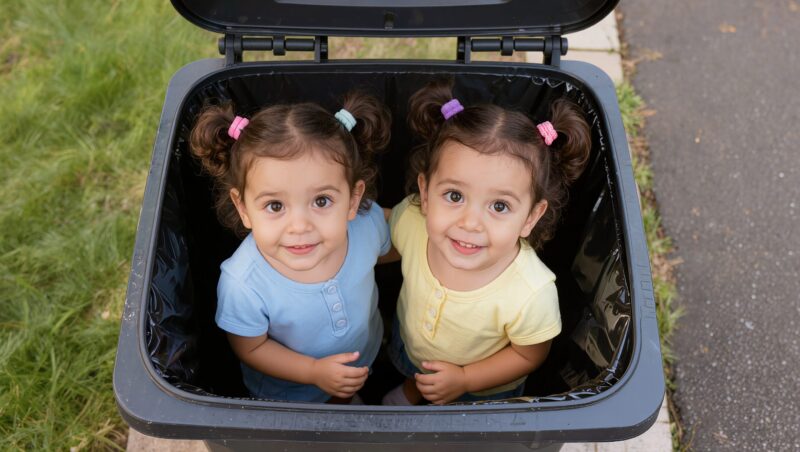
I lowered the lid just enough to block the view from the neighboring windows, without taking away their air. “I won’t take you to that house,” I said. “But you can’t stay here. Will you come with me, where the door locks?”
They looked at each other with a seriousness no three-year-old should need. Finally, the one with the yellow ribbon in her hair raised both arms toward me.
She weighed almost nothing. I set her on the pavement, then carried her sister. The moment they were standing, they wrapped themselves around my legs, trembling.
“I’m Camila,” I told them. “What are your names?”
“Sofía,” said the first.
“Valentina,” the other whispered.
I guided them up my driveway without looking directly at the house next door. It took all my self-control not to run.
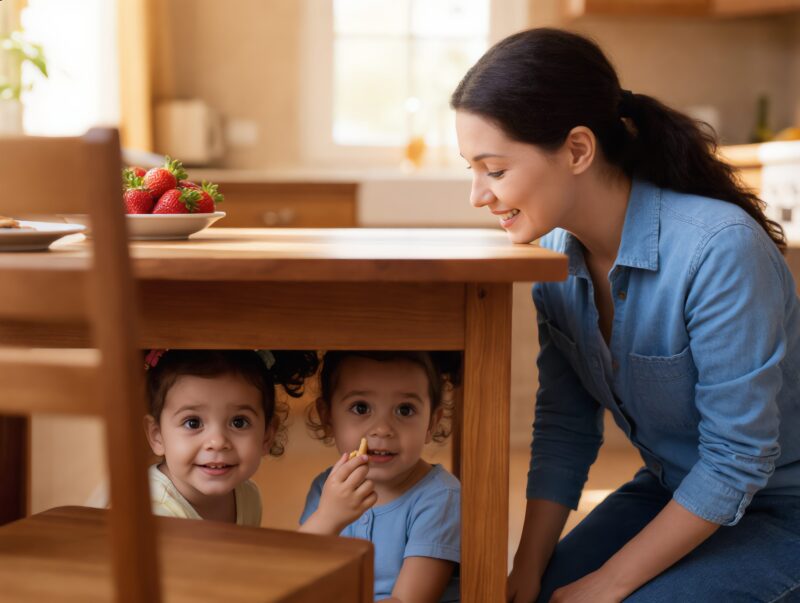
Inside, I put water, crackers, and strawberries on the table. They ate with urgent little bites, as if someone might take the plate away.
“Is your mom next door?” I asked carefully.
Both stopped chewing.
“What about your dad?”
Valentina shook her head, but neither said more. I slowly reached for my phone. Sofía slid off her chair so fast it scraped the floor.
“No police!” she cried.
“Why are you afraid of the police?”
Her eyes filled with tears. “He said police take bad girls away.”
Before I could ask who had told her that, a man’s shout came through my partly open window.
“Sofía! Valentina!”
The effect was immediate. Both girls vanished beneath my table. I closed the window, drew the curtain, and peered through a gap in the blinds. The man next door was striding off his porch, his face furious.
Three hard blows struck my door.
“Good morning,” he said, though nothing in his expression was polite. “Have you seen two little girls?”
I feigned confusion. “Little girls?”
“Twins. Three years old. They wandered off.”
So he knew exactly who they were. “No,” I said. “I haven’t seen anyone.”
“If you see them, contact me first. Don’t call anyone else. The girls can be difficult. They make things up.”
He didn’t leave right away. After several uncomfortable seconds, he gave a thin smile and walked back across my lawn.
I returned to the kitchen. Sofía and Valentina were still under the table, holding each other.
“You didn’t tell,” Sofía whispered.
I knelt beside them. “No. But now I need the truth. Who is that man?”
“Rodrigo,” Valentina said.
“Is he your dad? Your uncle?”
They shook their heads.
“Then where is your mom?”
Sofía’s face crumpled with grief. Valentina leaned close and answered for them both: “He locked Mommy downstairs.”
The room seemed to tilt around me. I asked Valentina to repeat what she’d said, hoping I’d misunderstood.
“Rodrigo put Mommy down there,” she murmured. “She can’t open the door.”
Sofía added: “Mommy told us to be very quiet.”
I wanted to call the police right then, but Sofía was watching my phone with pure terror. I sat on the floor at her height. “Listen carefully: you are not bad girls. Asking for help doesn’t make you bad, and the police won’t punish you for being scared. Rodrigo told you that because he didn’t want anyone to know the truth.”
Sofía studied me for a long time. “They won’t take us away?”
“They’ll help you get back to your mom.”
I stepped into the pantry, leaving the door open enough to see them, and called emergency services. In a low voice, I explained that two little girls from the neighboring house were in my kitchen and believed their mother was locked downstairs. The dispatcher told me to lock every entrance, keep the girls away from windows, and avoid any confrontation.
I’d barely hung up when another blow struck the front door.
“Camila!” Rodrigo shouted.
A chill ran through me. I’d never introduced myself to him.
“Open the door. We need to talk.”
I stayed several feet back. “How do you know my name?”
He ignored the question. The doorknob turned hard against the lock. “Those girls belong to me. You have no idea what’s going on.”
“They’re afraid of you.”
“They’re three. They repeat nonsense.”
“They were sensible enough to find a place to hide.”
His voice sharpened. “Open the door now.”
“No.”
The porch went silent. Then I heard quick footsteps moving away. I ran to the side window and saw him cross toward my backyard gate.
I reached the kitchen door seconds before he did and locked it. Rodrigo grabbed the outside handle and shook it. Valentina screamed. Through the glass, his expression froze as he realized the girls were inside.
“So you lied to me,” he said.
I put the twins behind me. “The police are already on their way.”
For the first time, his confidence cracked. He let go of the handle and ran toward his house.
A distant siren rose at the end of the street. It was the most welcome sound I’d ever heard.
Several officers entered Rodrigo’s house. I stayed with the girls while every second stretched painfully. Finally, there was movement at the neighboring door: two officers brought Rodrigo out in handcuffs. Behind them, another officer supported a woman.
Her hair was tangled, her face pale with exhaustion, one arm held carefully against her body. But the instant she saw the twins at my door, strength seemed to flood back into her.
“My babies!” she cried.
Sofía and Valentina let go of my hands and ran. Their mother dropped to her knees and gathered them close.
Her name was Renata.
Paramedics took her to the hospital along with the girls to treat dehydration, bruising, and an injured wrist. The twins had no serious physical injuries.
An officer later explained what they’d learned: Rodrigo was Renata’s ex-boyfriend. She’d ended the relationship after his behavior grew increasingly controlling. When she tried to take the girls to her sister’s house, Rodrigo intercepted them and forced them to live in the house next door, controlling the phones, the keys, and every movement inside.
The silence I’d mistaken for reserve had been fear.
Three days later, Renata came back to my house. Her sister, Daniela, drove her, along with the twins.
“There’s no way to thank you for what you did,” she told me.
“You don’t owe me anything,” I said. “Your daughters were brave. They brought the truth to my door.”
Renata explained that Rodrigo had taken her phone, her ID, her keys. Whenever she resisted, he threatened to separate her from the girls.
Then she told me something that changed the meaning of that entire morning: the twins hadn’t chosen my trash bin by accident.
From an upstairs bathroom window, Renata could see part of my driveway. With no phone and no safe way to speak to me, she’d begun watching the small rhythms of my days: when I collected the mail, when I watered my plants, when I brought the grey bin back from the street.
Tuesday mornings were predictable. The truck came early, but I usually left the empty bin by the curb until mid-morning. Renata realized it was somewhere the girls could reach quickly, and somewhere I was certain to check.
Over several days, quietly, she taught the twins what to do if they ever found the back door open: wait until Rodrigo couldn’t hear them, run to the grey bin beside my house, climb inside, and stay hidden until I came.
“I knew your name from the little plate on your mailbox,” Renata said. “I told them to wait for Camila.”
That explained how the girls had known they could trust a stranger. It also explained how Rodrigo had known my name when he came back to my door.
The morning of the escape, Rodrigo demanded access to Renata’s email. When she refused, he took her downstairs and locked her in a storage room. Beforehand, she’d managed to leave the back door unlatched. She’d already given the twins their final instructions: stay silent until the house was quiet, then follow the plan exactly.
“You trusted someone you’d never even spoken to,” I told her.
“I’d watched you wave to everyone,” she replied. “I saw you carry groceries for the older man across the street. I saw you put a neighbor’s package under your porch when it started raining. I didn’t know you, but I knew you noticed people.”
Her words stayed with me. I’d thought those gestures were too small to matter. To Renata, they’d become evidence — tiny signs that I might protect her daughters if they could reach me.
Weeks later, before moving to a different town to rebuild her life closer to family, Renata and the twins visited me one last time. Valentina arrived carrying a drawing in both hands: three figures under a bright yellow sun, arms stretched toward each other. Beside them, a huge grey rectangle, nearly as tall as the people.
“That’s us,” she announced proudly.
I pointed to the rectangle. “And is that supposed to be my trash bin?”
Both twins burst into giggles. Renata laughed too, though tears shone in her eyes.
After they left, I stood alone in my driveway, the drawing pressed to my chest. The grey bin waited by the garage, ordinary and slightly scuffed, exactly as it had always been.
When I first opened its lid, I believed I’d found two frightened children who’d climbed into the nearest hiding place. The truth was far more powerful. Their mother, trapped only yards away, had studied my quiet routine and built an escape route from the smallest details of an ordinary neighborhood.
She had noticed when the truck came. She had noticed when I went outside. Most of all, she had noticed how I treated people when I thought no one important was watching.
Sofía and Valentina didn’t end up in my trash bin by chance. They had crossed that yard carrying their mother’s courage, following a plan built from hope, observation, and the belief that a stranger might choose to help.
That morning taught me that safety doesn’t always look heroic. Sometimes it looks like a locked kitchen door, a plate of strawberries, a calm voice on the phone, or an empty grey bin waiting beside the curb.