When my marriage ended, I was left with a four-year-old daughter, $1,100 in my account, and a car that only started if I turned the key twice.
The only place I could afford was a converted garage behind an old blue house on Palmer Street.
It had one bedroom, a kitchen barely larger than a cupboard, and a window above the sink overlooking someone else’s tomato plants.
To me, it looked like safety.
The landlord, Mr. Aguirre, met me in the driveway. He was in his seventies, wore the same grey work shirt almost every day, and had a face that revealed absolutely nothing.
He asked only three questions.
“Do you smoke?” “No.” “Do you have a dog?” “No.” “Is the little girl yours?” “Yes.”
He looked at my daughter for a moment, then nodded.
“Eight hundred dollars a month. Due on the first. No lease — I don’t like paperwork.”
I nearly cried right there.
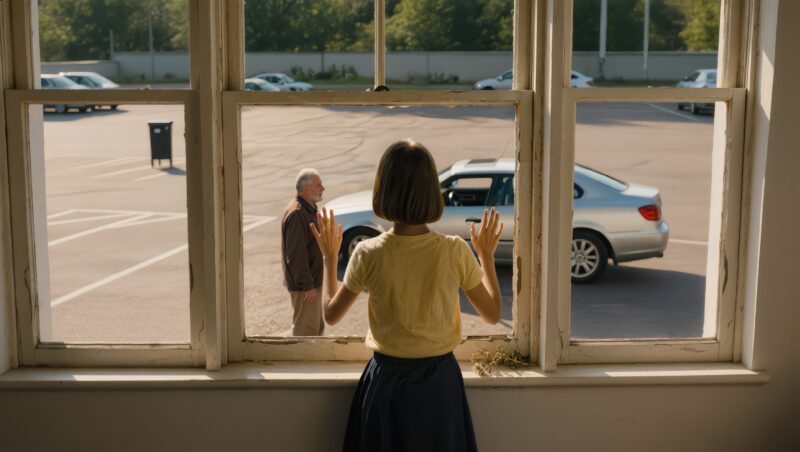
So, on the first day of each month, I wrote Mr. Aguirre a check, crossed the yard, and slid it beneath his back door. That was our entire arrangement. He never gave me a receipt. I never asked for one.
Three months after we moved in, I noticed something strange. I was checking my bank account — the nervous habit you develop when every dollar matters — when I realized the balance hadn’t changed. The $800 rent payment was still there.
My first thought wasn’t that I’d received free rent. It was that Mr. Aguirre had lost my check and now believed I hadn’t paid him.
I immediately knocked on his door.
“Mr. Aguirre, I think you may have misplaced my rent check,” I said. “I can write another one. Just destroy the first if you find it.”
He studied me for a moment.
“It’s handled,” he replied.
Then he closed the door. Not angrily. Just as though the conversation was over.
I convinced myself he was old-fashioned and preferred depositing several checks at once.
But December passed, and the payment remained untouched. Then January. Then February.
Every month, I wrote another check. Every month, the money stayed in my account.
For three years, I refused to spend a single dollar of it. By then, nearly $29,000 was sitting untouched, and I could no longer live with the uncertainty.
So I marched across the yard, knocked on Mr. Aguirre’s door, and demanded the truth.
He didn’t argue. He didn’t explain. He simply disappeared into his house, returned with an old shoebox, and placed it in my hands.
“Open it,” he said.
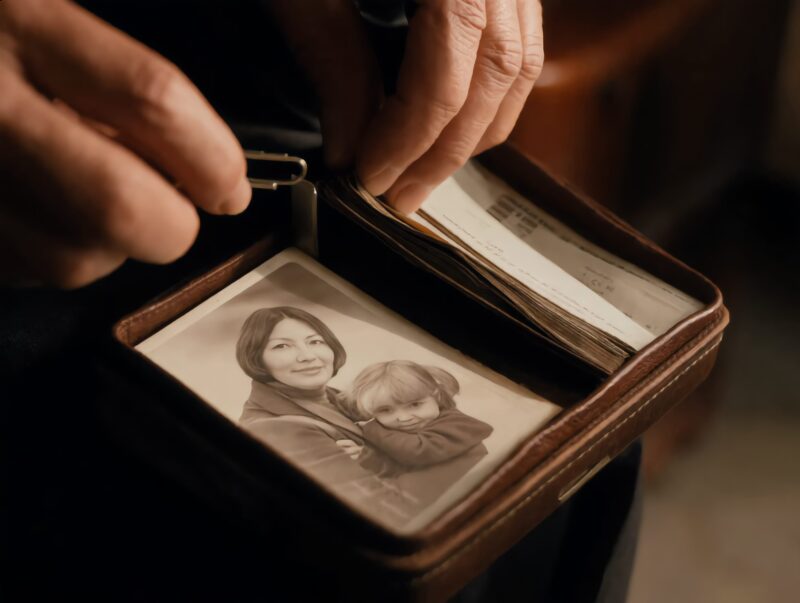
With trembling hands, I lifted the lid. Inside were twenty-six uncashed checks, each for $800, carefully arranged by date with a paperclip. Beneath them was a black-and-white photograph, worn by the years: a smiling young woman holding a small girl in front of the same blue house.
“That was my wife, Rosario,” Mr. Aguirre said, his voice breaking for the first time since I’d known him. “And that little girl was our daughter, Adela.”
He told me that, forty years earlier, he and Rosario had lost Adela in an accident when she was barely five years old. Rosario never fully recovered, and she spent her final years talking about “the little family” that would someday come to live in that garage, as though it could somehow repair what they had lost.
Rosario passed away eight years ago. Before she died, she asked her husband one thing: that if a young mother with a small daughter ever came looking for a safe place, he should let them stay, charge them nothing, and save the money for the girl’s future.
“You showed up with your daughter exactly as Rosario described,” he continued. “I couldn’t tell you then. I was afraid you’d feel obligated to refuse it, or think I expected something in return. So I just kept the checks, waiting for the moment you’d demand answers yourself.”
With tears rolling down my face, I understood that those $29,000 weren’t charity. They were the last gift of a woman I never met, passed on through a silent man who had kept his promise for three years without asking for anything in return.
I used that money for my daughter’s education and to finally buy a small house of our own. But every first of the month, even though we no longer lived in that garage, I kept visiting Mr. Aguirre, now as family, not as a tenant.
And every time my daughter ran to hug him, I could swear that, for a moment, I saw in his eyes something like the peace Rosario had so desperately wanted to find.