Five siblings were about to be separated forever. Then a single father asked if he could keep them all.
My name is Daniel. I’m thirty-eight years old, I work in construction and I live alone. Or I did, until a few months ago.
It all started when I signed up as a foster family. I was assigned three children: Marcos, Iván and Leo, brothers aged six, four and two.
During the first few weeks, all three talked constantly about their sisters. Sofía and Noa. Five years old and three years old. In another foster home, twenty kilometres away.
One day I brought the boys to a joint visit.
When the five of them saw each other, they hugged so tightly that the social worker had to look away.
And when the moment came to separate them again, the three boys cried in a way I will never forget for the rest of my life.
In that moment I knew what I had to do.
I raised my hand and asked: “Can I keep all five?”
The social worker, Pilar, looked at me with a mixture of surprise and something close to hope.
“Daniel, there are five children. The oldest is six. The youngest is two.”
“I know.”
“You’re single. You live in a two-bedroom flat.”
“I know that too.”
“The system doesn’t usually authorise…”
“Pilar.” I looked her in the eyes. “I was in foster care. At twelve years old. My mother couldn’t look after us and we were all separated. It took me fourteen years to find my little brother. He was two when I lost sight of him. Two. The same age Leo is now.”
Pilar didn’t answer immediately.
“Give me a chance to try,” I said. “If I can’t manage, I can’t. But at least let it not be for lack of trying.”
What followed was a process that lasted almost a year.
Reports. Home visits. Interviews with psychologists. Meetings with the judge.
The first obstacle was the flat. Two bedrooms weren’t enough for seven people. So I took out a loan, moved to a bigger flat and spent three months paying two rents at once.
The second obstacle was financial. My construction salary was enough to live on, but the system wanted guarantees. I submitted my accounts, my contracts, my references. I worked overtime for months to make the numbers work.
The third obstacle was the hardest.
At the hearing before the judge, the prosecutor asked me if I was aware of what I was asking for.
“Five children under seven, sir. No partner. No nearby family who can support you regularly. Tell me why I should grant this.”
I was silent for a moment.
Then I told him about my brother. About the fourteen years. About how when I finally found him, he no longer remembered me.
“When I saw those five children embrace in that room,” I said, “and I saw their faces when they were separated again, I thought one thing: I have the possibility of stopping that from happening to them. And if I can stop it and I don’t, that is also a choice.”
The judge looked at me for a long moment. Then he took off his glasses. And he nodded.
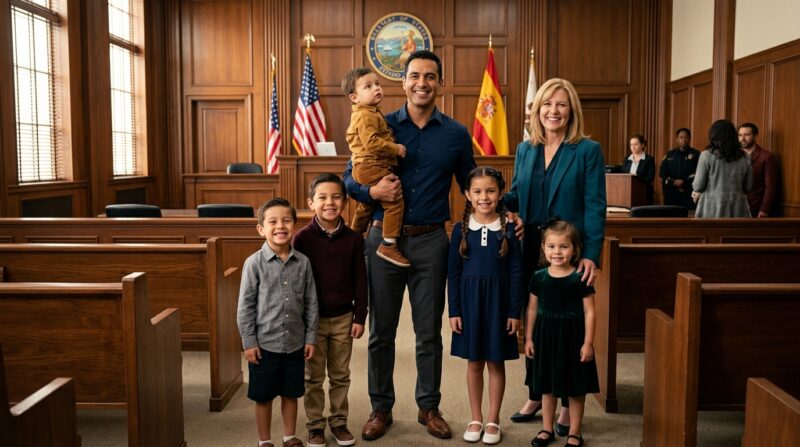
The adoption was finalised on a Friday in November.
Pilar brought us all to the courthouse: the five children, me, and her with a camera because she said she wanted to remember that day.
Marcos, the eldest, was wearing a tie we had bought together the day before. He had put it on himself, crooked, and hadn’t let me straighten it.
“It’s fine like this,” he told me very seriously.
“It’s a bit crooked.”
“Crooked ties are the special ones.”
I didn’t know what to say to that.
When the judge read the adoption order and called them one by one by their new surname, Marcos stood up and clapped. The others looked at him. And then they clapped too.
The judge tried to maintain his composure. Not entirely. Pilar didn’t even try.
On the way home, Leo fell asleep in the car before we had even left the car park. Sofía was looking out of the window with a serious expression. Noa had Sofía’s hair ribbon in her hand and was stroking it as if it were the most important thing in the world. Iván asked me if we could get a dog now.
I told him we would think about it.
“That means yes,” he said.
“That means we’ll think about it.”
“Yeah,” he said, very pleased with himself.
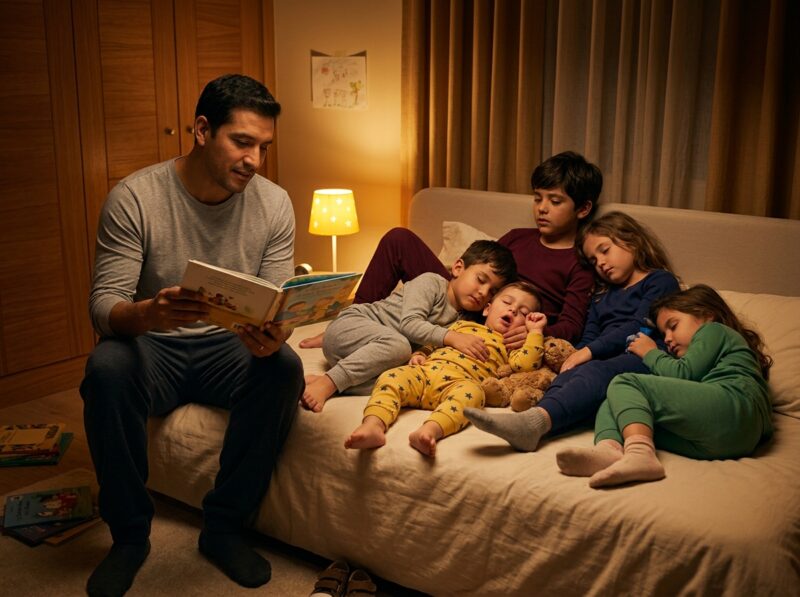
That evening, after dinner, when the five of them were already in their pyjamas and I was trying to manage the chaos of five toothbrushes and three simultaneous arguments about who slept in which bed, Marcos came over to me.
He stood beside me without saying anything for a moment.
Then he asked: “Is it really true that we’re yours forever now?”
“Yes.”
“What if we do something bad?”
“You’re still mine.”
“What if we do something very bad?”
I looked at him.
“You’re still mine.”
Marcos thought about this for a second.
“All right,” he said. And he went off to brush his teeth.
Five months have passed since that afternoon at the courthouse.
I’m not going to tell you it’s easy. It isn’t. There are mornings when breakfast feels like a high-level diplomatic negotiation. There are nights when Leo cries in the early hours and when I go to see him the four older ones are already sitting on his bed trying to comfort him before I get there.
Every time that happens, I’m left without words.
There are also hard weeks, moments when one of them has an outburst that comes from a long time ago, from before I existed in their lives, and the only thing I can do is be there.
But being there is exactly what I promised.
Every night when I put them to bed I say the same thing.
“I am your father forever. I will be here tomorrow. And the day after. And every day that comes after that.”
Marcos no longer asks me if it’s true. Now he’s the one who says it to me.
“Dad, we’re yours forever.”
“Yes,” I say.
“Forever,” he repeats. And he turns over and goes to sleep.