My mother locked my bedroom door on the night of my senior prom. That was when I understood something was truly wrong.
Downstairs, Mateo waited for me in a navy suit, a white shirt, and the bow tie he’d bought months before the dance. Mom appeared in the doorway while I was fighting a stubborn earring.
“You can go with Mateo tonight, Camila,” she said. “But only if you promise me something.”
“I know,” I said. “Do I need to be home by midnight?”
“No. Camila.”
Hearing my full name wiped the joke off my face. Mom didn’t use it unless she was scared, or trying not to show it. Her hands were shaking.
“You need to hear something first.”
“About what?”
She glanced at the closed door. “About Mateo.”
My stomach tightened. “What about him?”
“And about me.”
She sat on the edge of my bed. For a few seconds she looked less like my mother and more like a woman who’d carried a heavy box for years and finally understood she couldn’t hold it alone.
“I owe both of you the truth,” she whispered.
Twelve years earlier, Mateo and I had made a promise over raisins, dinosaurs, and the certainty of two six-year-olds that being almost grown up was the most important thing in the world.
I forgot the promise before dinner that night.
Mateo didn’t.
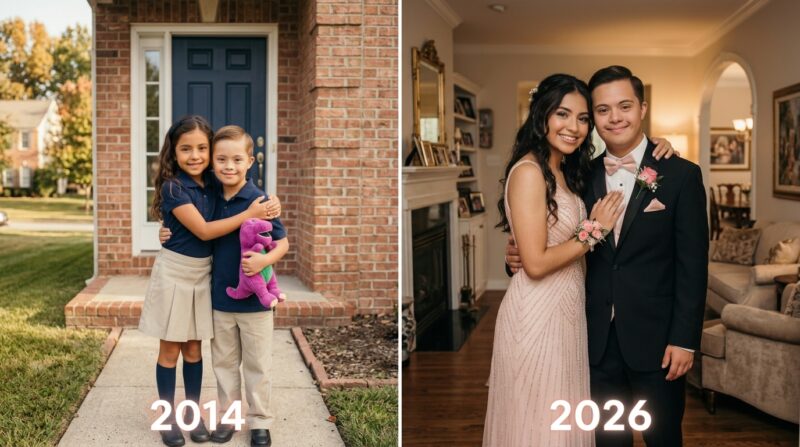
Mateo and I became friends because neither of us wanted the raisins our first-grade teacher handed out at snack time.
“Those are old grapes,” he said, looking at my little red box hidden under a napkin.
“They are,” I answered.
That settled everything. By lunch, we were inseparable. Dinosaurs made the friendship permanent. Mateo knew an astonishing amount about them. I drew them for him, though my drawings looked less like prehistoric predators and more like potatoes with teeth.
Mateo had Down syndrome. At six, that was simply one fact about him. What I noticed first was his honesty, his enormous laugh, and the way he never pretended to like something just because everyone else did.
One day our teacher announced she was getting married. A classmate, Bruno, sneered when Mateo said he’d get married someday too.
“Nobody’s going to marry you,” Bruno laughed.
I watched Mateo’s smile disappear. After class, he found me alone.
“Camila, would you love me?” he asked, his eyes serious.
I was six. I didn’t understand romance or marriage. I only knew Mateo was hurt and I wanted the hurt to stop.
“Maybe,” I answered. Then I remembered my cousin talking about prom, a huge dance for people who were almost adults. “But first we have to go to prom together.”
Mateo held out his pinkie. “Promise?”
I wrapped my pinkie around his. “Promise.”
I forgot it before dinner. Mateo carried it with him for twelve years.
Twelve years is a long time for a childhood friendship to survive. But somehow we always found our way back to each other.
When we were twelve, my parents divorced. I stopped eating much at school. I had no words for what I felt, so I gave everyone silence instead. Mateo never demanded an explanation. He just sat beside me.
Years later, after I failed my first driving test, Mateo showed up at my house carrying two ice creams.
“Why did you bring two?” I asked.
“One because you tried. The other because you drove badly.”
At sixteen, I told him I wanted to quit art after a classmate mocked one of my paintings. The next morning I found the ugliest dinosaur I’d ever drawn, taped inside Mateo’s locker.
“It still looks like a potato with arms,” he said, studying it.
“Then take it down.”
“No. Because you can’t quit yet. The dinosaurs haven’t improved.”
I laughed when I wanted to cry. That was Mateo’s gift. He didn’t give speeches about resilience. He just stayed until the pain grew light enough to carry.
Looking back, I understand our friendship was never built on one of us rescuing the other. It was built from small, ordinary acts of attention — a seat at lunch, a shared ice cream, a terrible drawing taped inside a locker.
So when prom approached, I never doubted who’d be standing beside me.
One February afternoon, Mateo found me at my locker, unusually nervous.
“Camila, do you remember first grade?”
He held out his pinkie. The sight pulled me back through time — the little red raisin box, the potato-legged dinosaur, Bruno’s cruel laugh, and a promise I’d forgotten that same afternoon but that he’d kept for twelve years.
I hooked my pinkie around his. “Prom?”
He nodded. “Prom.” His whole face lit up. “I already bought the bow tie.”
“When?”
“November.”
“Mateo, it was November.”
“Exactly. Stores run out of things.”
That was Mateo’s official invitation.
On prom night, my aunt spent nearly an hour curling my hair. The doorbell rang. I heard my aunt call, “Camila, he’s here!”
I went down the stairs. Then I heard Mom open the front door.
The house went quiet. Not ordinary quiet. The kind that makes your body stop before your mind understands why.
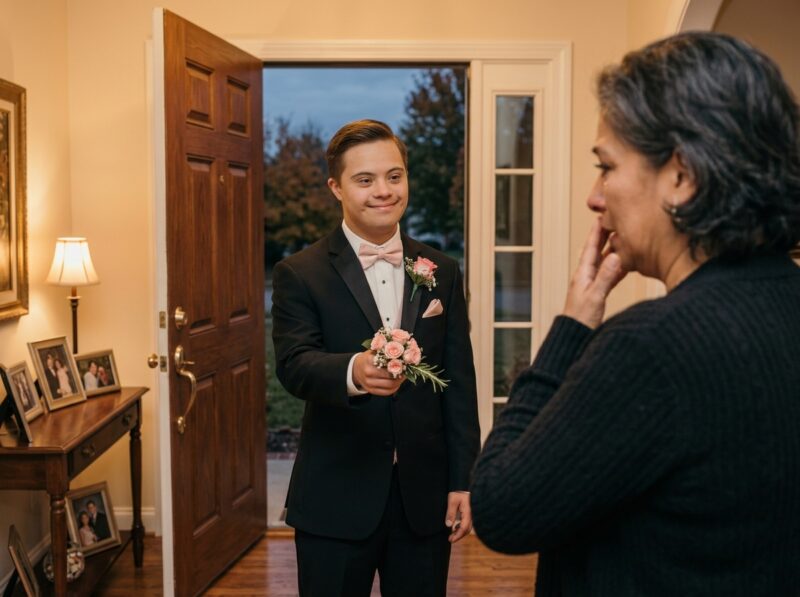
Mateo stood in the entryway in his navy suit. His bow tie was perfectly straight. In his hand was a small corsage with a sprig of rosemary tucked among the flowers.
He was smiling.
Mom stared at him as if she’d seen someone from a dream she’d tried to forget.
“Mrs. Elena?” Mateo asked. “Are you okay?”
Mom blinked. “Yes. Of course.”
But she wasn’t okay. Her eyes moved from the corsage to the bow tie, then back to Mateo’s face.
“Camila’s almost ready,” she said too quickly.
“I’m ready,” I called from the stairs.
Mom looked up. “Come upstairs with me.”
The moment we got to my room, Mom closed the door and locked it.
“You can go with Mateo tonight,” she said. “But only after you promise me something.”
“Do you remember the year your dad left?” she finally asked.
“You were twelve,” she said. “You stopped eating at school. You barely talked.”
“How do you know what I did at lunch?”
Mom looked down. “Mateo told me.”
“One afternoon he found me sitting in my car in the school parking lot, crying. He asked if you were broken.”
My breath caught. “Why would he ask that?”
“Because you weren’t eating. You weren’t laughing. You sat by yourself. He noticed everything.”
“What did you tell him?”
“That you weren’t broken. That I didn’t know how to help you.”
“What did he say?”
A tear slid down Mom’s cheek. “He said he didn’t know how to fix people either. He only knew how to stay beside them.”
“I asked Mateo to promise he’d look after you,” Mom said.
“You asked him that?”
“I was falling apart, Camila. Your dad had left, you were disappearing inside yourself, and Mateo was the only person who could still make you look up.”
“And he said yes?”
“Immediately.”
I heard Mateo’s laugh downstairs, and suddenly years of memories rearranged themselves in my mind: the ice cream after my driving test, the dinosaur in his locker, the afternoons I couldn’t explain my sadness. Mateo had never been waiting for me to pay him back. He’d just kept showing up.
“For six years I’ve been afraid you were giving away pieces of your life because you felt responsible for him,” Mom continued. “Every time you waited for Mateo, defended him, or changed plans so he wouldn’t be left out, I wondered if you were carrying him instead of walking beside him. I never stopped to ask what he gave you.”
“So what’s the condition?” I asked softly.
Mom smiled through her tears. “Don’t go tonight only because a six-year-old promised him. Go because the eighteen-year-old you are now chooses him.”
A laugh escaped me. “Mom, I wasn’t going because of a childhood promise. The promise only explains why Mateo bought a bow tie four months early.”
For the first time that night, Mom laughed too. Then she unlocked the door.
We went downstairs together. “You took a long time,” Mateo said.
Mom walked straight toward him. “Mateo, may I have the first dance?”
I laughed so hard I had to hold the banister. After thirty awkward seconds, Mateo sighed: “Mrs. Elena, Camila dances better.”
“That’s why she’s your date,” Mom replied. Then her voice softened. “Thank you for staying.”
Mateo frowned, as if she’d thanked him for breathing. “She stays too,” he said.
Mom closed her eyes. It was the answer she’d needed for six years. Not that Mateo had rescued me. Not that I’d rescued him. Only that we’d chosen each other again and again, and neither of us had been alone in the choosing.
At prom, the first slow song began just as we reached the dance floor. Mateo held out his hand. “Camila, you owe me.”
“For what?”
“Twelve years.”
“That’s a long time to keep score.”
“I’m very good at statistics.”
Five seconds later, he stepped on my shoe.
“You’re terrible at this,” I told him.
“Your dress is badly designed,” he answered.
Nothing extraordinary happened that night. No applause, no grand announcement. We were just two eighteen-year-olds trying to dance without falling, teasing each other under a ceiling of paper decorations.
And somehow, it was perfect.
Afterward, Mom waited outside by the car. Mateo carried my heels because my feet ached. I carried his jacket because he was warm.
No one was being rescued. No one was paying back an old debt. We were two people who had learned, at six years old, something many adults spend decades trying to understand: love isn’t always loud. Sometimes it’s simply staying.