Doña Remedios yanked Camila off the rug as if she’d caught her committing a crime, while the twins cried, trying to cling to her blouse.
Ricardo Duval stood motionless in the doorway, still holding his briefcase, fury etched across his face. He was supposed to be closing a deal in the capital, but he’d cancelled the trip after several calls from Doña Remedios, the family’s housekeeper for nearly thirty-five years. According to her, the new caregiver was doing dangerous things with the children.
Cushions scattered across the living room, a blanket draped between two armchairs forming a fort. In the middle of the mess was Camila Reyes, twenty-six, hired barely three weeks earlier. Diego was the one the doctors worried about most. That afternoon he was standing, legs trembling. Camila held out her hands, ready to catch him without touching him. “Come on, champ.”
Then Ricardo spoke. “What the hell are you doing?”
Diego lost his balance from the fright.
“Pack your things,” Ricardo ordered. “You’re fired.”
Doña Remedios leaned close to Camila’s ear and whispered: “I told you you wouldn’t last here.”
Camila looked up. Doña Remedios was smiling — not with relief, but with victory. And in that instant, Camila understood something that made her blood run cold: that woman didn’t just want her fired. She’d prepared something far worse.

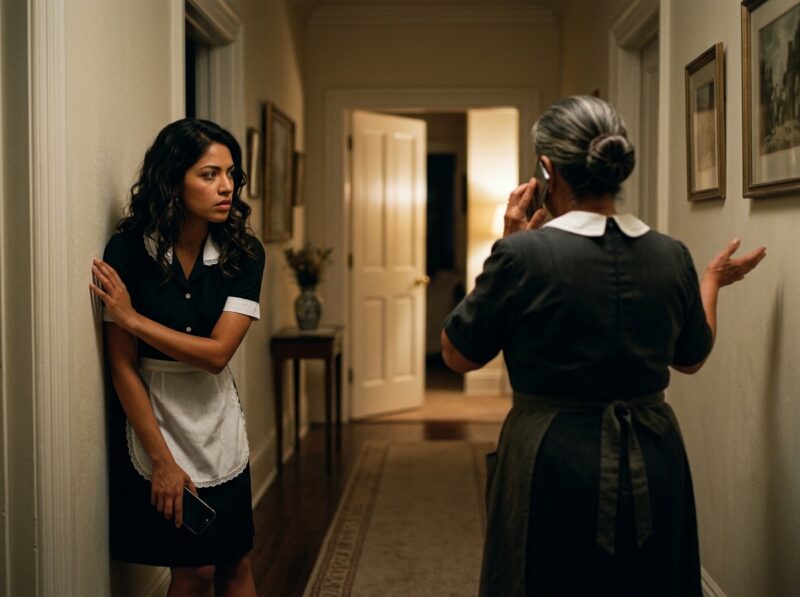
Camila went upstairs to gather her things, hands trembling — not with fear, but with contained fury. While packing her clothes, she heard muffled voices drifting up the stairwell. She peeked out and saw Doña Remedios on the phone in the hallway, using a tone Camila had never heard her use in front of Ricardo.
“This one’s gone too,” she was saying, almost laughing. “Five in a year, and sir still hasn’t suspected a thing.”
Camila froze.
“No, don’t worry. As long as I control who comes and goes in this house, no one will find out about Mrs. Fernanda’s foundation money. Or the inflated maintenance invoices. That man is so buried in grief he signs whatever I put in front of him.”
Camila slowly pulled out her phone and started recording.
Doña Remedios continued, oblivious: “The children are my insurance. As long as he believes only I know how to take care of them, he’ll never fire me. That’s why every nanny who gets too close to them, who makes them trust someone else, has to go. Fast.”
Camila recorded nearly four full minutes before the call ended. She went downstairs, heart pounding, but determined to say nothing yet. She knew that if she accused Doña Remedios without solid proof, thirty-five years of “family loyalty” would weigh far more than the word of a fired nanny.
That night, in her apartment, she listened to the whole recording. It confirmed her suspicions: Doña Remedios had spent years diverting funds from the charitable foundation Fernanda, Ricardo’s late wife, had created for children with motor disabilities — the same condition Diego faced. She also talked about fake home maintenance invoices, nonexistent vendors, and a clear pattern: every caregiver who made real progress with the twins ended up fired on fabricated accusations, always right before Ricardo could see the progress with his own eyes.
Camila didn’t go to the police right away. She first contacted a lawyer specializing in financial fraud, an old college friend, who explained how to properly document everything so the recording would hold up as evidence.
Four days later, Camila requested a meeting with Ricardo. He agreed, more out of curiosity than courtesy, still convinced she just wanted her job back or a settlement.
“Mr. Duval, I’m not here to ask you to rehire me,” she said, setting her phone on the desk. “I’m here to show you something you should have heard a long time ago.”
She played the entire recording.
Ricardo’s face moved through disbelief, denial, and finally a cold, silent fury Camila had never seen in him.
“Five nannies?” he asked, voice breaking. “In one year?”
“According to what she says herself, yes.”
Ricardo immediately called his personal lawyer and a forensic accountant. Within seventy-two hours, the audit revealed exactly what Doña Remedios had confessed on the call: over four million pesos diverted from the foundation over the past three years, along with systematically inflated maintenance invoices since Fernanda’s death.
When Ricardo confronted Doña Remedios with the recording, she first tried to deny everything. Then, once she understood the evidence was irrefutable, she changed tactics.
“Everything I did was to protect this family,” she said, with tears that convinced no one. “No one else understands them like I do.”
“You nearly ruined the only chance my son had to walk with confidence again,” Ricardo replied. “All to protect your control over this house — not my children.”
Doña Remedios was fired that same afternoon and, days later, faced formal charges for fraud and embezzlement.
Ricardo called Camila that night.
“I need you to come back,” he said, without preamble. “The children ask about you every day. And I… need to understand how I let this happen for so long under my own roof.”
Camila accepted, with one condition: that Ricardo actively participate in Diego’s therapy, not just pay for it from a distance.
Six months later, Diego walked, unassisted, the full fifteen steps from the sofa to the garden door. Ricardo was there, kneeling, arms open, waiting for him, while Camila and Emiliano applauded from the living room rug — the same rug where she’d once been fired for daring to let the children play.