At the family reunion, my mother looked across the resort dining table and said, “People like us don’t spend holidays with people like you.” My aunt Marisol nodded at once: “Honestly, Camila, everyone would be more comfortable if you’d stayed home.”
I gave them a faint smile, pretending the words hadn’t landed exactly where they intended.
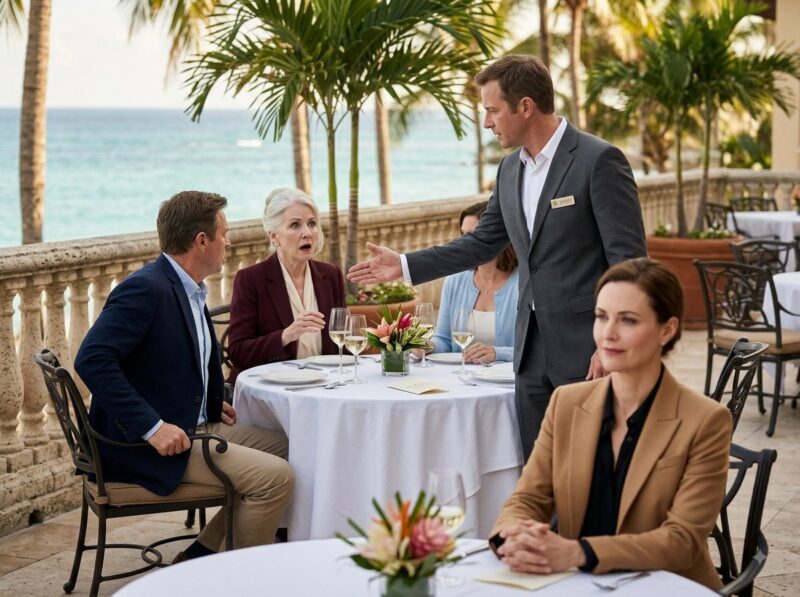
Half an hour later, the resort director crossed the room, passed every other guest, and stopped beside my chair.
“Ms. Duarte, your private suite is ready.”
Then he turned toward my family.
“As for your reservation,” he said calmly, “would you like to explain the problem, or should I?”
The invitation had arrived exactly the way my mother liked everything: heavy cream paper, raised gold lettering, far too much empty space, because Doña Beatriz believed even stationery should look more important than the people receiving it.
My full name appeared on the front: Camila Duarte.

Her handwriting was elegant and precise. It looked beautiful, unless you’d spent a lifetime recognizing how much judgment could hide inside every perfect curve.
I opened the envelope in my kitchen in Monterrey. Valentina’s lunchbox was half packed. Her pink bottle had leaked onto a dish towel. The school bus would arrive in four minutes.
Valentina sat at the counter, one sock on, the other in her hand.
“Is it bad mail?” she asked.
“It’s from Grandma Beatriz.”
“So, yes?”
I almost laughed.
“It’s an invitation to a family reunion.”
“Is it fancy?”
“Painfully fancy.”
The gathering would be held at the Cumbre Verde resort, an exclusive retreat among the green hills of the region. My mother had undoubtedly chosen it because the name sounded expensive enough to impress people before they even arrived. The property had pale stone terraces, exposed timber ceilings, private dining salons, a spring-fed pool, and a reservation list long enough to make every guest feel specially selected.
The invitation repeated the word “exclusive” so many times I considered counting them.
At the bottom, my mother had written a note by hand: “Please dress appropriately. This is not an informal venue.”
Valentina sounded out the sentence.
“Does that mean I can’t wear sneakers?”
“It means your grandmother distrusts comfortable shoes.”
She examined her mismatched socks.
“Then she’d definitely distrust me.”
The funny thing was, my mother was right about one detail: Cumbre Verde was not informal.
It was also mine.
I had bought the resort two years and three months earlier through Meridian Crest Group, my company. My relatives knew nothing because they’d never cared enough to ask the right questions. They preferred the version of me that fit neatly into their assumptions: a single mother living in Monterrey, a woman who did “something in hospitality,” someone who owned “a few little properties,” as Doña Beatriz liked to explain, as though I spent my days collecting late rent from struggling tenants.
My brother Andrés once asked whether my “little real estate experiment” was still operating. My aunt Marisol sincerely believed I decorated vacation rentals. My cousin Daniela suggested I’d make better connections if I ever hoped to understand luxury hospitality, while posting photos from expensive vacations she could barely afford.
I never corrected them. Only a handful of people knew the truth: Renata had been beside me from the beginning. Licenciado Héctor knew because he handled my contracts. Tomás Fuentes knew because I had personally hired him to run Cumbre Verde. That was enough. Silence can be a form of protection, especially around people who refuse to hear you unless achievement arrives accompanied by a large check and a public announcement.
I founded Meridian Crest Group at twenty-six, with the equivalent of forty thousand dollars, a used laptop, and a fierce determination not to become the limited version of me my mother had always predicted.
Cumbre Verde was the project that nearly broke me. The first time I saw it, rain drifted across the hills in thin grey curtains. The place smelled of cedar, dust, and money that had faded slowly over time. But beneath the neglect, the place was extraordinary. I knew immediately what color the entrance should be: slate green. I knew that before I knew almost anything else.
When the broker stepped outside to take a call, I stood beside the neglected pool and cried. Not because the property was beyond saving. Because I could already see what it might become.
Then I bought it.
When Cumbre Verde reopened, the waiting list reached three months almost immediately. The following year, several travel publications named it among the finest boutique resorts in the region. That same week, my mother forwarded me a long article praising Andrés’s promotion.
Still, I said nothing.
After reading the invitation, I folded it carefully. Valentina kept watching me.
“Are you going?”
“Yes.”
“Will they be mean?”
I set the envelope on the counter.
“They’ll probably behave exactly as they always do.”
“So, yes.”
I looked at my daughter, toast crumbs still on her chin, with more understanding in her eyes than any seven-year-old should need to have. I wanted her to inherit none of the shame, comparison, or quiet cruelty that had shaped my childhood.
She slid off the stool and hugged me.
“You should wear the blue dress,” she said.
“Which blue dress?”
“The one that makes you look like you own important things.”
“I do own important things.”
“I know. That’s why you should wear it.”
But I didn’t. I chose a plain beige linen dress, flat sandals, and small gold earrings that caught the light without asking to be noticed. I arrived looking exactly like the woman my mother expected to dismiss. Exactly like the daughter my relatives believed had never accomplished much.
That was deliberate.
Because before I showed them who I really was, I wanted to find out exactly who they were willing to be.
That afternoon, when Tomás walked up to the table and said those words in front of everyone, I watched the color drain from my mother’s face for the first time in my entire life. My aunt Marisol dropped her wine glass. Andrés stood up so fast he knocked over his chair.
“What is he talking about?” Doña Beatriz stammered.
I stood up calmly.
“Tomás runs the resort I bought two years ago, Mom. So if you have any problem with your reservation, I’ll be happy to resolve it myself, as the owner.”
The silence that followed lasted almost a full minute. Finally, my aunt Marisol whispered, “You always knew… and you never said anything?”
“You never asked,” I replied. “You only assumed.”
That night I dined alone in my private suite, looking out at the sea, while my family tried unsuccessfully to sort out a bill that suddenly seemed much more expensive than they remembered. I didn’t kick them out of the resort. I didn’t need to. I simply left them sitting there with the discomfort of having spent a lifetime underestimating the wrong person.
The next day, as I packed to head home with Valentina, my phone buzzed. It was a message from my mother: “We should talk.”
I smiled, put the phone away, and took my daughter’s hand.
“Are we going home?” Valentina asked.
“We’re going home,” I answered. “And this time, we’ll decide when to talk to Grandma. Not the other way around.”