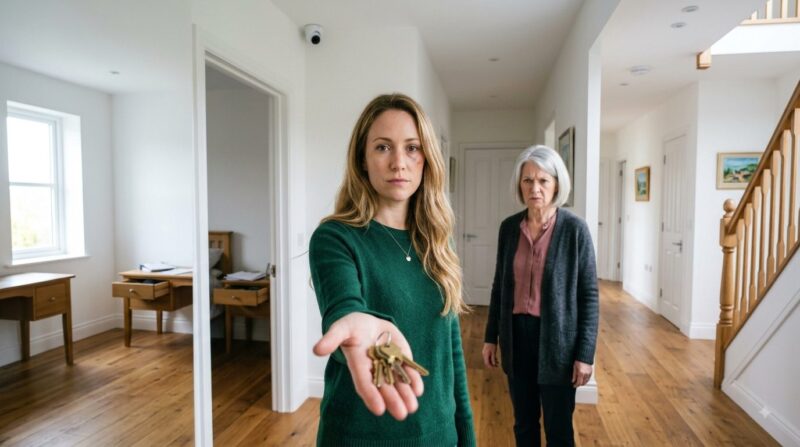
My mother-in-law hurled a heavy ring of house keys directly at my face after I told her she could no longer enter our bedroom whenever she wanted. “This is my son’s house,” she snapped. The keys struck just below my eye, leaving an angry red mark across my cheek.
I bent down, picked them up from the floor, and calmly extended my hand toward her. “Then I suppose you won’t be needing these anymore,” I said.
By that afternoon, every exterior lock had been changed. And there was only one name on the property deed. Mine.
I bought the house three years before marrying Rodrigo. My grandmother, Rosa, left me an inheritance when she passed, and I used part of it for the down payment. Everything was in my name. Rodrigo knew that from the beginning.
Six months earlier, a plumbing problem had damaged my mother-in-law Silvia’s condo. She asked to stay with us temporarily. “Two weeks,” she promised. It became six months, and at some point, she decided she’d become a permanent resident.
That morning, when Silvia threw the keys at me, something finally became clear. She no longer considered herself a guest. She believed she had rights in my home.
At first, Silvia’s behavior was just annoying. She walked into our bedroom without knocking. She rearranged my closet shelves because she said they were “more practical” her way. She moved personal items on my dresser.
Then things got more serious. Twice I noticed folders with financial documents had been moved on my desk. I asked her about it. She denied touching anything. Rodrigo told me I was probably imagining it.
That’s when I installed security cameras in the shared hallways. I didn’t hide them. There were no secret cameras. Both Silvia and Rodrigo knew exactly where they were.
Rodrigo called it unnecessary. Silvia called it insulting. I called it documentation.
The house was far more than property to me. My grandmother had raised me after I lost my parents. She had given me stability when everything else in my childhood fell apart. The inheritance she left me wasn’t just money. It was the final protection she’d managed to give me.
Rodrigo knew exactly what that property meant. At our wedding, he’d even joked about it: “I married you, not your house,” he told everyone. People laughed. I laughed too. But somewhere between our wedding day and his mother moving into our guest room, that joke seemed to become something else. Resentment. Entitlement. Maybe even jealousy.
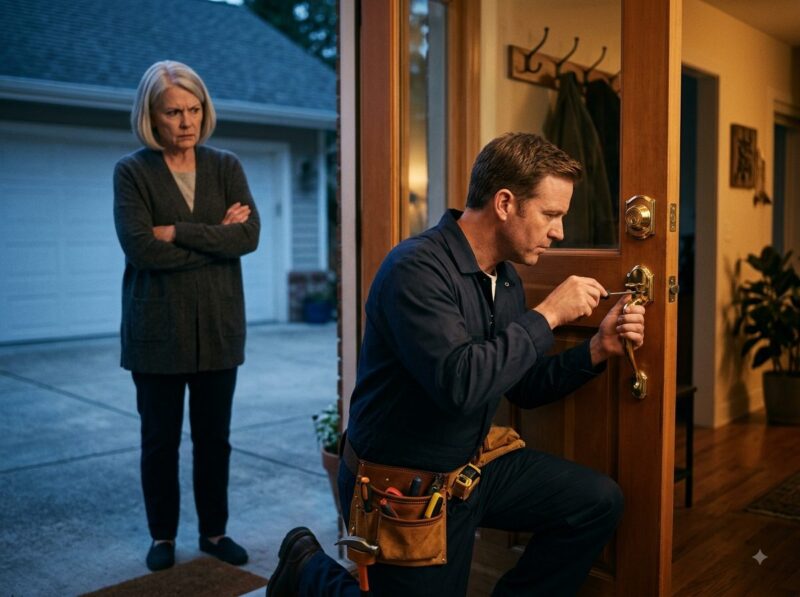
I called a locksmith that same afternoon. I showed him my ID along with the deed confirming I was the sole legal owner. He changed the front door lock. Then the back one. Then the side one. Finally he reset the electronic keypad.
Silvia stood in the driveway through the whole process, arms crossed. She looked furious.
When the locksmith finished, he asked how many copies of the new key I wanted.
“Two,” I said. One for me. One for my husband. None for Silvia.
She gave me a smug smile.
“That doesn’t matter,” she said. “Rodrigo will just give me his.”
I turned to her. “Then Rodrigo will be making a very clear choice.”
Her smile faded slightly.
Rodrigo got home shortly before dinner. The moment he walked in, his eyes went to my face. The red mark near my eye was still visible. Then he looked at his mother.
“You shouldn’t have thrown anything at her,” he said.
For half a second, I felt relief. I thought he was finally going to stand up for me.
Then he added: “But changing every lock seems like an extreme reaction.”
I stared at him. Six years together. Years of sharing a life. And somehow, after seeing the mark on my face, his first concern was whether I had overreacted.
He didn’t ask if I was hurt. He didn’t ask why his mother had been going through my desk. He didn’t ask why she believed she had the right to walk into our bedroom whenever she pleased. Instead, he was worried about the locks.
I reached into my pocket and placed a new key in his palm.
“This lets you into your home,” I said quietly. “But it doesn’t give your mother permission to walk into our bedroom. It doesn’t give her permission to go through my belongings. And it absolutely does not give her permission to make herself a copy.”
Behind him, Silvia’s expression hardened. Rodrigo looked down at the key in his hand. No one spoke. Then, very slowly, his fingers closed around it.
That simple movement told me more than all his careful words had.
I gave Rodrigo a one-week deadline to decide whether his mother would move to her own place, or whether our marriage needed a serious pause. On the third day, without telling me, he gave Silvia a spare key he’d had made himself.
When I found out — thanks to the cameras both of them knew existed — I didn’t yell or argue. I simply called a real estate lawyer, and two weeks later filed for separation, citing as legal grounds the fact that he had repeatedly ignored clear boundaries inside a property that had never legally been his.
Today I live alone in my grandmother’s house, with new locks only I control, and with the certainty that protecting my boundaries, even though it cost me my marriage, was the right decision. Silvia and Rodrigo now share a small apartment, and according to mutual friends, she still complains that the doors “aren’t as good as the old ones.”