He dragged her by the wrist as if she were an object.
Emma didn’t scream. She had learned long ago that screaming was useless with Alejandro.
The salon door flew open. He entered first, pulling her behind him, and Emma’s hair —which reached the floor on all sides, front and back, the same length everywhere, like a living curtain— swept across the marble behind them.
The salon froze.
Scissors in the air. Conversations interrupted. Eyes that didn’t know where to look.
Alejandro paid no attention to any of them. He located the person in charge, looked at him directly, and spoke without raising his voice.
“Cut her hair. All of it.”
Emma’s head was bowed. Her dress, dirty and torn at the shoulder, barely moved. She had spent months without lifting her eyes in front of him.
The young man in the black apron took a step toward her.
Not toward Alejandro.
Toward her.
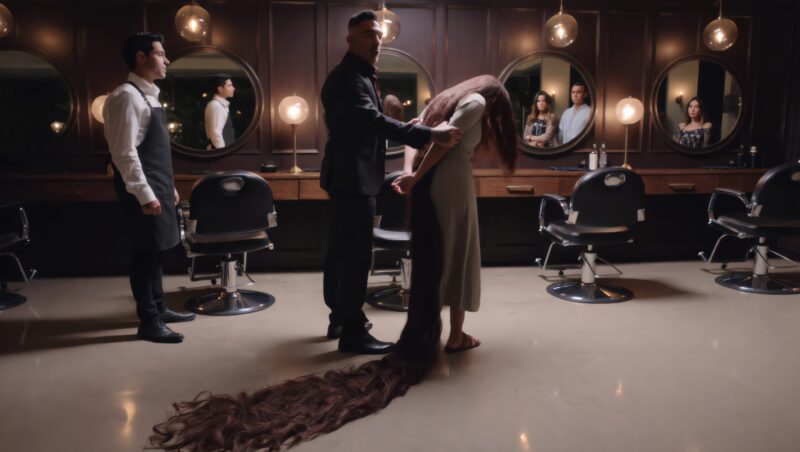
His name was Marcos.
Nobody knew it in that moment, but they would remember it afterward.
He approached Emma with the same calmness with which one approaches something fragile. Unhurried. Without looking at Alejandro for permission. He pulled a chair in front of her, crouched slightly to bring himself to her level, and spoke to her quietly, as if they were the only two in the room.
“Please sit. I’ll take care of it.”
Emma took a moment. Then she sat.
Alejandro crossed his arms. His tattoos were visible on the backs of his hands, dark as old warnings. He said nothing. He waited.
Marcos paid him no attention.
With both hands, very slowly, he moved Emma’s hair away from her face. She tensed for an instant — that reflex of someone not accustomed to being touched with care — and then, without being able to stop it, a tear fell.
Just one.
Marcos didn’t acknowledge it. He did nothing with it. No special gesture, no words of comfort. He let it be. Sometimes that is the most you can do for someone: let what they feel exist without turning it into something that needs to be fixed. He kept working.
He took a wide-tooth comb and started at the ends, slowly, without pulling. Emma’s hair was extraordinary. All the same length. Reaching the floor in front, behind, on the sides — a single uniform curtain that had grown without anyone tending to it for a very long time. It had knots, but it also had something else: the memory of a person who had once mattered.
Marcos worked for what felt like a long time and wasn’t. Each strand treated as if it were worth something. No abrupt movements. No sighs of impatience. Just his hands and the comb and the silence.
Emma didn’t cry again. But she didn’t leave either.
The salon remained silent.
Nobody left. Nobody spoke. The clients sitting in their chairs didn’t ask for their own services to continue. They just watched.
Alejandro watched too.
And something in his expression — barely perceptible, almost imperceptible — had changed. He had arrived with a plan. He was watching something that was not in the plan. He couldn’t name what he felt watching the young man work with that patience on Emma’s hair. It wasn’t regret. Not yet. But it was something that looked like remembering that people have a before.
Marcos finished combing a section and picked up the scissors.
He paused.
In the round mirror in front of them, Emma had lifted her eyes for the first time.
She didn’t look at him. She looked at herself.
And Marcos, watching her through the reflection, saw something he would not forget: the exact moment when someone remembers they exist.
The scissors were open. The hair between his fingers, ready.
Alejandro saw it too.
And that was when he did something nobody expected.
He took a step toward the door.
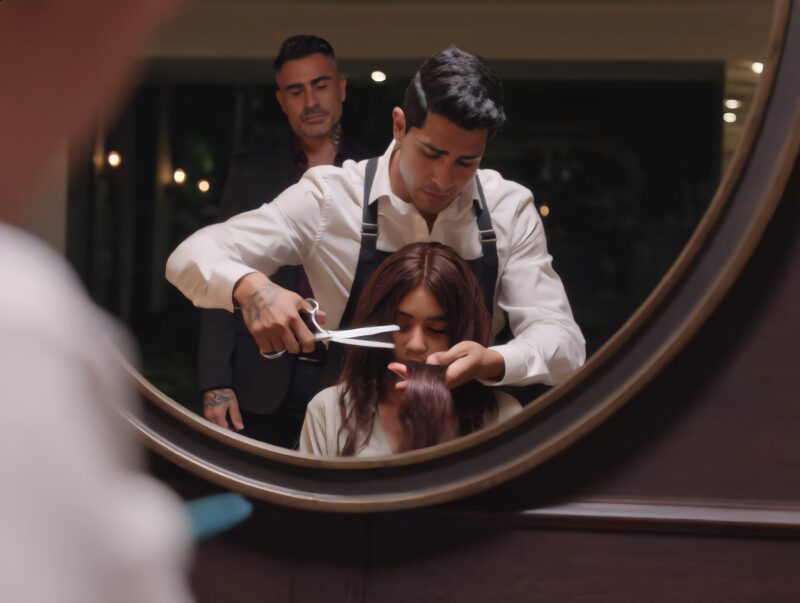
He said nothing. Gave no explanation. He simply walked to the entrance of the salon and stood there with his back turned, looking outside, as if he suddenly needed to see the street.
Marcos waited one second.
Then he cut.
The first lock fell to the floor like something that had been waiting too long to fall. Emma closed her eyes. Her hands, resting in her lap, opened slowly, like flowers.
When the salon closed that night, Marcos swept the floor for twenty minutes.
When he finished, he picked up a lock of hair from the pile, held it for a moment, and put it in the pocket of his apron.
He didn’t know why he did it.
He only knew it was important.
Three weeks later, a woman walked into the salon. She had short hair, clean, well-kept. She was wearing new clothes. She sat in Marcos’s chair without anyone calling her and looked at him in the mirror.
It took him a moment to recognize her.
She said nothing. She just smiled.
And Marcos understood that sometimes the most important work you do looks nothing like work.