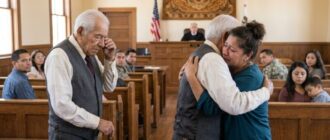
The music stopped when an eight-year-old boy burst into Madrid’s most luxurious ballroom.
Missing one shoe, his shirt wrinkled and his eyes filled with tears, Mateo ran toward a woman sitting in a wheelchair.
“Ma’am, he’s lying!”
Alejandro, Sofía’s husband, grabbed the boy roughly by his shirt.
“You don’t know what you’re talking about!”
But Mateo refused to back down.
“I saw him switch your pills! The doctor said you could already stand up!”
Sofía turned pale.
For eighteen months, Alejandro had repeatedly told her she would never walk again. She had trusted him more than anyone.
“Alejandro… what have you been giving me?”
Her husband said nothing.
Then Sofía placed both hands on the wheelchair’s armrests. Her legs began to tremble.
And in front of two hundred guests, she tried to stand for the first time in months.

The silence that settled over the ballroom was so profound that Sofía could hear her shoes brushing against the marble floor.
Her legs shook violently. A sharp pain shot through her right knee, and for a moment she thought she would collapse.
But she didn’t.
Gripping the wheelchair’s armrests, she struggled to breathe and managed to remain standing for three seconds.
Three seconds that shattered eighteen months of lies.
“Sit down immediately,” Alejandro ordered, rushing toward her. “You’re going to hurt yourself.”
Sofía looked at him as though she were seeing a stranger.
“Don’t touch me.”
Her voice was barely audible, yet everyone heard.
An older woman in a cobalt-blue dress hurried forward. It was Elena, Sofía’s sister.
“I’m here,” she whispered, supporting her around the waist.
Together, they helped Sofía sit safely.
Alejandro tried to regain control.
“My wife is confused. That child entered without permission and is making ridiculous accusations.”
“Then you won’t mind if we call her doctor,” Elena replied.
Alejandro froze.
Mateo, standing beside a table, raised his hand.
“I know where the real pills are.”
Every face turned toward him.
The Secret Behind the Closed Door
Eighteen months earlier, Sofía had been seriously injured in a car accident. Her pelvis was fractured, and several nerves in her legs were damaged.
The first months were devastating. She underwent surgery, intensive rehabilitation, and needed help with tasks she had once performed effortlessly.
Alejandro appeared to be the perfect husband.
He prepared her meals, accompanied her to appointments, and managed her medications.
When doctors began discussing a promising recovery, he requested that subsequent consultations be held privately.
Soon afterward, he delivered crushing news.
“The specialists have confirmed you’ll never walk again.”
Sofía cried for days.
What she didn’t know was that her doctors had never said those words.
Dr. Clara Montes, her rehabilitation specialist, had documented progressive neurological recovery and recommended supervised standing exercises.
Alejandro had concealed the report.
Mateo knew part of the truth because his mother, Rosa, worked as a cleaner at the Valcárcel mansion.
One afternoon, while waiting for her shift to end, he overheard an argument behind the study door.
“She’s recovering too quickly,” Alejandro said into his phone. “I need another six months. Then we’ll sign the sale.”
Mateo didn’t understand what sale he meant.
Two days later, he watched Alejandro remove capsules from a bottle bearing Sofía’s name and replace them with pills from an unmarked box.
Alejandro never noticed the boy hiding behind the half-open door.
Mateo told his mother.
Rosa went pale.
“Stay away from that office,” she warned. “I’ll handle it.”
But before she could speak to Sofía, Alejandro fired her without explanation.
What Alejandro Really Wanted
Sofía had founded a successful medical technology company long before meeting her husband.
After the accident, she signed a temporary power of attorney allowing Alejandro to manage her affairs during recovery.
The arrangement was supposed to be reviewed once she regained sufficient independence.
That was exactly what Alejandro feared.
For months, he had secretly negotiated the sale of a vital division of the company to an investment group connected to his business associates.
The deal would generate millions in hidden commissions.
If Sofía resumed making decisions, she would discover the scheme and stop it.
So Alejandro falsified medical reports, intercepted communications, and replaced some of her prescribed medication with substances that caused drowsiness and weakness.
He didn’t want his wife dead.
He wanted her dependent.
Evidence Nobody Expected
Back in the ballroom, Alejandro tried to escort Mateo through a side door.
“That boy needs to go home.”
“The boy stays,” Sofía declared.
Elena called the police and an ambulance.
Mateo approached Sofía and pulled an old phone with a cracked screen from his pocket.
“My mom recorded this before he fired her.”
On the screen, Alejandro appeared inside his study.
Rosa had recorded him from the hallway after returning to collect her handbag.
The footage showed him opening the medicine cabinet, removing Sofía’s bottle, and changing its contents.
The recording alone could not establish what the capsules contained, but it was enough to justify an investigation.
Alejandro lunged for the phone.
A security guard blocked his path.
“Don’t take another step, sir.”
For the first time that evening, Alejandro looked frightened.
The Medical Truth
At the hospital, specialists conducted blood tests, reviewed the original prescriptions, and examined the medication recovered from the mansion.
The results confirmed the presence of a sedative that had never been authorized as part of Sofía’s treatment.
They also discovered that some prescribed doses had been altered.
Dr. Montes came personally.
“Sofía, I never told your husband you wouldn’t walk again,” she explained. “Quite the opposite. Your last evaluation showed significant progress.”
Sofía closed her eyes.
She remembered every night Alejandro had told her to accept her fate.
Every time her legs had felt impossibly heavy.
Every occasion when she had begged to return to rehabilitation, only for him to insist it would be pointless.
“He made me believe my body had abandoned me,” she whispered.
“Your body was trying to recover,” the doctor answered. “And there’s still work ahead.”
The Perfect Husband’s Downfall
Financial investigators uncovered secret contracts, suspicious transfers, and falsified documents.
Rosa testified. Mateo also described what he had witnessed, supported by his mother and trained child-interview specialists.

Alejandro was arrested and, following trial, convicted of offenses involving fraudulent management, document forgery, and interference with Sofía’s medical treatment.
The illegal contracts were voided, and Sofía regained control of her company.
But her most important victory happened far from the courtroom.
Over the following months, she returned to rehabilitation.
At first, she could stand for only a few seconds with assistance.
Then she learned to shift her weight between her legs.
Eventually, she took one step between the parallel bars.
Then another.
It wasn’t an instant miracle. There was pain, exhaustion, setbacks, and days when she wanted to quit.
But nobody was hiding the truth from her anymore.
One Year Later
On the anniversary of the gala, Sofía hosted a much smaller celebration.
There were no speeches about enormous business deals and no guests interested in her fortune.
Only family, friends, and people who had stayed beside her.
Mateo arrived with his mother, wearing a new shirt and red sneakers Sofía had given him.
“Do you still remember what I told you?” he asked shyly.
Sofía smiled.
“I remember every day.”
Then she rose from her wheelchair with the help of a cane and slowly walked toward him.
Mateo’s eyes widened.
“You’re walking!”
“A little more every day,” she replied.
She hugged him while Rosa wiped away tears.
Sofía then handed Rosa an envelope containing an offer of stable employment at a foundation she had just established to help patients who couldn’t afford rehabilitation.
There was also an educational scholarship for Mateo.
“You don’t have to do this,” Rosa whispered.
“I know,” Sofía answered. “But I want to.”
That evening, after everyone had left, Sofía looked at the wheelchair beside the window.
She didn’t hate it. The chair had supported her when she needed it most.
What she hated was the lie someone had built around her.
She picked up a photograph of Mateo and smiled.
A child nobody wanted to listen to had found the courage to speak the truth.
And because of him, Sofía had regained more than the possibility of walking.
She had regained her life.