It was the most elegant party of the year. Warm lights, laughter, champagne. Sofía, ten years old, was bored among adults who didn’t notice her. She walked up to the Bluetooth speaker and turned it off, just out of curiosity.
Silence fell over the garden.
And then she heard it.
A cry. Weak, muffled, desperate. Coming from the dark shed at the back of the garden — the one that was always locked with a padlock.
“Dad,” Sofía whispered, pulling his arm. “There’s someone in there. They’re crying.”
Marcos frowned. Elena stopped smiling.
The three of them ran toward the shed. Sofía arrived first, as always. She pressed her ear against the door and closed her eyes. The crying was real. It was a woman. And she sounded exhausted — like she had been waiting a long time for someone to finally listen.
Marcos picked up the hammer from the ground.
“There’s someone inside,” he said, with a calm that made your blood run cold.

The first blow cracked the glass. The second shattered it completely.
Marcos reached through the broken shards, ignoring the pain, and unlatched the bolt from inside. The door creaked as it swung wide open, and the evening light flooded into the darkness of the shed.
What they saw left them speechless.
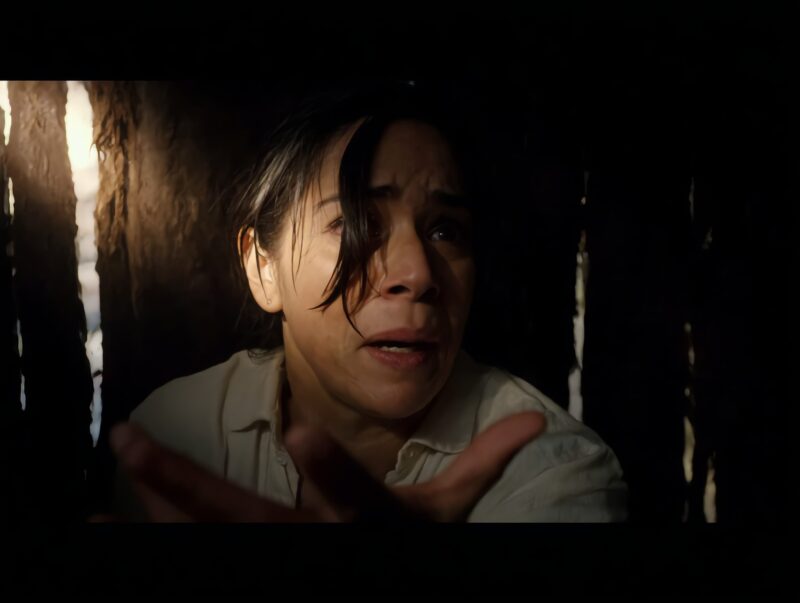
On the floor, curled up against the far wall, was a woman. She looked about fifty, though in that moment she seemed much older. She was wearing a crumpled, dirty white blouse. Her black hair fell in damp strands across her face. Her eyes were wide open, red from crying, and her lips were cracked from thirst. She raised one trembling hand toward them.
“Please,” she whispered. “I need help.”
Elena pressed both hands to her mouth. Marcos couldn’t move. Sofía, however, took a step forward.
“You’re safe now,” the girl said, with a certainty no adult could have faked.
The woman’s name was Carmen. She was fifty-two years old, a neighbor from the area, and no one had missed her because she lived alone since her son had gone abroad to study. She had entered the shed three days earlier, looking for some tools she had lent to the homeowners. The door slammed shut in the wind. The padlock, which had been hanging on the outside, caught by itself.
Three days.
Three days screaming while the party continued on the other side of the garden. Three days with the music drowning out her voice. Three days without water, without food, without anyone at that elegant party stopping long enough to listen.
Only a girl who turned off the music out of curiosity.
Marcos called emergency services. An ambulance arrived in less than twenty minutes. Carmen was dehydrated but stable. The doctors said that if she had spent another night in there, the outcome would have been very different.
At the hospital, while Carmen rested connected to an IV drip, Sofía sat beside her in silence, without anyone asking her to.
“Why are you staying?” Carmen asked, her voice still hoarse.
Sofía shrugged.
“Because I already heard you once,” she said. “I don’t want you to stop hearing someone.”
Carmen closed her eyes. For the first time in three days, she wasn’t crying.
Marcos, from the doorway of the room, watched his daughter and didn’t know what to say. Elena took his hand in silence.
There are things adults learn to ignore over the years: background noise, distant cries, signals that don’t fit the moment. We learn to filter the world so it doesn’t interrupt us. So the party can go on.
Children haven’t learned that yet.
And sometimes, that ignorance makes them the only ones capable of saving a life.
Three weeks later, Carmen knocked on the Vidal family’s door. She brought a homemade cake and a handwritten letter that had taken her several days to write. She handed it directly to Sofía, without going through the parents.
The letter read:
“Some people listen with their ears. You listened with your heart. Thank you for not keep dancing.”
Sofía read the letter twice, folded it carefully, and kept it in the drawer of her bedside table, beneath the book she was reading.
That night, before going to sleep, she asked her mother to turn off the music from the living room.
“I just want to hear if there’s anything else,” she said.
Elena turned off the music. The two of them sat in silence for a moment.
There was nothing else to hear. Only the wind, and the crickets, and the quiet breathing of the house.
But Sofía smiled anyway.
Because now she knew that silence wasn’t empty. It was the place where the things that mattered lived.