They shoved her into the room and locked the door behind her.
Sofía stood motionless in the center of the concrete enclosure, barefoot on the cold floor, blood sliding down her forehead from a cut they had made two hours earlier.
Then she heard them.
Two black Cane Corsos appeared from opposite sides of the room, moving toward her with their teeth bared and a low growl that reverberated off the cement walls.
There was no way out.
On the balcony above, a dozen men watched in silence. And among them, hands gripping the metal railing, eyes overflowing with terror, was her father.
Sofía took a deep breath.
When she opened her eyes again, the dogs were less than two meters away.
She raised her hand very slowly, palm facing down.
The dogs didn’t stop.
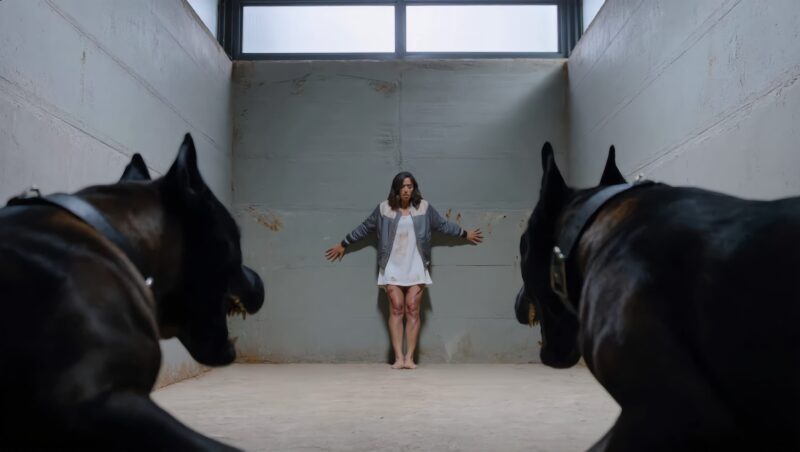
Sofía didn’t look away.
She didn’t scream. She didn’t back up. She didn’t close her eyes.
Her feet were planted on the cold concrete and her hand was extended with a calm she herself didn’t understand. A calm that didn’t come from courage or resignation. It came from something deeper, from a place inside her that had always existed but that she had never before needed to use.
She had spent the last three days locked in a room with no windows. They had given her water once a day. They had explained very few things to her, and none of them were good. But at some point during those endless hours, while she listened to footsteps on the other side of the door and voices discussing in low tones what they were going to do with her, Sofía had made a decision. She was not going to die with fear on her face. If she was going to die, she was going to die standing up.
The dog on the left stopped first.
It wasn’t an abrupt halt. It was a slow deceleration, almost confused, as if something in its instinct had received a signal that contradicted all its orders. Its lips were still raised. Its teeth were still visible. But the growl dropped in intensity. And its paws stopped advancing.
The one on the right took two more seconds.
Then it stopped too.
Sofía didn’t move. She kept her hand in the same position, fingers slightly apart, palm facing down. She could feel her heart hammering against her chest with brutal force, but her face didn’t show it. Her face showed nothing. That was the only thing she could control.
The dog on the left lowered its head.
It approached slowly, with short cautious steps, and sniffed her hand. A long, deep sniff, as if it were reading something humans couldn’t see. Then it sat down beside her.
The second one did the same.
Above, on the balcony, there was absolute silence for three seconds.
Then the rage exploded.
The man in the center — the one who had ordered all of this, the one who had been telling her father for weeks that Sofía was a problem that needed to be solved — threw himself against the railing with clenched fists.
“¡Ataquen! ¡Ataquen ahora!”
His voice bounced off the concrete and the metal. The fluorescent lights hummed above him. The dogs didn’t move. They looked at him for a moment, then looked back at Sofía, and never looked at him again.
At the far right of the balcony, her father had stopped breathing.
When he saw the dogs sit, when he understood his daughter was still standing, he bent over the railing with both hands and began to cry silently. The tears ran down his face and he couldn’t do anything to stop them. He hadn’t slept in three days. Three days since they had called to tell him that Sofía had seen something she shouldn’t have seen, had spoken to someone she shouldn’t have spoken to, and would now have to pay for it.
He hadn’t been able to stop it.
He hadn’t been able to stop it because when they called him it was already too late. Because when he tried to negotiate they told him Sofía was not his daughter but someone else’s problem who had, unfortunately, gotten too close to him. Because in that world fathers didn’t negotiate. They only watched.
Below, Sofía watched the dogs. Both animals flanked her in silence, as if they had decided on their own which side they were on.
The man on the balcony kept shouting. His men were starting to look at each other, unsure what to do. No one had anticipated this scenario. The dogs always obeyed. Always.
Sofía looked up toward the balcony.
She searched for her father’s face among the crowd. She found him: hunched over the railing, broken, with red eyes and trembling hands.
She held his gaze.
And she gave him a gesture only he understood: an almost imperceptible movement of her head. Just once. To the right.
Toward the emergency door she had spotted when they brought her in.
The same door that, three minutes earlier, one of the guards had left unlatched.
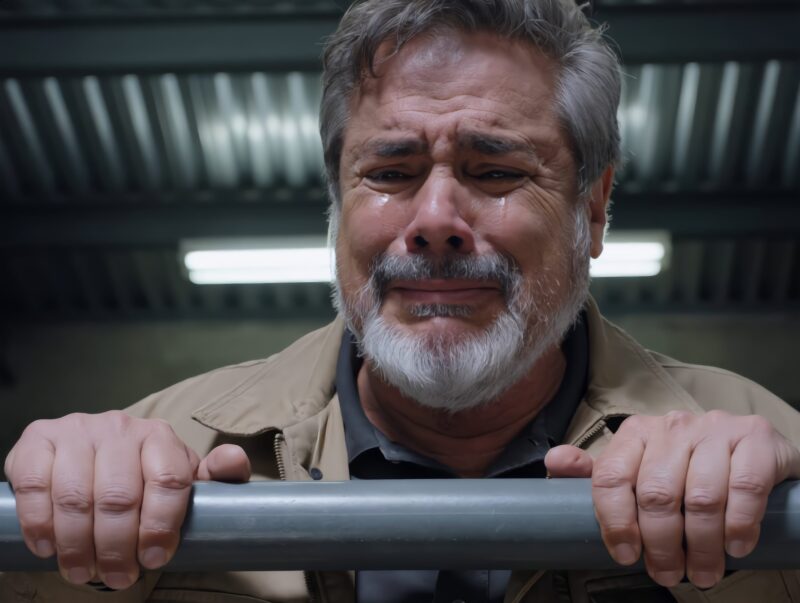
Her father understood immediately. He straightened up. He wiped his face with the back of his hand. And he began to move slowly to the side, blending into the men who were still looking down, confused by what they couldn’t explain.
The man in the center kept screaming.
The dogs still didn’t move.
And Sofía, blood still running down her face and bare feet on the cold concrete, knew exactly what she had to do next.
She looked one last time at the man screaming on the balcony. She looked at him steadily, without blinking, like someone memorizing a face so they will never forget it. Because she had no intention of forgetting it. She had a great deal to tell the world about that man and everything she had seen. That was why they had brought her here. So she couldn’t tell it.
They had made a mistake.
She waited.
Five seconds.
Ten.
And when she saw the far door open just a centimeter, with both dogs still flanking her as if they knew exactly what she was about to do, she ran.