Lucía Navarro had spent six months behind bars when she was brought, handcuffed, before a military tribunal in Madrid.
She was accused of betraying her country, falsifying reports, and causing the deaths of three soldiers during a secret operation.
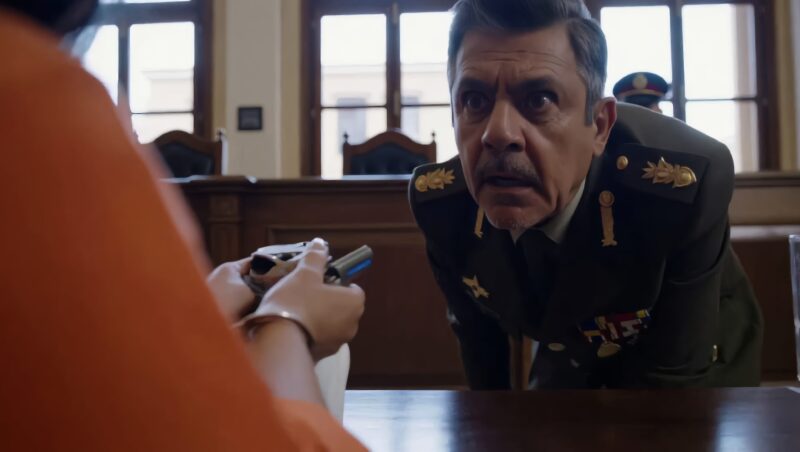
Across from her stood General Alejandro Valdés, the man who had personally signed her arrest order.
“Let the record show that the accused has no evidence in her defense!” he declared.
Lucía lowered her head. Everyone thought she had given up.
But then she slowly moved her cuffed hands toward her white sneaker.
A tiny metallic glint appeared between her fingers.
“Stop her!” Valdés shouted, leaping to his feet.
A guard approached. Lucía remained still.
“What’s in your hand?” the general demanded.
She raised a tiny dark object.
For the first time, Valdés looked genuinely terrified.
Then Lucía spoke five words that changed everything:
“My brother was never there.”
The silence that followed was so deep that Lucía could hear the courtroom lights humming.
The guard who had approached her looked to the general for instructions. Alejandro Valdés stood with one hand gripping the table, staring at the small object between Lucía’s fingers.
“Confiscate it,” he finally ordered.
“I request that it be admitted into evidence,” Lucía replied.
Colonel Isabel Roldán, the military judge, raised her hand.
“No one touches that object until we know what it is.”
Valdés turned toward her.
“Your Honor, the accused is dangerous. It could be a weapon.”
Lucía slowly opened her fingers.
The object had no blade. It was a tiny dark metal capsule with a narrow silver line at one end.
“It isn’t a weapon,” she said. “It’s the reason three men died—and the reason you’ve called me a traitor for six months.”
Six Months Earlier
Lucía was a communications specialist in the Spanish Army. Her younger brother, Daniel Navarro, worked as a civilian technician at a logistics base.
They had grown up believing that public service meant responsibility, not blind obedience. Their father, a retired firefighter, often told them that a uniform should never be used to hide a lie.
Everything changed during a humanitarian mission overseas.
A military convoy was carrying medicine and medical equipment to an isolated hospital. According to the official report, an ambush destroyed two vehicles and killed three soldiers.
General Valdés called it an unavoidable tragedy. He claimed that leaked information had exposed the convoy’s route and accused Lucía of being responsible.
Investigators produced access logs bearing her identification, messages supposedly sent from her terminal, and a digital authorization carrying her signature.
The case seemed impossible to challenge.
But Lucía remembered something that did not fit.
The night before the attack, Daniel had called her.
“Lucía, if something happens tomorrow, don’t believe the first report you read.”
“What are you talking about?”
“They changed the convoy’s route. Not for security. Someone wants it to pass through that place.”
The call ended before he could explain.
The following day, Daniel disappeared.
He was listed neither among the dead nor among the survivors. The Army insisted he had never taken part in the operation.
Three days later, Lucía was arrested.
The Hidden Message
During her first interrogations, Lucía repeatedly said that her brother had discovered something. Nobody listened.
Then one afternoon she received some personal belongings: a watch without a battery, a family photograph, and a pair of white sneakers Daniel had given her for her birthday.
Inside the box was a note in his handwriting:
“You always check the laces. This time, look behind.”
Lucía realized Daniel had managed to send her something before disappearing.
Inside the lining of the right heel, beneath a seam repaired by hand, she found a tiny capsule.
When she opened it in private, she discovered an encrypted storage module and a slip of paper covered in numbers.
The password was a date that meant everything to them: the anniversary of their mother’s death, when they had promised never to lie to one another.
During a technical review of the evidence, Lucía gained access to an isolated terminal and managed to read part of the files.
What she discovered left her stunned.
The convoy’s route had not been leaked to an enemy.
It had been changed from an office authorized by General Valdés himself.
And the vehicles had not been transporting medicine alone. One carried documents proving that funds intended for field hospitals had been illegally diverted.
Three soldiers had discovered the scheme and planned to report it.
The ambush had been arranged to silence them.
But there was something worse.
Daniel’s name appeared on a list of people detained after the operation.
Her brother might still be alive.
Lucía knew that revealing the capsule before the trial could make it disappear forever. She might never leave prison herself. So she hid it again in her shoe and waited until she stood before a judge, a court clerk, and witnesses.
The Evidence
Back in the courtroom, Judge Roldán ordered an independent forensic expert to examine the capsule.
Valdés tried to intervene.
“This is classified military information. I demand a closed hearing.”
“Classification does not authorize the destruction of evidence,” the judge replied.
The expert removed the metal casing and connected the memory module to a forensic computer disconnected from external networks.
A password request appeared.
Lucía recited the numbers.
A directory opened, revealing files, communication logs, and dated recordings.
The first document showed the convoy’s original orders. The second revealed the route change made just hours before the ambush.
Both carried verifiable digital signatures.
The third recording made Valdés reach for his collar.
It was his own voice.
“The three of them have seen the documents. If they reach the hospital, they’ll talk. Change the route. The problem must end tonight.”
The judge stopped the playback.
“General Valdés, do you recognize your voice?”
“It’s a forgery.”
The expert spoke.

“The recording retains original metadata and matches system records. I cannot establish definitive authenticity at this moment, but there are no immediate signs of manipulation.”
Lucía pointed to another file.
“Then play the last one.”
Daniel appeared on the screen, seated in a windowless room. His face was bruised, but he was alive when the video was recorded.
“My name is Daniel Navarro. I’m being held at an unregistered military facility. If anyone finds this, search warehouse seventeen at the former San Gregorio base. Two other people are here with me.”
The recording was four days old.
Lucía began crying silently.
For six months she had imagined her brother buried somewhere unknown. Now she had a location—and a real chance of finding him.
The General’s Final Order
Valdés realized he could no longer control the situation.
He moved quietly toward the exit, but two military judicial police officers blocked the doorway on the judge’s orders.
“General Alejandro Valdés,” Roldán announced, “you are being provisionally detained in connection with serious suspected offenses. All records will be preserved, and the location identified in this evidence will be investigated immediately.”
Valdés looked at Lucía.
“You have no idea what you’ve done.”
“Yes,” she answered. “I’ve stopped being afraid of you.”
That same afternoon, a judicial and police team searched warehouse seventeen.
They found Daniel and two other witnesses alive. Although weak, they identified the people who had held them captive and supplied further documents.
The investigation continued for months. Investigators examined contracts, bank transfers, operational orders, and official communications.
The records established that Valdés had led a corruption network and arranged the ambush to prevent the three soldiers from exposing the diversion of funds. Several accomplices were also prosecuted.
Lucía was acquitted of every charge. Her record was cleared, and authorities publicly acknowledged that the evidence against her had been fabricated.
Following a trial with full legal safeguards, Valdés was convicted of the offenses proven against him.
One Year Later
On the anniversary of the operation, Lucía and Daniel visited a small memorial honoring the three fallen soldiers.
She placed three white flowers beside their names.
Daniel was carrying the old sneakers that had helped expose the truth.
“Are you going to keep them forever?” he asked.
“Only one,” Lucía said with a smile.
“Why just one?”
“Because I want to donate the other to the museum that will tell this story. People deserve to know that even the smallest piece of evidence can bring down an enormous lie.”
Daniel embraced her.
For months, the country had known Lucía Navarro as a traitor.
Now it remembered her as the woman who, handcuffed and surrounded by people determined to silence her, had refused to surrender.
And the object the general had mistaken for a threat had never been used to hurt anyone.
It had been used to give people their freedom back.