The day the prince was to choose his teacher, the castle courtyard had never shone so bright. Fifty nobles dressed in velvet and gold stood in line, each holding a jeweled chest of credentials. The king spread his arms wide from the top of the stairs. Fanfares rang between the towers.
The prince walked slowly down the aisle of honor. He stopped. He turned.
And he walked toward the corner of the courtyard where no one was looking.
There, against the cold stone, sat an old man with wild white hair and a long beard. Worn robes. Cracked hands. Invisible to everyone.
The prince stood before him, looked into his eyes, and spoke aloud — loud enough to reach the king:
«Father, I want that man as my teacher.»
The silence that followed lasted three seconds. Then the golden chests began to fall.
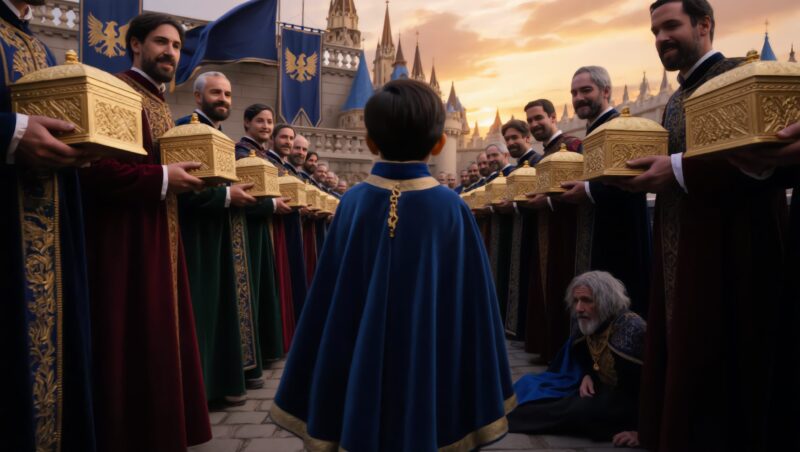
The chests hit the cobblestones like golden thunder. Coins and jewels scattered in every direction, glinting in the afternoon sun. The nobles stood with arms still outstretched, mouths open, eyes wide, unable to move a single muscle.
The king descended three steps. Only three. And stopped.
«To a beggar?» — his voice echoed across the courtyard —. «Why?»
The prince did not turn immediately. He first looked at the old man. The old man looked at him. And in that silent exchange there was something no witness could quite describe afterward: a kind of recognition. As if the two had known each other somewhere that was not this courtyard, not this kingdom, not this time.
Then the prince looked up at his father and answered with the calm of someone who had been preparing a single sentence for weeks:
«Because he gives the little that he has.»
The king frowned. Too simple. Too small for this setting, for these banners, for these carved stone stairs. He was about to speak when one of the chamberlains pointed toward the corner.
«Your Majesty. Look.»
In that same corner, beside the old man, was a child no one had noticed. A boy of no more than five, lying on the cold cobblestones, cheek pressed against the stone. Sick. Alone. Completely invisible to the entire court.
And the old man — that man with nothing, that man who had nowhere even to sleep — had laid his only cloak over him. The only cloth that stood between himself and the cold. He had removed it from his own shoulders in silence, while everyone was watching the golden chests, while no one was watching the corner.
The king said nothing for a very long time.
Then he descended the rest of the steps. He crossed the entire courtyard. The nobles parted without being asked. And when he reached the corner, before the old man who looked at him without fear and without hope, the king did something no royal chronicler had ever recorded.
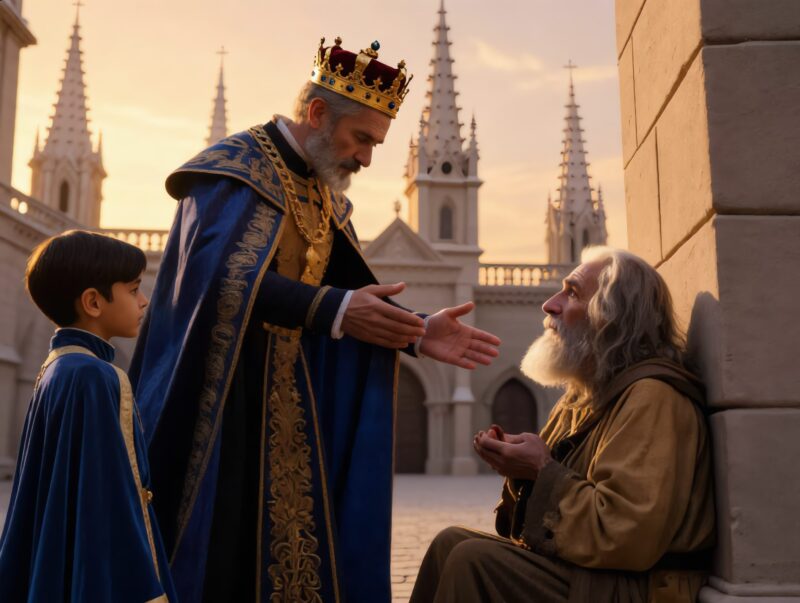
He bent his knees. Not fully. But enough. And he extended both hands.
«Rise», he said. And his voice no longer sounded like a king giving an order. It sounded like a man who had just understood something he should have known a long time ago.
The old man took the offered hands. He rose slowly, with the quiet dignity of someone who has never needed anyone’s validation to know who he is.
The king turned to his son.
«How did you know?»
The prince paused. «Because he had been coming here every afternoon for three weeks», he said. «And every afternoon he did the same thing. He gave his bread to whoever was hungry. His water to whoever was thirsty. His cloak to whoever was cold. Always without anyone watching. Always without asking for anything in return.»
He paused.
«A man who gives when no one is watching doesn’t do it to be seen. He does it because he cannot do otherwise.»
That night there was a banquet. The king, the prince, and the old man — whose name was Matthew, as they learned then, and who had been a village schoolteacher until the village ceased to exist — sat at the same table.
When the king asked what reward he wanted, Matthew thought for a moment and replied:
«A room with a window to the courtyard. So I can see if anyone needs something.»
They say the prince became the most just ruler that kingdom had seen in centuries. They say his first decree was to build in every square a fountain with fresh water and a covered bench — so that no one would ever have to sit cold against a wall without anyone noticing. And they say he had the same four words engraved on every fountain:
True nobility is this.
But what no chronicle records — what remained between the prince and Matthew through all the years they spent together — is exactly what the old man taught him.
Only this much is known: the prince, already grown, whenever someone asked what had been the most important lesson of his life, always gave the same answer:
«That greatness is not inherited. It is practiced in silence. When no one is watching.»