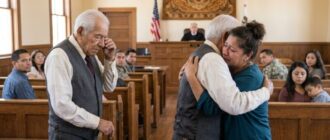
The white coffin was already positioned above the open grave when a scream shattered the cemetery’s silence.
“Wait! Don’t bury him!”
Eleven-year-old Mateo ran through the mourners, tears streaming down his face. His father, Ricardo, gently caught him by the shoulders.
“What’s wrong, son? What are you saying?”
“You have to open Grandpa Gabriel’s coffin!”
A red-haired woman covered her mouth in shock. The workers immediately stopped the burial.
“Mateo, we’ve already said goodbye to him,” Ricardo whispered.
But the boy shook his head desperately.
“You don’t understand! I heard his voice last night!”
Ricardo turned pale.
Gabriel had died three days earlier, and his coffin had been sealed since that morning.
“Where did you hear his voice?” he asked.
Mateo pointed at the coffin.
“Inside there! And he said someone was lying to us.”
Ricardo approached, placed both hands on the lid, and began lifting it.
Then he noticed something that made him freeze.
The silence was so deep that Ricardo could hear himself breathing. As he began lifting the coffin lid, he noticed a small strip of white paper trapped beneath its edge. It was not part of the flowers or funeral decorations. Someone had placed it there deliberately.
Ricardo gently pulled it free. Four words were written in handwriting he immediately recognized: “Ricardo, listen to Mateo.”
It was his father’s handwriting.
“What does this mean?” he whispered.
Behind him, his red-haired aunt Beatriz stepped backward.
“You shouldn’t touch anything. Gabriel deserves to rest.”
“Then explain how a note written by him appeared in a coffin nobody was supposed to have opened.”
Beatriz remained silent. Mateo approached his father.
“I told you, Dad.”
Ricardo knelt beside the boy.
“Tell me exactly what you heard last night.”
“I was looking for my jacket in the room where they kept the coffin. Then I heard Grandpa’s voice. He said, ‘Ricardo, don’t trust the certificate. Find the blue folder.’”
Gabriel Salazar, owner of a family construction company, had always been meticulous. Yet his death had been sudden. The previous night he had called Ricardo three times. Ricardo was in a meeting and did not answer. The next morning his father was gone.
Ricardo requested that the ceremony be suspended. The funeral director contacted the authorities so the coffin could be examined properly. Mateo stayed beside his father, tightly holding his hand.
The authorized personnel found a small recording device hidden in a decorative compartment inside the lid. Nothing supernatural had happened: the voice Mateo heard had come from the device.
Inspector Elena Vargas authorized the recording to be played as part of the investigation. Gabriel’s voice filled the room:
“Ricardo, if you’re hearing this, my suspicions were correct. There are documents someone wants to destroy. Don’t trust the certificate Beatriz gave you. Find the blue folder in my office.”
Beatriz, standing near the door, turned pale. Three days earlier, she had given Ricardo a medical document attributing Gabriel’s death to heart complications. She had also insisted on arranging the funeral quickly. Ricardo had trusted her since childhood, but now he remembered that his father and aunt had argued two weeks before the death.
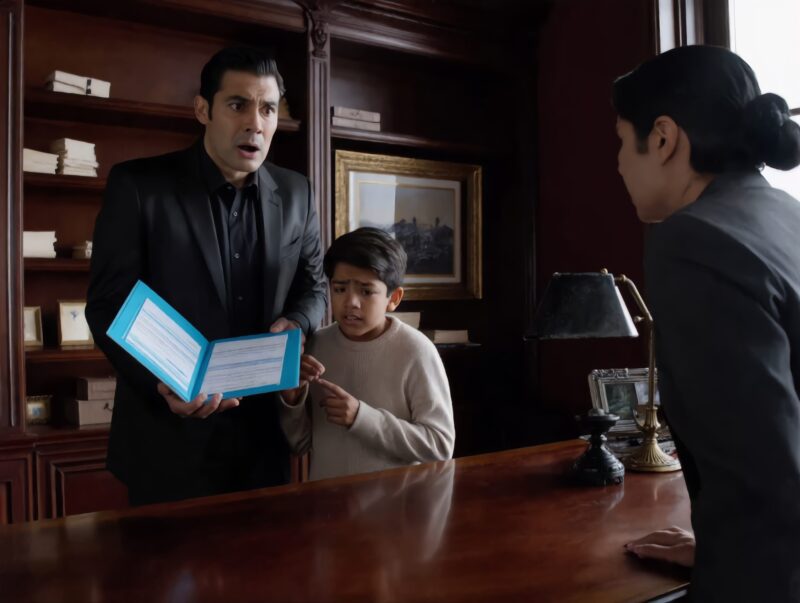
That afternoon Ricardo, Mateo, and the inspector returned to Gabriel’s house. They searched drawers and shelves for the blue folder without success. Then Mateo pointed to a painting beside the window.
“Grandpa always said he kept his greatest treasure there.”
Ricardo removed the painting. Behind it was a small built-in cabinet containing the blue folder.
It held contracts, bank transfers, and copies of signatures. For eighteen months, millions had been paid to suppliers who did not exist. Several signatures supposedly belonging to Gabriel were forged. The inspector pointed to a name that appeared repeatedly among the beneficiaries: Beatriz Salazar.
“Your father was investigating fraud,” Elena said.
The investigation revealed that Beatriz, the company’s financial administrator, had invented suppliers to divert funds. When an audit uncovered the payments, Gabriel confronted his sister and asked her to return the money. She promised to do so, but began destroying documents and pressuring employees to remain silent.
Gabriel had prepared the folder and recording to protect Ricardo. He had also requested an independent review of his medical records, fearing someone might exploit his declining health to seize control of the company. Among the documents was a message: “I don’t want my son to inherit a company built on lies. I want him to know the truth.”
Police investigated whether Beatriz had been involved in Gabriel’s death. After reviewing the original reports and interviewing healthcare workers, an independent assessment confirmed that Gabriel had died from a natural cardiac complication. There was no evidence Beatriz had caused his death. But the certificate she had given Ricardo was an altered copy that concealed relevant information. She had rushed the funeral to prevent anyone discovering the unresolved business and recording.
When Elena presented the evidence, Beatriz began crying.
“I only wanted to solve my problems. At first I took a small amount. I thought I could repay it.”
“Dad gave you a chance to make things right,” Ricardo answered. “And you chose to lie to all of us.”
Beatriz was arrested and later prosecuted for fraud, forgery, and misappropriation. Some money was recovered and other assets seized to compensate the losses. Two employees who had assisted her also faced legal consequences.
A week later, the family held another farewell ceremony. Standing beside the white coffin, Ricardo squeezed Mateo’s hand.
“Forgive me, Dad. I didn’t answer your calls,” he whispered.
“Grandpa knew you loved him,” the boy replied. “He always said you were his greatest pride.”
Six months later, Ricardo had reorganized the company, introduced independent financial controls, and created a fund for affected workers. Beneath Gabriel’s photograph he placed a plaque: “Truth is the only inheritance nobody can steal from us.”
One afternoon, Mateo found an old watch and a letter among his grandfather’s belongings. Gabriel had written: “Dear Mateo, you’ve always had the courage to speak your mind, even when adults didn’t want to listen. Never lose that courage. Remember that bravery also means asking for help and telling the truth. Love, Grandpa Gabriel.”
“Do you think I did the right thing that day?” Mateo asked.
“You did something very important. You spoke up when all of us were too sad to pay attention.”
“And can Grandpa rest now?”
Ricardo looked at his father’s photograph.
“Yes, son. Now we can say goodbye knowing the truth.”
That night Mateo placed the watch on his bedside table. He knew his grandfather had loved him deeply. And Ricardo understood something he would never forget: that day his son had not interrupted a funeral. He had prevented a lie from being buried alongside his grandfather.
THE END.