“A common servant will never be worthy of touching it!”
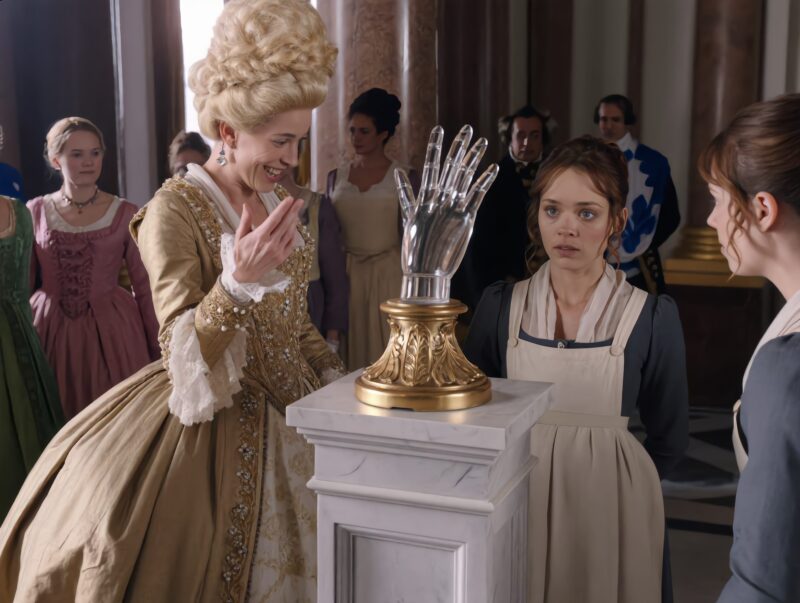
Lady Catherine’s voice echoed through the palace hall. The nobles burst into laughter as Élise, a twenty-one-year-old maid, stood motionless before a mysterious crystal hand.
Resting on a marble pedestal, the relic had been presented to the king and queen as a symbol of an ancient royal promise.
“Go on! Show everyone how ridiculous you are!” Catherine mocked.
Wearing a faded gray dress and a worn apron, Élise slowly raised her hand.
Her fingers brushed the crystal.
As she pulled away, a small scratch appeared on her palm. Then she noticed something caught in the golden base: a tiny fleur-de-lis.
She picked it up, unaware of its significance.
From her throne, Queen Isabelle saw the object.
Her face turned pale. She rose, trembling, and whispered:
“My God… That symbol belonged to my daughter.”
But the princess had been missing for twenty years.
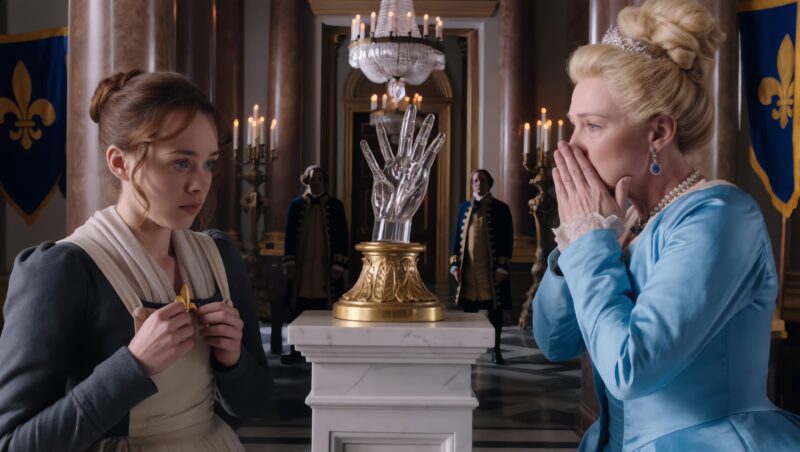
The silence was so complete that Élise could hear her own heartbeat.
Queen Isabelle slowly descended the steps of her throne. Her sapphire-blue gown swept across the marble as she approached the young servant.
“Show me what you’re holding,” she asked, her voice trembling.
Élise opened her fingers.
The little golden fleur-de-lis rested on her palm beside a thin red scratch.
The queen examined it carefully.
Three tiny dots were engraved on the back, forming a triangle.
Isabelle pressed a hand against her chest.
“Louis… Come here.”
The king approached.
“What is it?”
“Look at these markings.”
Louis studied the ornament. His expression changed instantly.
“It cannot be…”
Lady Catherine gave a nervous laugh.
“Your Majesty, it’s merely an old decoration. Surely we shouldn’t interrupt the ceremony over a servant.”
The queen turned toward her.
“This is no ordinary decoration.”
Her voice carried across the hall.
“It is half of a medallion I commissioned for my daughter when she was born.”
The Missing Princess
Twenty years earlier, the palace had celebrated the birth of Princess Amélie.
Isabelle remembered the snow falling outside the windows, the candles burning beside the cradle, and the little gold medallion Louis had ordered for their daughter.
It was shaped like a fleur-de-lis and divided into two matching halves.
Isabelle kept one.
The other was sewn into the baby’s blanket.
On the back, the goldsmith had engraved three dots—a secret mark known only to the royal parents and himself.
Six months later, a fire broke out in the palace’s northern wing.
When the guards entered the nursery, the cradle was empty.
A window stood open.
A burned blanket lay on the floor.
The princess was gone.
No body was ever found.
For twenty years, Isabelle refused to believe her daughter was dead.
Now a servant was holding a piece of jewelry that should have disappeared with her.
A Question Nobody Expected
“Where did you find it?” Louis asked.
Élise pointed toward the crystal hand.
“It was caught in a crack in the golden base, Your Majesty. I scratched myself when I touched the edge.”
The king examined the pedestal.
The crystal hand had belonged to his mother. For generations, nobles had touched it during ceremonies to symbolize their loyalty to the crown.
After the fire, however, the sculpture had been placed in storage.
It had been brought back into the hall only that morning.
“Who ordered it brought here?” Louis demanded.
The master of ceremonies bowed.
“Lady Catherine, Your Majesty.”
Every face turned toward Catherine.
Her smile vanished.
“I thought it appropriate for today’s celebration.”
Isabelle studied Élise.
“What is your name?”
“Élise Martin, Your Majesty.”
“Where were you born?”
“I don’t know.”
The queen stared at her.
“What do you mean?”
“I was raised by a woman named Marguerite, in a village near Tours. She found me as a baby. Someone had left me outside her door, wrapped in a blue blanket.”
Isabelle struggled to breathe.
Amélie’s blanket had been blue.
The Mark on Her Shoulder
“Is Marguerite still alive?” the queen asked.
“Yes, Your Majesty. She’s ill. I work here to send her money.”
Isabelle studied the young woman’s face.
The blue-gray eyes.
The delicate nose.
The little dimple beside her mouth.
Something about her seemed painfully familiar.
“Élise, do you have a birthmark?”
The girl hesitated.
“A small one behind my left shoulder.”
Tears filled Isabelle’s eyes.
“Amélie had a crescent-shaped mark there.”
Catherine stepped backward.
“This is absurd! Anyone could have a birthmark!”
“Then you will have no objection to an investigation,” the king replied.
With Élise’s permission, a trusted lady-in-waiting privately examined the mark.
It was a small crescent, exactly where Isabelle remembered it.
Yet the queen refused to rely on resemblance alone.
She needed proof.
Marguerite’s Secret
That night, royal guards traveled to Marguerite’s village.
They found her in a modest cottage.
When she learned that the queen wished to speak to her, she began to cry.
“I have waited twenty years for this moment.”
Two days later, Marguerite arrived at the palace carrying a wooden box.
Before the royal family and Élise, she opened it.
Inside lay a little blue blanket, a silk ribbon, and a yellowed document.
“On the night of the fire,” Marguerite began, “a wounded man arrived at my door carrying a baby.”
He had begged her to protect the child.
“He said someone at court wanted her dead. If anyone asked, I was to pretend she was my own daughter.”
The man died before dawn.
Marguerite buried him and raised the little girl herself.
“Why didn’t you contact the palace?” Louis asked.
“Because I found this among his clothes.”
She handed him the document.
It was an order authorizing the princess’s secret removal from the palace on the night of the fire.
The order bore the signature of the former captain of the royal guard.
And beneath it was another name.
The father of Lady Catherine.
The Truth About the Fire
Catherine tried to leave.
Two guards blocked her path.
“My father died years ago! I had nothing to do with this!”
Louis ordered a thorough investigation.
For three days, royal officials examined correspondence, financial records, and witness statements.
They discovered that Catherine’s father, the Duke of Valmont, had participated in a plot to replace the rightful royal heir with a child from a rival branch of the family.
The fire had been deliberately started to conceal the kidnapping.
But one guard discovered that the conspirators intended to murder the infant princess.
He fled with Amélie and carried her to Marguerite’s cottage.
The duke searched for the child for months but never found her.
Then investigators discovered something more recent.
Catherine herself had learned of Élise’s possible identity several months earlier.
She had recognized Marguerite’s name in an old family record and traced the girl to her village.
Instead of informing the king, Catherine arranged for Élise to be hired as a palace servant.
She wanted to keep the young woman close, watch her, and ensure that she never discovered the truth.
Her public humiliation of Élise was deliberate.
She wanted the court to regard the girl as insignificant.
But Catherine did not know that her father had hidden the other half of the medallion inside the golden base of the crystal hand.
During the sculpture’s recent move, the little ornament had come loose.
And the very girl Catherine wished to humiliate had discovered it.
The King’s Judgment
Catherine fell to her knees.
“Your Majesty, I wasn’t involved in the fire. I was only protecting my family’s name.”
Louis looked at her coldly.
“You knew my daughter might be alive, and you chose to hide it.”
Catherine was arrested.
The investigation confirmed that she had forged documents and threatened former servants to conceal the truth.
She was tried and stripped of her titles, privileges, and position at court.
The king also restored the reputation of the guard who had rescued Amélie.
His surviving family received recognition and compensation.
Marguerite was honored for raising and protecting the princess.
But the most important decision still belonged to Élise.
A Daughter, Not a Possession
One afternoon, Isabelle found her standing beside a window in the old royal nursery.
“You don’t have to call me Mother until you’re ready,” the queen said.
Élise turned toward her.
“I don’t know how to be a princess.”
Isabelle approached gently.
“And I don’t know how to recover twenty lost years.”
They stood in silence.
“But perhaps we can begin by getting to know each other.”
Élise looked down.
“Marguerite is my mother. She raised me.”
Isabelle nodded.
“And she always will be. I would never take away the woman who saved you.”
For the first time, Élise smiled without fear.
“Then… perhaps I can have two mothers.”
The queen embraced her daughter and wept.
The Final Secret of the Crystal Hand
One month later, the king summoned the entire court.
The crystal hand stood once more on its marble pedestal.
But this time, nobody approached it to demonstrate superiority.
Isabelle took Élise’s hand.
“I present our daughter, Princess Amélie, whom many of you knew as Élise Martin.”
The nobles bowed.
Later, Élise asked her mother why the crystal hand had been preserved.
“Because it represents a promise,” Isabelle answered. “Power has value only when it is used to protect those who cannot defend themselves.”
Élise looked toward Marguerite, seated beside the throne.
Then she made a request.
She wanted the palace’s abandoned northern wing transformed into a home and school for orphaned children.
The king agreed.
Months later, the doors opened.
Marguerite helped organize the school.
And the princess, who had experienced the cruelty of the powerful, dedicated her new position to those who had never been heard.
The golden fleur-de-lis was restored and joined to the other half of the medallion.
The two pieces fitted perfectly.
Beside the crystal hand, Isabelle placed the reunited jewel and a simple inscription:
“Birth does not make a person worthy. Their actions reveal their true nobility.”
Twenty years after losing her daughter, the queen had finally found her.
And the servant humiliated before the king became the princess who taught the entire court the true meaning of dignity.