The Maison Aurelia restaurant was bathed in midday sunlight when Victoria Rosewood looked up from her coffee. Standing before her was a girl of about seven, wearing a beige sweater, holding a tray full of red roses.
“Would you like a rose, ma’am?”
Victoria smiled and took a flower, leaving a few coins on the tray.
“They’re fresh,” the girl said proudly. “My mom made them this morning.”
Everything seemed ordinary… until the little girl’s eyes settled on Victoria’s hand.
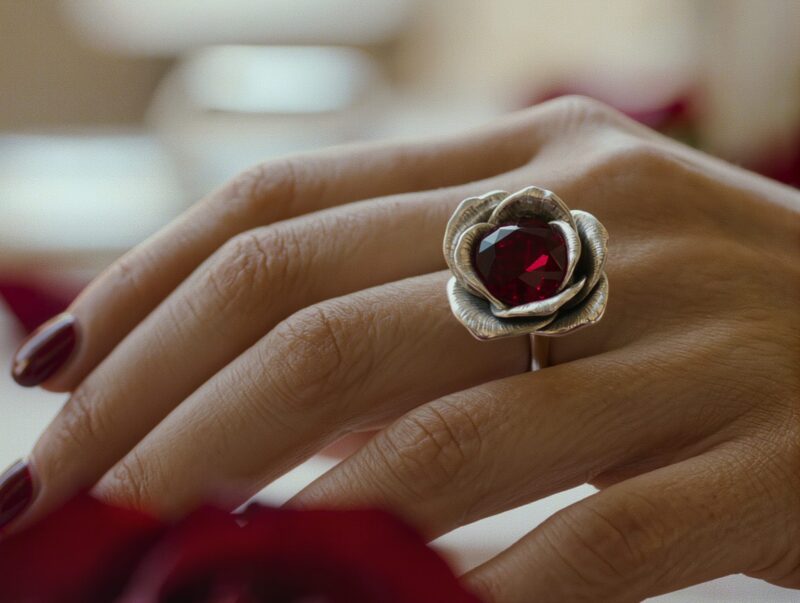
“Ma’am… your ring is just like my mom’s,” she said, pointing at the silver jewel with the red stone.
Victoria laughed softly.
“No, sweetheart. This is my family’s ring.”
But the girl wouldn’t let it go.
“But hers has a red stone in the middle too.”
Victoria’s smile froze. Something in her chest tightened for no reason she could name.
“How… what’s your mom’s name?” she asked, her voice barely audible.

“She’s at the flower shop, two streets from here,” Lily answered, not understanding why the question had made the elegant woman’s voice shake. “Her name is Elena Carter.”
Victoria closed her eyes in relief. Elena. Not Isabel. Just a cruel coincidence.
But Lily went on, thoughtfully:
“Though sometimes, when she’s asleep, she says another name.”
“What name?” Victoria could barely breathe.
The girl hesitated, hugging the tray to her chest.
“Isabel.”
The whole restaurant seemed to disappear. Victoria suddenly saw a five-year-old girl running through the gardens of the Rosewood mansion; saw her father, Henry, whispering with doctors; saw a blue box vanishing from a room forever. For thirty years she’d been told her little sister had died. There was never an open funeral. Never a family grave.
“Take me to her,” Victoria said, standing so fast the chair scraped the floor.
The flower shop was small, unassuming, tucked between a bakery and an antique store. Nothing in it recalled the marble-and-portraits world Victoria had grown up in. When the bell rang, a woman with delicate hands and a tired face looked up from the back of the shop, arranging a bouquet. The scissors fell from her fingers with a dull clatter.
Nothing needed to be said. Victoria recognized the eyes, the shape of the mouth, the small mole beside the eyebrow.
“Isabel,” she whispered.
“That’s not my name anymore,” the woman answered, her voice breaking.
“Our father said you were dead.”
“And I thought you knew everything and simply chose to forget me.”
Neither could speak for a long moment. Behind the back door, Lily listened without understanding, still clutching her empty tray.
Isabel pulled a small blue box from a cabinet — identical to the one Victoria remembered from childhood. Inside, a second silver ring with a matching red stone caught the light.
“Our father sent me away when I was barely sixteen,” Isabel explained, her voice steady for the first time. “He said a daughter he couldn’t control was a threat to the Rosewood name. They changed my name. They told me you never once asked about me.”
“I asked every single day,” Victoria said, tears finally falling. “Father punished me for it.”
“They told me you’d forgotten all about me.”
“They lied to both of us.”
That same afternoon, Victoria canceled her meeting with the family lawyer and called another one — someone who didn’t work for the Rosewoods. Isabel handed over old documents, letters never sent, and an altered birth certificate. For weeks, the two sisters faced the family foundation’s board together — the resistance, the veiled threats, the attempts to buy their silence.
But this time, Victoria refused to let silence win.
“For thirty years, this family repeated that Isabel Rosewood had died,” she announced to the board, the blue box open on the long table of the mansion. “They lied. And as of today, my sister legally reclaims her name.”
The legal battle wasn’t easy. There was resistance, private offers to buy her silence, and more than one night when Isabel nearly gave up.
“I don’t want a war,” she confessed to Victoria one early morning. “I just want to raise my daughter in peace.”
“I don’t want a war either,” Victoria answered, holding her hand. “But I won’t let them erase you twice.”
In the end, the documents Henry Rosewood had left behind — signatures, payments, witnesses — spoke for themselves. Isabel legally reclaimed her surname. Several board members quietly resigned. Her father’s portrait was removed from the main hall — not destroyed, but moved to an archive with a plaque that finally told the whole truth.
A year later, Victoria returned to Maison Aurelia. This time she wasn’t alone: Isabel sat across from her, by the same window where it had all begun. Lily sat between them, holding a small tray of red roses she no longer sold out of need, but because she liked helping in her mother’s flower shop.
Both sisters wore their rings. Lily watched the two jewels catch the midday light.
“They really match now,” she said, smiling.
“They always did,” Victoria answered, taking her sister’s hand.
Isabel squeezed her daughter’s hand, and for the first time in thirty years, the name Rosewood stopped being a wound.
It had finally become a home.