Nine-year-old Maya was just playing on the beach when she found it — a massive great white shark, stranded in the shallows, gasping, terrified, alone.
Most people would have run. Maya didn’t.
She knelt beside it in the sand, placed her small hand on its rough skin, and started to dig. Handful after handful, she cleared the sand from around its tail, pushing, pleading, refusing to give up on an animal everyone else would have called a monster.
When the water finally took it, the shark paused for one long moment before disappearing into the blue — as if it knew.
Sixteen years later, that same girl would need saving too.
Maya was nine years old the summer she learned that fear and love could live in the same breath.
It had been an ordinary afternoon — sun too bright, sand too hot, the kind of day that blurred into every other day of that endless childhood summer — until she rounded the curve of the shoreline and stopped dead. There, half out of the water, lay something enormous. Grey and white and utterly still except for the slow, labored movement of its gills.
A shark. A real one. Bigger than the boat her uncle kept in the marina, bigger than anything she’d ever imagined lying so close, so helpless, so stuck.

Every instinct a nine-year-old is supposed to have told her to scream, to run, to find an adult. Instead, she found herself walking closer, one bare foot after another in the wet sand, until she was kneeling close enough to see her own reflection in its dark, unblinking eye.
It didn’t move. It couldn’t. And somehow, in that eye, Maya saw something that had nothing to do with the monster stories she’d grown up hearing — she saw exhaustion. Fear. A creature that was, in that moment, no different from any other living thing that wanted to survive.
“Hey,” she whispered, so quietly the wind almost took it. “It’s okay. I’ve got you.”
She had no plan. No strength to match four meters of muscle and cartilage. What she had were two small hands and a stubbornness her parents would later say she’d had since birth. She started digging — scooping wet sand from around its tail, its fins, anywhere the ocean had abandoned it — until her arms ached and her knees were raw from kneeling in the surf.
It took almost fifteen minutes. Fifteen minutes of digging, pushing, coaxing the tide back in with cupped hands like that could somehow hurry the ocean along. And then, all at once, the shark’s tail found purchase. One powerful stroke sent water crashing over her legs, and it was moving — clumsy at first, then strong, then gone, a grey shadow melting into blue.
Except it paused. Just once, just for a second, at the edge of where she could still see it. Maya always swore, for the rest of her life, that it looked back.
She never told many people about that day. Who would believe a nine-year-old freed a great white shark with her bare hands and sheer refusal to give up? But she never forgot the weight of that gaze, and somewhere underneath the ordinary business of growing up, it planted something in her that never stopped growing either.
By the time she was twenty-five, marine biology wasn’t a career choice anymore — it was just who she’d become. She spent more hours underwater than most people spend awake, tracking reef health along a coastline half a world from the beach where her story had started, cataloguing the quiet, patient work of an ocean that never seemed to run out of things worth saving.
That morning was supposed to be routine. Clipboard, dive slate, a healthy stretch of coral she’d surveyed a dozen times before. She moved through the water the way she’d moved through it her whole life — easily, gratefully, like she belonged there.
She never saw the net.
Old, dark, half-buried in the reef, forgotten by whatever boat had lost it years ago — it caught her ankle mid-kick, and the ocean that had always felt like home suddenly felt like something closing around her. The rope went taut. Her body snapped to a stop so hard the air left her lungs in a burst of silver bubbles.
Panic doesn’t ask permission. It arrived instantly, completely, drowning out every hour of training that had ever taught her to stay calm underwater. She clawed at the net, kicked, twisted, felt the rope bite deeper with every desperate movement, felt the seconds and the air both running out at the same terrifying rate.
That was when she saw it.
A shape at the edge of her vision, too large to be anything she’d surveyed on this reef before, moving toward her with a directness that made her blood run cold before her mind could even process what she was looking at. Every part of her screamed the same word: shark.
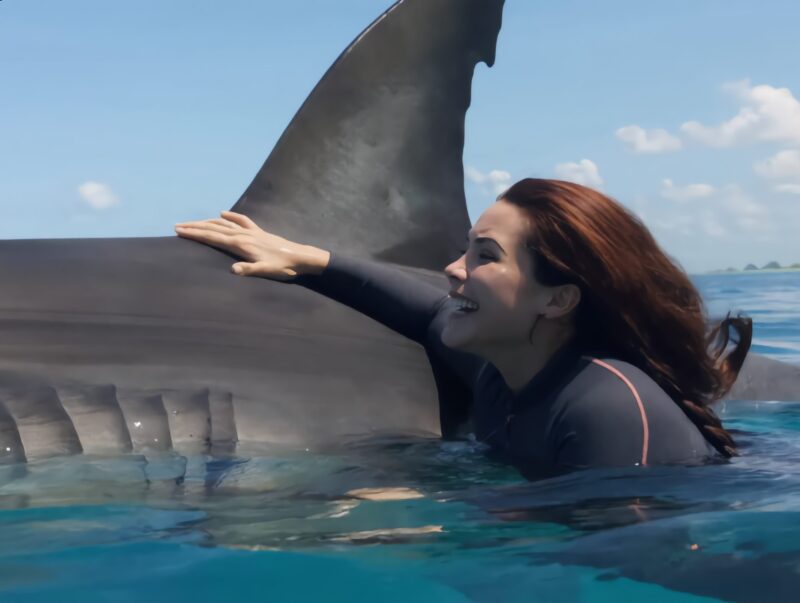
And then her eyes found the fin.
A pale, crescent-shaped scar, notched into the top edge, unmistakable even through the haze of her own fear and rising bubbles.
It couldn’t be. It shouldn’t be. Sixteen years and an entire ocean apart, and yet there it was, closing the distance with a calm, unhurried purpose she recognized in her bones before her mind caught up — because she had seen that exact intention once before, on a beach that now felt like it belonged to someone else’s memory.
The shark didn’t slow. It came straight to her, pressed its broad snout against the tangled rope at her ankle, and began to work the strands loose with a gentleness that seemed almost impossible for something so powerful — patient, deliberate, careful around her leg the way you’d handle something you’d decided, long ago, was worth protecting.
Maya stopped fighting. Her hands, which had been clawing in blind panic seconds earlier, now moved with the shark instead of against her own fear, pulling the last loosened strands free together. The net slipped away, drifting down into the coral like it had never mattered at all.
They broke the surface together.
Maya’s first breath came out as half a laugh and half a sob, salt water and tears indistinguishable on her face. She reached out without thinking and rested her palm flat against the massive dorsal fin gliding beside her — right over the pale crescent scar she would have known anywhere, in any ocean, after any number of years.
“It’s you,” she whispered, voice breaking. “After all this time… it’s you.”
Sixteen years. One small act of kindness on an ordinary afternoon, and an ocean vast enough to swallow entire lifetimes had somehow, impossibly, carried it all the way back to her — exactly when she needed it most.