In the neighborhood where the walls carried more history than paint, where dust rose with every step and the sun beat down hard even on the quietest afternoons, lived doña Rosa. A seventy-six-year-old woman, with hands worn rough by labor and a gaze that had seen too much poverty to be surprised by anything anymore… and yet her heart remained untouched.
Every evening, without fail, rain or unbearable heat, doña Rosa would step out of her house with a steaming plate in her hands. It wasn’t much — a little rice, some meat in sauce, whatever she’d managed to find that day — but for the three boys who slept on the corner of her street, with no parents, no roof of their own, no one in the world to ask if they’d eaten, that plate was everything.
“Here, mijos… it’s not much, but it’s hot,” she always said, with that tired but genuine smile only found on people who have given more than they had. The boys looked at her like she was the closest thing to an angel they knew in this world. The smallest of them always thanked her softly: “Thank you, abuela… you always take care of us.”
So the days passed. So the months passed. And so, without doña Rosa noticing time slip by, the years passed too.

The street changed a little — more cracks in the walls, more peeling paint, a shop that closed here, another that opened there — but she stayed the same, faithful to her routine, faithful to that plate she handed out every evening like a sacred ritual.
Until one day, the three boys simply vanished.
There was no goodbye. No explanation. One day they were there, sitting on the same corner as always, and the next, they were gone.
The question stayed lodged in doña Rosa’s chest for years. Had they found a home? Had life pulled them apart? Or had they simply forgotten her, the way so many things get carried off by time without warning? She never knew. She just kept living, kept cooking, kept stepping out every evening with her plate — even though no one waited for her on that corner anymore.
Twenty years passed like that. In silence. In routine. On the same street as always, under the same sun as always.
Until one golden afternoon like any other — one of those evenings when the sun sets so slowly it feels like time itself has paused — the roar of an engine shattered the silence of the street completely.
A black, gleaming, elegant car, a model that clearly didn’t belong in that neighborhood of peeling walls and dirt streets, rolled slowly through the dust… and stopped right in front of doña Rosa’s door.
The car doors opened almost simultaneously. First, two men in dark suits stepped out, carrying that rigid posture of people trained to protect someone. They positioned themselves on either side, like silent guardians, while a third man emerged from the back seat.
He was tall. He wore an impeccable navy suit, as out of place on that dirt street as a jewel in the middle of dust. He walked toward her with slow, almost hesitant steps — like someone who has rehearsed this moment a thousand times in his head, but now that it’s finally happening, doesn’t quite know how to hold himself together.
Doña Rosa watched him approach, understanding nothing. Who was this man? Why was he looking at her like that, with eyes shining in a way she knew all too well — the eyes of someone on the verge of tears, fighting hard not to let them fall?
When he was close enough, she saw it clearly: a tear was already running down his cheek.
“Forgive me, señora…” he said, his voice breaking from the very first word. “Do you remember me?”
Doña Rosa narrowed her eyes. She searched that grown, refined, clean-shaven face for any trace of something familiar. It couldn’t be. It was impossible. Years don’t slip away like that, without leaving a single clue.
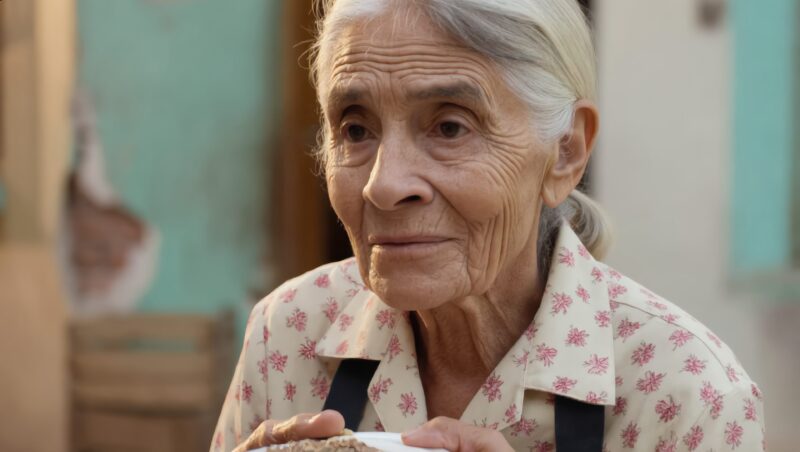
“Who… who are you?” she asked, her voice trembling, feeling the plate in her hands — the same kind of plate she’d held thousands of times throughout her life — now weighing more than it ever had.
The man took another step closer. And then, with a gentleness that contrasted with the strength of his bearing, he took doña Rosa’s hands in his own. The same hands that for years had served food to those who had nothing. The same hands that never expected anything in return.
“I’m one of those boys…” he began to say, his voice growing more broken, “…the ones you fed every night.”
Time stopped.
Doña Rosa felt the air escape her chest. The pieces began coming together in her mind — the face, the gaze, something in the way he looked at her that suddenly felt devastatingly familiar.
“Mijo…” she whispered, her voice breaking completely. “It was you! It was you!”
Tears were already flowing freely down both their faces. The guards kept a respectful distance, heads bowed. On the corner, today’s children — different ones, strangers, but just as curious as the boys from before — watched the scene unfold, not fully understanding what they were witnessing, but somehow sensing that something important was happening before their eyes.
“I came to give back everything you gave me,” the man whispered, his voice almost completely broken, as he held the hands of the woman who, without ever knowing it, had changed the course of his life with a simple plate of food more than twenty years ago.
But that sentence — those few words — barely began to explain what he had actually come to do.
Because what doña Rosa didn’t yet know, what she was about to discover in the next few minutes, was that this reunion wasn’t just a visit of gratitude.
It was the beginning of something that would change her life — and his — forever.
What exactly had the man prepared for her? Why had he waited twenty years to return? The answer is about to be revealed… and nothing will ever be the same again.