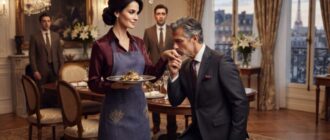
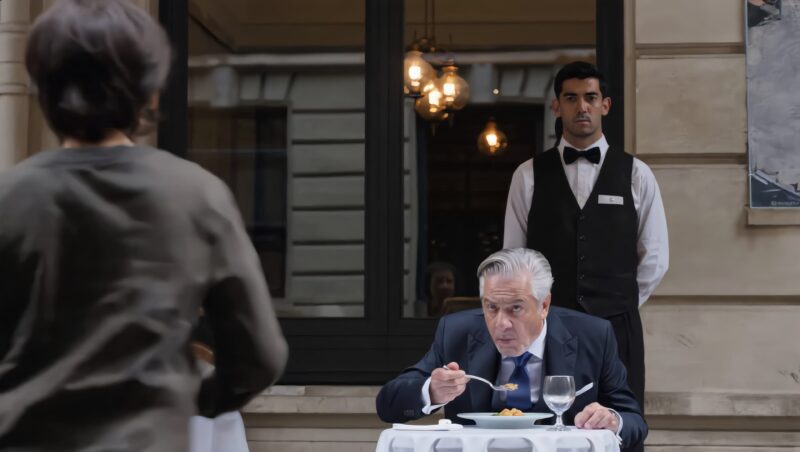
The old man had spent years eating alone at that table. Always the same corner, the same dark suit, the same silence.
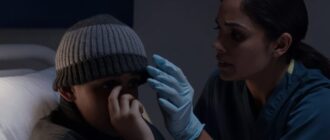
That afternoon, a boy burst out of nowhere. Dirty. Eyes swollen from crying.
He knelt down in the middle of the terrace, not caring about the people watching.
—Please, sir. Just one minute. I know who you are.
The old man looked up. His expression was stone.
—I don’t have time for this.
But the boy didn’t move. He pulled something from inside his torn clothes and held it out with trembling hands.
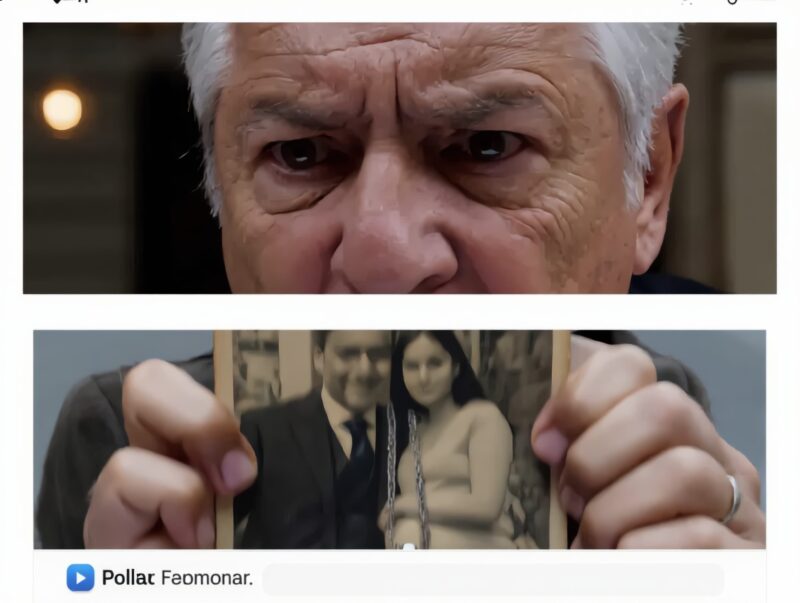
An old photograph. A young couple. A pregnant woman in a pink dress.
And a silver medallion the old man recognized before he wanted to.
—Where did you find this? —he asked in a voice that was no longer his own.
—He gave it to me —the boy answered—. He said you would recognize it.
The old man closed his eyes. When he opened them, the boy was pointing silently at a black car parked across the street.
The rear door began to open.
The old man had spent eleven years without saying that name.
He had built the silence carefully, brick by brick, like someone erecting a wall to avoid seeing what lies on the other side. He sold the house where they had lived together. He donated the clothes left in the wardrobe. He gave away the furniture, the paintings, the books his son had marked with small notes in the margins. He got rid of everything except one thing.
The photograph.
He always kept it on him, folded in four, inside the inner pocket of his suit. He never looked at it. But he couldn’t get rid of it either. It was the only thing left from that night, eleven years ago, when his son walked out the door after the worst argument of their lives and never came back.
For months, the old man waited. First with anger. Then with wounded pride. Then, when the months turned into years, with something that resembled regret too closely to look at directly.
The detectives found nothing. The police closed the case. Acquaintances stopped asking. And the old man learned to live with a hole in the center of his chest that over time stopped hurting, though it never fully closed.
That October afternoon, as his fork hung suspended in the air and the world of the café kept spinning around him, the old man looked at the boy kneeling before him and felt something he hadn’t felt in years.
Fear.
Not ordinary fear. The other kind. The kind that appears when something you buried starts moving underground.
The boy didn’t look crazy. That was the most unsettling thing. His face was dirty, his eyes destroyed from crying, his clothes in tatters. But his gaze was that of someone who knows exactly what they’re doing. Someone who has traveled a very long and very hard road to reach that table, and who has no intention of leaving until what needs to happen, happens.
—Where did you find this? —the old man repeated, and this time his voice came out broken.
The boy held the photograph in both hands, as though it were something sacred that might break if he wasn’t careful. The woman in the pink dress, hands resting on her belly. The young man who resembled the old man so much it hurt to look at him.
And the medallion. The damned silver medallion with the engraved family crest that the old man had believed lost forever the night his son left.
—He gave it to me —the boy said quietly—. Before they took him away.
The old man felt the entire café disappear. The voices, the glasses, the traffic. Only that boy, that photograph, that medallion existed — and a question burning in his throat.
—Before they took him? Who took him?
The boy slowly lowered the photograph. He looked toward the street without a word. And pointed.
The old man followed his gaze.
The black car had been parked there all afternoon. He had seen it when he arrived, without giving it a second thought. A car like any other. Dark, large, with tinted windows that revealed nothing inside.
The rear door opened slowly, with the heavy and final sound that large car doors make.
From inside, first a hand appeared, gripping the frame. Then an arm. Then a man pulling himself upright with great effort, as though each movement cost him something that couldn’t be measured in physical pain.
He had dark hair with some new gray strands. A thick scar crossed his jaw — a scar that wasn’t in the photograph. He walked with a slight limp that hadn’t existed eleven years ago.
But the eyes. The eyes were the same. The same eyes the old man had been searching for eleven years in every stranger’s face he passed.
And in those eyes was something the photograph could never have contained. Guilt. Relief. And an enormous, silent fear that too much time had passed.
The old man rose from his chair without realizing he was doing it.
His legs — which doctors had been saying for years barely responded — held him.
He took one step. Then another. He crossed the terrace, stepped off the curb, walked into the street.
In the middle of the road, father and son stopped face to face.
Neither spoke for a time that cannot be measured in seconds.
The old man raised his hand slowly. Not to shake it. He reached toward the scar on his son’s jaw and touched it with his fingertips, very carefully, as though verifying it was real. That he was there. That this wasn’t another dream he would wake from alone.
—I thought you were dead —he finally said. His voice came out small, smaller than it had been in many years.
—I was —his son answered—. Almost.
There was another silence. Then the old man did the only thing he could. He closed the last few centimeters between them and embraced his son with the force of someone who has been holding that embrace for eleven years.
His son hesitated for one second. Just one. Then returned the embrace with equal force.
Behind them, on the sidewalk, the boy watched without moving. On his face, for the first time in a long while, a small smile.
He had known from the beginning how this was going to end.
That’s why he had come. That’s why he had traveled all that way. That’s why he had knelt before a cold, powerful man who didn’t want to listen.
Because sometimes the only person capable of opening a door that has been locked for years is someone with nothing left to lose.
And he had nothing. Except that photograph, that medallion, and the certainty that some broken families can still become whole again.