In the Herrera mansion, every antique object holds a story… but no one imagined that the old hallway mirror hid something far worse.
During the most elegant party of the year, Clara, the housekeeper, felt something strange as she passed the mirror inherited by the family. A muffled voice, a child’s sob that no one else seemed to hear… except her.
Isabel, the lady of the house, saw her acting strangely and scolded her in front of all the guests, furious at the nerve of touching a family heirloom. But Clara couldn’t stop herself anymore. She grabbed a hammer from the cleaning cart and, under everyone’s horrified stares, struck the glass again and again.
What came out of that mirror left everyone speechless… and what remained inside, even colder.
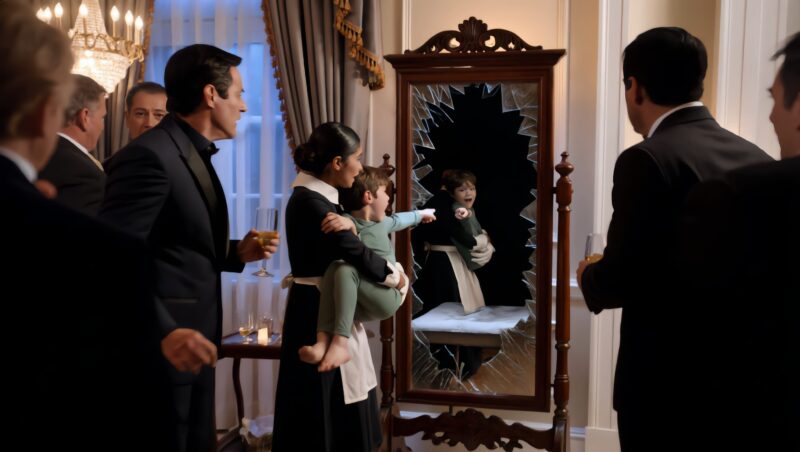
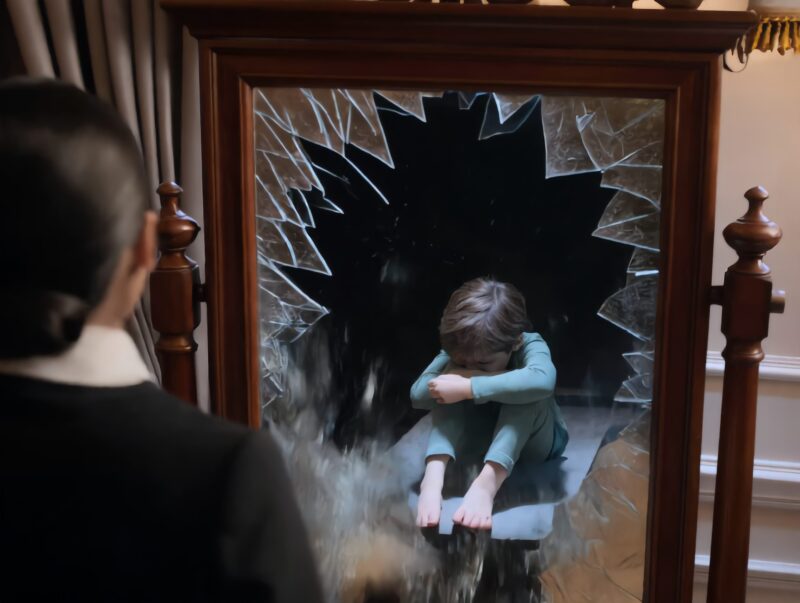
The hammer struck the glass a second time and the mirror shattered into a thousand pieces. Behind the gilded frame there was no wall, only a deep black void that shouldn’t exist. The guests stepped back. Isabel covered her mouth. And then, among the fragments, Clara saw a small figure, trembling, curled up in the darkness.
It was a boy. Barefoot, pale, his eyes swollen from crying. Clara didn’t think twice: she reached into the opening and pulled him out, holding him against her chest as if she had done it her whole life.
“You’re safe now,” she whispered. “I heard you.”
The boy, who said his name was Tomas, wouldn’t let go of her uniform. Daniel, the man of the house, approached, pale as wax, unable to voice the question everyone was thinking: how could a living child be inside a mirror?
It was Isabel who finally broke the silence. Her voice cracking, she recalled a story her own grandmother used to tell her as a child: more than forty years ago, during a party just like this one, a girl named Sofia had vanished without a trace. People said she must have wandered off into the garden, that perhaps she’d left with a relative. The family never spoke of it again. And the mirror, that very same mirror, had arrived at the house that same night, a gift from an antique dealer no one remembered inviting.
Daniel ran to the library and came back with an old photo album. Among the yellowed pages appeared the face of a shy-smiling girl dressed in white. Sofia. And behind her, barely visible in the reflection of an identical mirror, there was a small shadow no one had noticed in forty years.
Tomas, still in Clara’s arms, pointed toward the dark hole. Inside, a pale hand reached out, searching for the light.
“There’s someone else in there,” the boy said, his voice cracking with fear.
Clara then understood what she had to do. The mirror hadn’t taken anyone out of malice: it had trapped those who were left alone, forgotten, with no one truly looking for them. And the only way to free them wasn’t with a hammer, but with something far simpler: someone had to remember them. Someone had to say their name out loud and promise they were no longer alone.
She approached the dark opening, still holding Tomas, and whispered:
“Sofia… we hear you. You don’t have to hide anymore.”
For a moment, nothing happened. Then, as if the air itself took a breath, a translucent figure crossed the dark threshold: a girl in the same white dress from the album, with a serene smile, like someone waking from an impossibly long sleep. Other, smaller figures followed her, children no one at the party recognized, each one walking toward the light of the room before dissolving like mist at dawn.
The mirror, now empty, cracked completely and crumbled into glass dust on the carpet.
Isabel wept silently, not from fear, but from a relief forty years in the making. Daniel embraced his wife. And Clara, with Tomas still asleep on her shoulder, understood that what she had uncovered that night wasn’t a monster, but a very old wound that had finally healed.
The next morning, the Herrera family decided not to replace the mirror. Instead, they hung a simple plaque with the names of every child who, according to records Daniel later found, had disappeared near the house over the course of a century. Every year, on that same date, they light a candle for each one.
Tomas stayed on to live with Clara. He never feared mirrors again, though he always asked that they be covered with a cloth before bed, “in case someone else needs help someday.”
Over time, the story of that night was told so many times around town that it stopped sounding like a tragedy and started sounding like a legend: the legend of the maid who listened to what no one else wanted to hear, and of the girl who finally got to rest. Neighbors began calling the house “the mansion that listens,” and more than a few slipped small notes under its door whenever they felt that someone, somewhere, needed to be found.
And so, the mansion that for a century kept a cold secret became the house that learned how to listen.