Nobody saw the girl arrive.
She walked through the church doors completely drenched, hair plastered to her face and shoes dripping water onto the red carpet. She was nine years old and had run three kilometers in the rain, clutching a yellow envelope against her chest as if it were the most valuable thing in the world.
Because it was.
At the altar, Rodrigo was about to say yes. Victoria, his fiancée, radiated in her white dress when she heard the girl’s shout from the back of the church.
— Wait! Please, wait!
Three hundred guests turned around at the same time.
Rodrigo recognized her before she said her name. And in that moment he knew the wedding was over — even though he still didn’t know exactly why.
The girl raised the envelope with both hands, trembling.
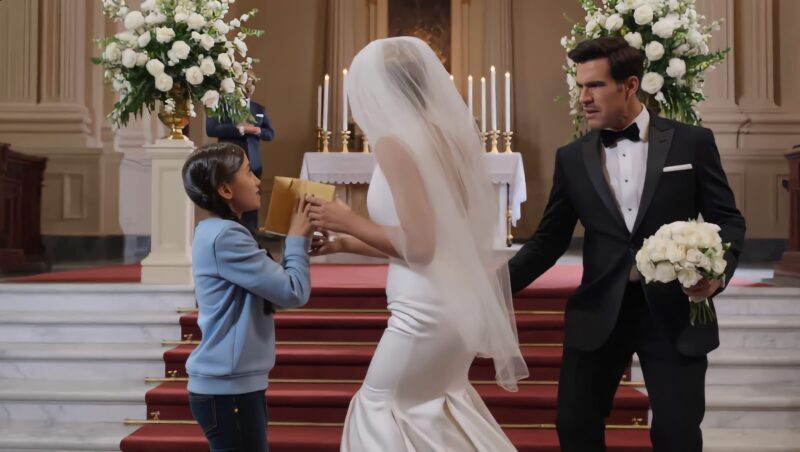
Victoria Hale had spent eighteen months building the perfect wedding.
She had ordered the dress from Milan. The flowers — three thousand white greenhouse roses — she had chosen herself, one by one. The church was the oldest in the city, with eighteenth-century stained glass and acoustics that made even the softest whisper sound like a sacred promise.
She had left nothing to chance.
Except Lucía.
Lucía was nine years old, with her mother’s dark hair and Rodrigo’s exact eyes. She had spent the last four years in a small apartment on the outskirts of the city, with her mother Elena, who worked double shifts on the night rotation at a public hospital and had never fully explained why her father didn’t live with them. She had only said he was “a complicated person” and that “someday she would understand.”
Lucía was nine years old. She already understood.
And the week before, she had found something that confirmed everything.
Inside an old shoebox, under her mother’s bed, was a yellow envelope with Elena’s name written by hand. Inside: a check for one thousand dollars signed by Victoria Hale, and a note that read, in perfect handwriting with not a gram of remorse: “So that the girl and her mother disappear from our lives. Don’t call. Don’t write. Don’t appear.”
Lucía didn’t understand everything. But she understood enough.
She waited for her mother to leave for work. She put on her blue sweatshirt, tucked the envelope under her arm, and walked out the door with the only purpose a nine-year-old girl can have after discovering that someone paid to erase her from the world: to get there before it was too late.
She ran three kilometers in the November rain. When she ran out of breath she stopped for ten seconds, pressed the envelope against her chest so it wouldn’t get any wetter than it already was, and started running again.
When she walked through the church doors and saw the altar — the flowers, the candles, the three hundred guests in silence — her step faltered for barely a second. Then she saw Rodrigo. And kept walking.
— He can’t marry her! — she shouted, voice breaking but steady. — She paid to make me disappear!
The silence that followed lasted exactly four seconds. Then the entire church began to whisper.
Rodrigo descended two altar steps without thinking. Victoria was faster.
She gathered her dress with one hand and came down the stairs in three strides, eyes fixed on the yellow envelope. She wasn’t going to comfort the girl or ask what was wrong. She was going to take the envelope.
— Give me that — Victoria said quietly, with a frozen smile more dangerous than any shout. — Right now.
She reached for the envelope. Lucía pressed it against her chest and took a step back.
— No.
One word. Said with the same voice her mother had taught her to use with strangers on the street.
Victoria grabbed her wrist.
That was the moment Rodrigo finished descending the stairs.
He said nothing. He took the envelope from Lucía’s hands with a gentleness that contrasted with everything happening around him, and opened it slowly, as if he needed time to prepare for what he was going to find inside. He pulled out the photograph first: him and Elena, ten years earlier, in the park where they had met. Then the check. Then the note.
He read the note twice.
When he looked up, he didn’t look at Lucía. He looked at Victoria.
— How long have you known I had a daughter? — he asked.
Victoria didn’t answer. But her silence answered for her.

Rodrigo knelt in front of Lucía. The blue sweatshirt was too small for her — she had bought it the year before and it already pulled at her shoulders — and her shoes were so soaked they left a trail of water on the red church carpet. The girl was still trembling, hair stuck to her face and eyes full of tears she hadn’t let fall yet, as if she had decided she first had to finish what she had come to do.
— What’s your mom’s name? — Rodrigo asked, even though he already knew the answer.
— Elena — said Lucía. — And you’re my dad. Even though nobody ever told me.
Rodrigo closed his eyes for a moment. When he opened them, they were the eyes of a man who had just lost a wedding and found something infinitely more important.
He stood up, took Lucía’s hand, and walked toward the church exit without saying another word.
Three hundred guests watched them in complete silence.
Victoria was left alone at the altar, with the Milan dress and the three thousand white roses and the perfect eighteenth-century acoustics. She had built the perfect wedding for eighteen months. She had controlled every detail, every person, every possible complication.
She had paid a thousand dollars to make a nine-year-old girl not exist.
It had taken that same girl, with a yellow envelope and three kilometers of rain on her, to undo it all in four minutes.