Victoria didn’t look up from her phone.
She had spent three years not doing so in moments like this: crowded sidewalks, cars passing meters from her feet, the world moving around her as if she were the axis and everything else the noise.
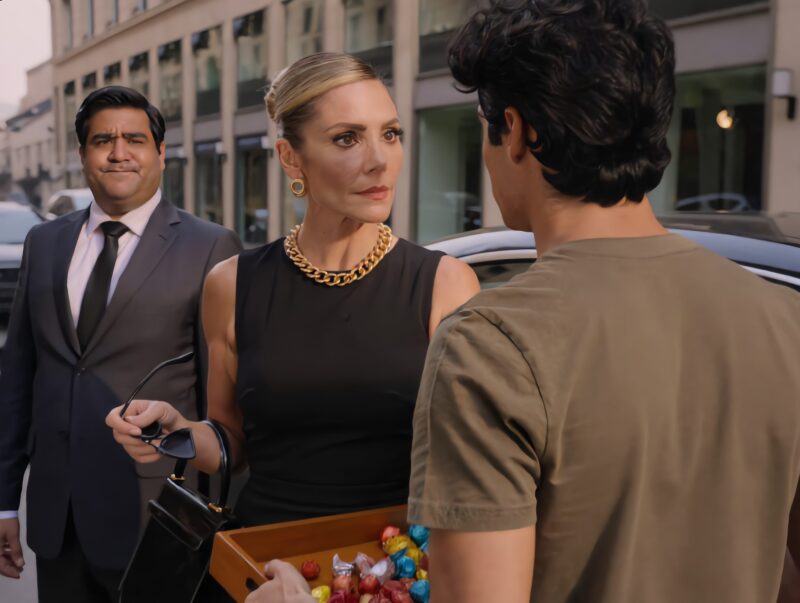
Then a boy with a tray of candies saw it before she saw anything.
“¡Cuidado!”
The tray hit the ground. The candies scattered across the pavement. And before Victoria could process what was happening, someone had grabbed her arm and pulled her sharply backward with a force she didn’t expect from someone who sold sweets on the street.
The car passed centimeters away.
Victoria stood motionless, leaning against the parked car, heart racing.
The boy was picking up his candies from the ground as if nothing had happened.
Javier, her head of security, arrived late. As always.
“Step back,” he told the boy.
Victoria raised her hand.
“Leave him.”

The boy didn’t step back.
Not because he was brave or because he was defying Javier. But because he had no reason to leave. He had picked up the tray, put the candies back in, and now stood simply there — with that calm Victoria couldn’t explain and that unsettled her more than the fright of the car.
Javier was still positioned between them, arm extended like a barrier.
Victoria moved it aside.
She didn’t push him, didn’t force him. She simply placed her open hand on Mateo’s chest — a deliberate pause, a punctuation — and studied him with the focused attention of someone doing rapid calculations.
“Do I know you?” she asked the boy.
He looked at her for a moment before answering.
“No. But I know you.”
Victoria had spent twenty-two years as the heir to the Valdés Group. She knew exactly what it meant when someone knew who she was: journalists, competitors, people who wanted something. She had learned to identify them in the first ten seconds of a conversation. They all had that specific brightness in their eyes — the mix of recognition and calculation.
This boy didn’t have that brightness.
He looked at her differently. The way someone looks at something they have been searching for a long time and finally find.
“What’s your name?” she asked.
“Mateo.”
Victoria took off her sunglasses. Completely. Not the half-gesture she used to intimidate people, but taking them off entirely and holding them in her hand, as if she had decided this conversation deserved her whole face.
“Mateo. And how is it that you know me?”
He didn’t answer immediately. He glanced at Javier — quick, almost imperceptible — and looked back at her.
“That depends on how much time you have.”
Victoria noticed that Javier had tensed. Not the professional tension he adopted when there was a real threat. A different kind. The tension of someone who recognizes something they didn’t want to see again.
“I have time,” said Victoria.
“Then we’d need to go somewhere else,” said Mateo. “Not here.”
Victoria looked at Javier. For the first time in years she really looked at him, without her usual distance, and saw something in his face she had never been able to read before: not professional irritation. Fear.
Javier was afraid of what Mateo might tell her.
“Javier,” said Victoria, her voice completely flat. “Wait for me in the car.”
“Ma’am, it’s not appropriate for you to—”
“In the car.”
Javier obeyed. He always obeyed. It was his greatest flaw and his greatest virtue at the same time.
Victoria waited until he was far enough away and turned back to Mateo.
“There’s a café two blocks from here,” she said. “Do you know El Gato Negro?”
“Yes.”
“Twenty minutes.”
Mateo nodded. He picked up his candy tray and turned to leave. Victoria watched him walk away — the worn t-shirt, the ripped jeans, the sneakers that had seen better days — and thought about everything that didn’t add up.
Street vendors didn’t have that calm.
Street vendors didn’t look at her like that.
And street vendors, when someone like Javier told them to step back, stepped back.
Twenty minutes later, Victoria walked into El Gato Negro alone.
Mateo was already seated. Without the tray. Hands on the table and a closed folder in front of him.
“What is that?” asked Victoria.
“What your father tried to tell you before he died,” said Mateo. “And what Javier has spent three years preventing you from knowing.”
Victoria sat down slowly.
She opened the folder.
The first page was a photograph. Her father, smiling, standing beside a young man she had never seen. The caption read: Madrid, four years ago.
The young man was Mateo.
Victoria looked up.
“How long have you been doing this?”
Mateo didn’t hesitate.
“Since your father asked me to. The night before he died.”
Victoria didn’t answer. She looked at the photograph again. Then at the folder, still full of pages she hadn’t read yet.
She thought about the car that had passed centimeters away that afternoon. She thought about how Mateo had seen it before anyone. She thought about how Javier, who should have been at her side, had arrived late.
Outside, on the street, Javier’s car was still parked.
Inside, for the first time in a long time, Victoria felt the ground move beneath her feet — and this time there was no arm to catch her. Except, perhaps, that of a stranger who had spent four years waiting for the moment to keep a promise she never even knew existed.