Nobody saw her.
She had been in that alley for weeks. Adults walked past without looking, quickening their step, pulling their coats tighter against the cold as if the cold were the only thing that existed.
The girl was eight years old. Or maybe nine. Nobody knew because nobody had asked.
Then another girl appeared.
Same age. Blonde braid, camel coat, school backpack. She was coming from class. She was carrying a bread roll wrapped in paper — the one her mother had put in her bag for a snack.
She stopped.
She didn’t keep walking the way the adults did. She stopped, looked at the girl on the ground, and crouched down slowly until she was at her level.
“Take it. It’s for you.”
The girl on the ground didn’t move at first. She had learned that kindness from strangers didn’t exist.
But the hand kept waiting.
And the bread smelled like something she had almost forgotten.

She extended her hand slowly.
Her dirty fingers touched the paper. She took it. She pressed it against her chest as if it were the most valuable thing she had ever held, because in that moment it was.
“Thank you,” she whispered.
Her voice came out broken. She hadn’t spoken to anyone in days.
The girl in the coat didn’t stand up. She didn’t say “you’re welcome” and continue on her way. She stayed there, crouching on the cold cobblestones, looking at her.
“When did you last eat?”
The girl on the ground didn’t answer. She lowered her head. It was a question with no easy answer — or one whose answer was too difficult to say out loud.
The girl in the coat didn’t insist. She simply sat down beside her. Directly on the ground, with her nice coat and her school backpack, on the damp cobblestones of the alley. As if it were the most normal thing in the world.
And she hugged her.
Without asking. Without thinking twice. She wrapped her arms around her and held her close, and the girl on the ground went rigid for one second, two seconds, because nobody had hugged her in a long time and the body takes time to remember how to receive something like that. As if she had forgotten the language of human contact and needed a moment to translate it.
Then she softened.
And she rested her head on the other girl’s shoulder and closed her eyes.
For the first time in weeks, the cold of the alley felt a little less cold.
That was when the mother arrived.
She came running from the end of the alley, her bag hitting her side and her heart in her throat. She had been looking for her daughter for twenty minutes. She had called the school, walked three streets, imagined every possible worst scenario.
She saw them from a distance.
“Wait! Don’t cling to her!”
It was the first thing she shouted, by instinct, by fear, because that is how adults react when they don’t understand what they’re seeing — when danger is the first thing they process, and everything else, if they get there at all, comes second.
But she reached them and stopped.
Her daughter looked at her with that calm that children sometimes have and that adults have lost.
“Mom, she’s hungry.”
Four words. Just four words. As if it were the simplest thing in the world, as if there were no other possible answer to what was happening.
The mother said nothing.
She looked at the girl on the ground. She looked at her properly, in a way she hadn’t looked before, in the way one looks when one can no longer keep from looking.
And then she saw her face.
The gray eyes. The bruise under the right eye. The shape of her cheekbones. Something in the line of her jaw that felt familiar in a way she couldn’t explain — the way the body recognizes something before the mind has words to name it.
The mother felt the alley spinning.
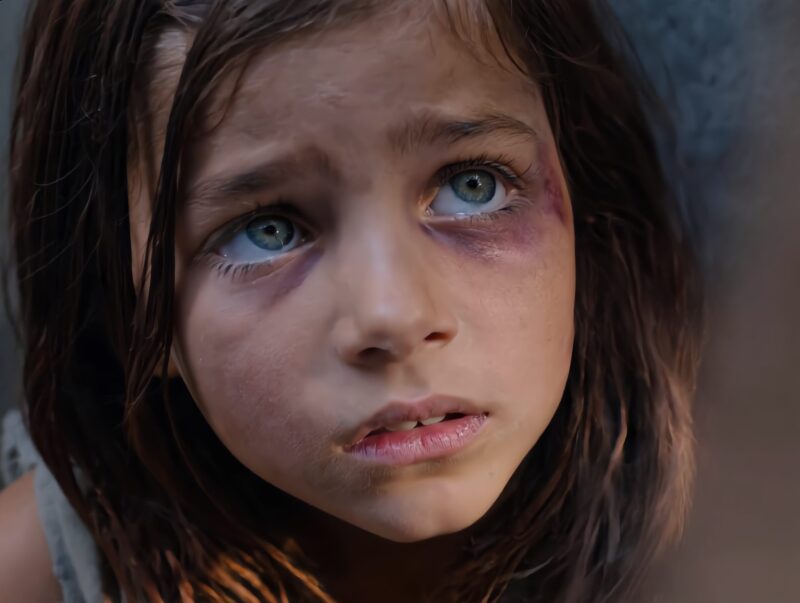
There was a photograph in her wallet. She had been carrying it for six years, folded and refolded until the edges were worn. A photograph of two small girls. One of them was her daughter, at four years old. The other was her niece, her sister’s daughter, whom they had lost track of when her sister disappeared one winter night and never came back.
The niece would have been eight or nine by now.
The mother knelt on the cobblestones.
She looked at the girl slowly, without rushing, searching for confirmation in every feature — the exact color of her eyes, the shape of her eyebrows.
“What’s your name?” she asked, with a voice that was no longer the same as before.
The girl looked at her for a moment before answering.
“Clara.”
The mother closed her eyes.
Clara was her sister’s name.
She stayed kneeling on the cobblestones, not moving, not speaking, with tears running without permission. Her daughter watched her without fully understanding, but sensing that something very large had just happened. And the girl with gray eyes looked at both of them, not yet knowing that that cold afternoon in an alley nobody looked at was the end of something and the beginning of everything.