Sofia was seven years old and didn’t know how to tell him.
She had tried once, at dinner time, when her dad came home tired with his tie loosened. She had opened her mouth and then closed it again. The words didn’t come.
She tried again one morning, before going into school. Her dad was buckling her backpack and she wanted to say something, but he was looking at his phone and the bell rang and it was already too late.
So Sofia did what children do when adults don’t listen, when words don’t yet exist for what they need to say.
She drew.
She took a sheet of graph paper from her math notebook, crumpled it into something as small as a closed fist, and kept it in the pocket of her blue coat for three whole days, waiting for the right moment.
The moment came on a Tuesday afternoon, in the school corridor.
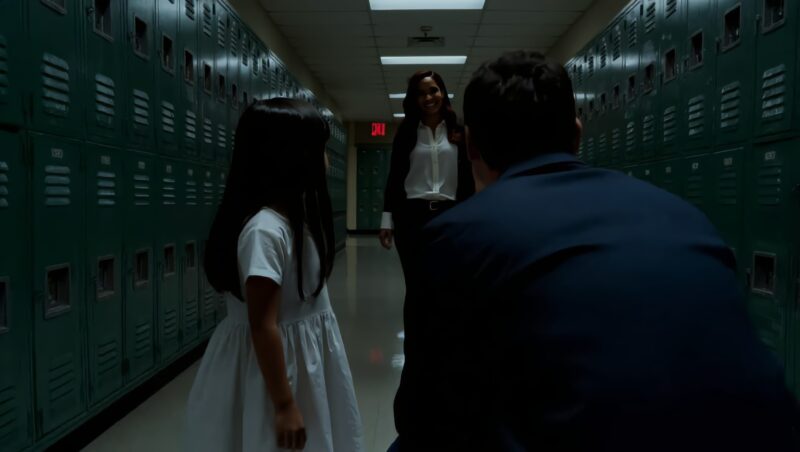
Marcos Villanueva had been waiting in the corridor for forty minutes when he finally saw his daughter appear around the corner.
Sofia walked slowly, with that seriousness of hers that sometimes unsettled him. She was seven years old and already had the look of someone who has thought hard about something. Marcos crouched to her level, put his hands on her shoulders, and smiled.
— Hi, little one.
Sofia didn’t smile. She held his gaze for a second. Then she put her hand in her coat pocket, pulled out something crumpled and small as a ball, and held it out to him without saying anything.
Marcos took it. He noticed the paper was slightly damp, as if she had squeezed it many times.
He began to unfold it with his thumbs, still smiling.
— What is this, sweetheart?
Sofia didn’t answer. She just watched him.
The first time he opened it, halfway, he saw only lines and patches of color. The second time, when the paper lay completely flat between his hands under the cold light of the corridor’s fluorescent panels, he understood all at once, everything together, like when a shape you don’t recognize suddenly takes form and you can’t stop seeing it.
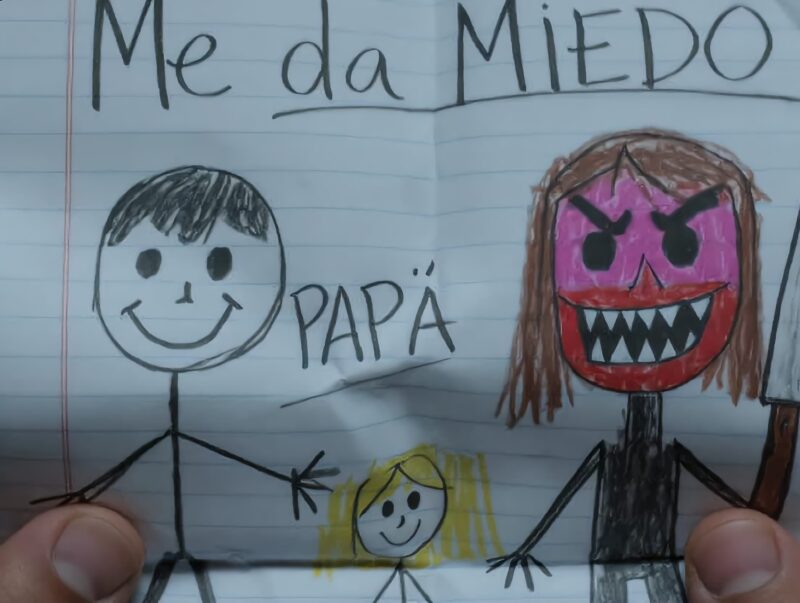
At the top, in large crooked letters written by a seven-year-old girl, it said: She scares me.
On the left she had drawn a man with a tie and short hair and a huge smile. Next to the figure she had written, with that h she always struggled with: DADDY.
In the center, smaller, was a girl with yellow zigzag hair. Sofia. Smiling too.
And on the right.
On the right was something different.
A tall figure, with long dark hair, eyes pressed down like two furious lines. Mouth open, filled with sharp teeth drawn one by one. The face colored in pink and red with crayon pressed so hard it had torn through the paper on one side. And in the right hand, a knife.
Marcos took a moment to breathe.
He read the words again. She scares me. He looked at the teeth drawn one by one with a precision that disturbed him far more than any tantrum or any crying. This was not the drawing of a frightened child. This was the drawing of a child who had observed someone for a long time and decided to portray them with accuracy.
He raised his eyes from the sheet and looked at his daughter. Sofia was still watching him with that absolute calm that children have when they have waited a long time for someone to finally understand something.
— Sofia — he said, his voice very low —. Who is this?
Sofia opened her mouth to answer. But before she could say anything, Marcos heard footsteps at the end of the corridor.
He turned slowly.
Teacher Irene was walking toward them. She wore the same black cardigan as always, the same white blouse as always. She raised a hand to wave from a distance, with a wide professional smile.
— Good morning! Everything okay with our little artist?
Marcos looked at the drawing. Looked at the teacher. Looked at the drawing again.
The long dark hair, exactly the same.
The eyes pressed downward, exactly the same.
The mouth full of teeth, drawn by a seven-year-old girl who had had to invent a new language to tell her father what was happening because the language of words had not worked for her.
He closed his fingers around the paper without realizing it, enough to crumple it slightly again, undoing part of the work Sofia had done to smooth it out. Sofia, beside him, took his hand.
Marcos felt his daughter’s small cold fingers in his and thought of all the mornings he had dropped her off at the school door, all the times she had turned to look at him before going in and he had thought it was just a child’s habit, a way of saying goodbye.
Now he saw it differently.
That night, Marcos Villanueva did three things.
First, he called the school principal and requested an urgent meeting for the following day. Second, he called his sister, who was a child psychologist, and read aloud what was written on his daughter’s paper while trying to keep his voice steady. Third, he went to Sofia’s room, sat on the edge of her bed, and told her she could tell him everything, that they had all night, that he had nowhere to be.
Sofia talked for forty minutes straight, with the precision of children who have held something inside too long and when they finally let it go they let it all go at once, without order but without anything missing.
Marcos listened without interrupting. He took notes on the back of a receipt he found in his jacket pocket.
The following week, Teacher Irene was removed from her classroom while a formal investigation was opened. Two months later, three more families had filed similar complaints.
Marcos kept the drawing. He smoothed it out carefully that same night, before Sofia fell asleep, and stored it inside a blue cardboard folder, along with the school documents, the letter to the principal, the investigation reports and the notes from the three meetings that took place in the weeks that followed.
Years later, when Sofia turned sixteen, he found it while looking for something else and showed it to her.
— Do you remember? — he asked.
Sofia looked at it for a moment. Then she said:
— I remember you took exactly four seconds to understand. I counted.
Marcos didn’t know what to say.
— That’s very little time — he finally said.
— For me it was a lot — she replied.
And she was right. And they both knew it.